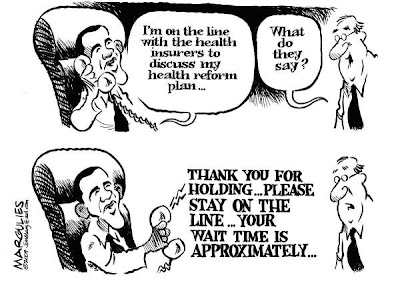
Showing posts with label Public Health Option. Show all posts

Thursday, February 18, 2010

The Public Option Through Reconciliation


The list is growing. There are now 16 Senators who have signed on to ask Majority Leader Harry Reid to pass the public health insurance option through "reconciliation." Sen. Michael Bennet from Colorado is circulating a letter to Majority Leader Reid, calling for this strategy.
There are four fundamental reasons why we support this approach – its potential for billions of dollars in cost savings; the growing need to increase competition and lower costs for the consumer; the history of using reconciliation for significant pieces of health care legislation; and the continued public support for a public option.
The following Democratic Senators have signed the letter to Sen Reid supporting reconciliation to pass a public option.
Sen. Michael Bennet, CO
Sen. Barbara Boxer, CA
Sen. Sherrod Brown, OH
Sen. Roland Burris, IL
Sen. Diane Feinstein, CA
Sen. Al Franken, MO
Sen. Kristin Gillibrand, NY
Sen. John Kerry, MA
Sen. Frank Lautenberg, NJ
Sen. Patrick Leahy, VT
Sen.. Jeff Merkley OR
Sen. Barbara Mikulski, MD
Sen. Jack Reed, RI
Sen. Bernie Sanders, VT
Sen. Tom Udall, MN
Sen. Sheldon Whitehouse, RI
Has your Senator taken a stand? Click Here to see if your Senator needs to be called to support the public health insurance option through reconciliation.

Wednesday, September 9, 2009

The President's Plan in a Nutshell


The Obama Plan: Stability & Security for all
Americans

If You Have Health Insurance

More Stability and Security

• Ends discrimination against people with pre-existing conditions. Over the last three years, 12 million people were denied coverage directly or indirectly through high premiums due to a pre-existing condition. Under the President’s plan, it will be against the law for insurance companies to deny coverage for health reasons or risks.

• Limits premium discrimination based on gender and age. The President’s plan will end insurers’ practice of charging different premiums or denying coverage based on gender, and will limit premium variation based on age.

• Prevents insurance companies from dropping coverage when people are sick and need it most. The President’s plan prohibits insurance companies from rescinding coverage that has already been purchased except in cases of fraud. In most states, insurance companies can cancel a policy if any medical condition was not listed on the application – even one not related to a current illness or one the patient didn’t even know about. A recent Congressional investigation found that over five years, three large insurance companies cancelled coverage for 20,000 people, saving them from paying $300 million in medical claims - $300 million that became either an obligation for the patient’s family or bad debt for doctors and hospitals.

• Caps out-of pocket expenses so people don’t go broke when they get sick. The President’s plan will cap out-of-pocket expenses and will prohibit insurance companies from imposing annual or lifetime caps on benefit payments. A middle class family purchasing health insurance directly from the individual insurance market today could spend up to 50 percent of household income on health care costs because there is no limit on out-of-pocket expenses.

• Eliminates extra charges for preventive care like mammograms, flu shots and diabetes tests to improve health and save money. The President’s plan ensures that all Americans have access to free preventive services under their health insurance plans. Too many Americans forgo needed preventive care, in part because of the cost of check-ups and screenings that can identify health problems early when they can be most effectively treated. For example, 24 percent of women age 40 and over have not received a mammogram in the past two years, and 38 percent of adults age 50 and over have never had a colon cancer screening.

• Protects Medicare for seniors. The President’s plan will extend new protections for Medicare beneficiaries that improve quality, coordinate care and reduce beneficiary and program costs. These protections will extend the life of the Medicare Trust Fund to pay for care for future generations.

• Eliminates the "donut-hole" gap in coverage for prescription drugs. The President’s plan begins immediately to close the Medicare "donut hole" - a current gap in its drug benefit - by providing a 50 percent discount on brand-name prescription drugs for seniors who fall into it. In 2007, over 8 million seniors hit this coverage gap in the standard Medicare drug benefit. By 2019, the President’s plan will completely close the "donut hole". The average out-of-pocket spending for such beneficiaries who lack another source of insurance is $4,080.

If You Don't Have Insurance

Quality, Affordable Choices for All Americans

• Creates a new insurance marketplace – the Exchange –that allows people without insurance and small businesses to compare plans and buy insurance at competitive prices. The President’s plan allows Americans who have health insurance and like it to keep it. But for those who lose their jobs, change jobs or move, new high quality, affordable options will be available in the exchange. Beginning in 2013, the Exchange will give Americans without access to affordable insurance on the job, and small businesses one-stop shopping for insurance where they can easily compare options based on price, benefits, and quality.

• Provides new tax credits to help people buy insurance. The President’s plan will provide new tax credits on a sliding scale to individuals and families that will limit how much of their income can be spent on premiums. There will also be greater protection for cost-sharing for out-of-pocket expenses.

• Provides small businesses tax credits and affordable options for covering employees. The President’s plan will also provide small businesses with tax credits to offset costs of providing coverage for their workers. Small businesses who for too long have faced higher prices than larger businesses, will now be eligible to enter the exchange so that they have lower costs and more choices for covering their workers.

• Offers a public health insurance option to provide the uninsured and those who can’t find affordable coverage with a real choice. The President believes this option will promote competition, hold insurance companies accountable and assure affordable choices. It is completely voluntary. The President believes the public option must operate like any private insurance company – it must be self sufficient and rely on the premiums it collects.

• Immediately offers new, low-cost coverage through a national "high risk" pool to protect people with preexisting conditions from financial ruin until the new Exchange is created. For those Americans who cannot get insurance coverage today because of a pre-existing condition, the President’s plan will immediately make available coverage without a mark-up due to their health condition. This policy will offer protection against financial ruin until a wider array of choices become available in the new exchange in 2013.

For All Americans

Reins In the Cost of Health Care for Our Families, Our Businesses, and
Our Government

• Won’t add a dime to the deficit and is paid for upfront. The President’s plan will not add one dime to the deficit today or in the future and is paid for in a fiscally responsible way. It begins the process of reforming the health care system so that we can further curb health care cost growth over the long term, and invests in quality improvements, consumer protections, prevention, and premium assistance. The plan fully pays for this investment through health system savings and new revenue including a fee on insurance companies that sell very expensive plans.

• Requires additional cuts if savings are not realized. Under the plan, if the savings promised at the time of enactment don’t materialize, the President will be required to put forth additional savings to ensure that the plan does not add to the deficit.

• Implements a number of delivery system reforms that begin to rein in health care costs and align incentives for hospitals, physicians, and others to improve quality. The President’s plan includes proposals that will improve the way care is delivered to emphasize quality over quantity, including: incentives for hospitals to prevent avoidable readmissions, pilots for new "bundled" payments in Medicare, and support for new models of delivering care through medical homes and accountable care organizations that focus on a coordinated approach to care and outcomes.

• Creates an independent commission of doctors and medical experts to identify waste, fraud and abuse in the health care system. The President’s plan will create an independent Commission, made up of doctors and medical experts, to make recommendations to Congress each year on how to promote greater efficiency and higher quality in Medicare. The Commission will not be authorized to propose or implement Medicare changes that ration care or affect benefits, eligibility or beneficiary access to care. It will ensure that your tax dollars go directly to caring for seniors.

• Orders immediate medical malpractice reform projects that could help doctors focus on putting their patients first, not on practicing defensive medicine. The President’s plan instructs the Secretary of Health and Human Services to move forward on awarding medical malpractice demonstration grants to states funded by the Agency for Healthcare Research and Quality as soon as possible.

• Requires large employers to cover their employees and individuals who can afford it to buy insurance so everyone shares in the responsibility of reform. Under the President’s plan, large businesses – those with more than 50 workers – will be required to offer their workers coverage or pay a fee to help cover the cost of making coverage affordable in the exchange. This will ensure that workers in firms not offering coverage will have affordable coverage options for themselves and their families. Individuals who can afford it will have a responsibility to purchase coverage – but there will be a "hardship exemption" for those who cannot.

Saturday, June 13, 2009

Public Health Option

A few thoughts on the Public Health Option:

Fact-Checking Republican Attacks Against The Public Option

During his speech in Green Bay, Wisconsin, President Obama reiterated his support for the public health option. “One of the options in the exchange should be a public insurance option — because if the private insurance companies have to compete with a public option, it will keep them honest and help keep prices down,” Obama said.

Indeed, a new public health insurance plan could restore competition into the consolidated health insurance market, lower health care premiums, lead the way in innovation, and improve health quality.

Republicans have mischaracterized the public option as a “government takeover” of health care.

Karl Rove penned an editorial in the Wall Street Journal attacking the public health care option. Rove’s ‘myths’ echo the poll-tested talking points of Frank Luntz and other conservatives determined to protect the private insurer’s monopoly over coverage and deny Americans choice. Below is a fact-check of Rove’s assertions. [Download a PDF version.]

Myth 1: A public option is unnecessary.
Myth 2: Private competition in Medicare Part D has reduced costs.
Myth 3: A public plan would shift costs to Americans with private insurance.
Myth 4: A public plan will lead to a welfare state.
Myth 5: The public option is too expensive.
Myth 6: Americans will be forced into a public option.
Myth 7: The public option would put a bureaucrat between you and your doctor.

MYTH 1: A public option is unnecessary: “It’s unnecessary. Advocates say a government-run insurance program is needed to provide competition for private health insurance. But 1,300 companies sell health insurance plans. That’s competition enough.” [WSJ, 6/11/2009]

TRUTH: Insurer and hospital markets are dominated by large insurers and provider systems. Private insurers rarely negotiate with dominant hospital systems and typically pass on the higher costs to beneficiaries in the form of higher premiums. Already, “1 in 6 metropolitan areas in a 2008 study of more than 300 U.S. markets is dominated by a single health insurer that controls at least 70% of consumers enrolled in health maintenance organizations or preferred provider organizations.” Such consolidation negates any real competition. Without it, insurers don’t negotiate prices and boost their profits. In fact, “there have been over 400 health care mergers in the last 10 years,” and premiums have risen “nearly eight times faster than average U.S. incomes.” A public plan could, in an environment of head-to-head competition, push private insurance companies to negotiate more aggressively with providers and dramatically lower health care spending.” [Urban Institute, 10/03/2008; LA Times, 4/09/2009]

MYTH 2: Private competition in Medicare Part D has reduced costs: “The results of robust private competition to provide the Medicare drug benefit underscore [the ability of private competition to lower prices]. When it was approved, the Congressional Budget Office estimated it would cost $74 billion a year by 2008. Nearly 100 providers deliver the drug benefit, competing on better benefits, more choices, and lower prices. So the actual cost was $44 billion in 2008 — nearly 41% less than predicted. No government plan was needed to guarantee competition’s benefits.” [WSJ, 6/11/2009]

TRUTH: Medicare Part D beneficiaries have experienced significant cost increases. According to a recent analysis by the Kaiser Family Foundation shows “significant increases in premiums, costsharing amounts, use of specialty tiers, and utilization management restrictions since 2008 that could have important implications for beneficiaries’ access to needed medications and out-of-pocket expenses.” [KFF, 6/2009]

MYTH 3: A public plan would shift costs to Americans with private insurance: “Second, a public option will undercut private insurers and pass the tab to taxpayers and health providers just as it does in existing government-run programs. For example, Medicare pays hospitals 71% and doctors 81% of what private insurers pay.” [WSJ, 6/11/2009]

TRUTH: Private insurer payments promote medical inefficiency. A new public option will change the way the health care reimbursement system so that we pay for value, not volume and reward efficient providers. According to MedPAC, Medicare rates are adequate and consistent with the efficient delivery of services. In fact, over-payments by private insurers to health-care providers drives up overall costs. “Hospitals which didn’t rely on high payment rates from private insurers ‘are able, in fact, to control their costs and reduce their costs when they need to’ and ‘combine low costs with quality.’” [WSJ, 3/17/2009]

MYTH 4: A public plan will lead to a welfare state:“If Democrats enact a public-option health-insurance program, America is on the way to becoming a European-style welfare state.” [WSJ, 6/11/2009]

TRUTH: Americans will choose a public health insurance plan from a menu of different options. The private insurance market isn’t going anywhere. Private insurers will play an important role in providing more integrated coverage options than the public plan and would retain a “brand advantage” (in the same way that a lot of people rather have the branded drug than the generic) for consumers. Private insurers who “offer a superior product through high levels of efficiency, satisfaction in consumer preferences and ease of access to quality medical services” will thrive in a reformed market. [Urban Institute, 10/03/2008]

MYTH 5: The public option is too expensive: “Fourth, the public option is far too expensive. The cost of Medicare — the purest form of a government-run “public choice” for seniors — will start exceeding its payroll-tax “trust fund” in 2017. The Obama administration estimates its health reforms will cost as much as $1.5 trillion over the next 10 years. It is no coincidence the Obama budget nearly triples the national debt over that same period.” [WSJ, 6/11/2009]

TRUTH: A public option will lower family premiums. If a public plan is “far too expensive” and has higher premiums, then Americans will not enroll. But if a public plan offers lower premiums, it will motivate private insurers to lower their costs. As a result, health care costs would decrease across the board.

MYTH 6: Americans will be forced into a public option: “Government-run health insurance would crater the private insurance market, forcing most Americans onto the government plan.” [WSJ, 6/11/2009]

TRUTH: The government would not force Americans to purchase coverage from the public plan, but Rove would force everyone under 65 to enroll with a private insurer. Rove is essentially arguing that the public plan would work too well. It would use its inherent efficiencies to lower family premiums and force private insurers to aggressively negotiate on behalf of their beneficiaries.

MYTH 7: The public option would put a bureaucrat between you and your doctor: “The public option puts government firmly in the middle of the relationship between patients and their doctors.” [WSJ, 6/11/2009]

TRUTH: A public option improves the doctor-patient relationship. Existing reform legislation explicitly preserves the doctor-patient relationship. As a draft of the HELP bill notes, “a strong doctor-patient relationship is essential to the practice of medicine, and patents have a right to an effective doctor patient relationships…Doctors, nurses, and other health professional have the right to judge what is best for their patients.” Moreover, the public plan’s payment innovations would reward doctors for providing quality care and spending more time listening to their patients. [HELP Legislation, 6/09/2009]

Read more »

Keeping Them Honest
By Paul Krugman

But the devil is in the details. Health reform will fail unless we get serious cost control — and we won’t get that kind of control unless we fundamentally change the way the insurance industry, in particular, behaves. So let me offer Congress two pieces of advice:

1) Don’t trust the insurance industry.

2) Don’t trust the insurance industry.
But how can we have fundamental reform of what Mr. Obama calls a “broken system” if the current players stay in place? The answer is supposed to lie in a combination of regulation and competition.

What’s still not settled, however, is whether regulation will be supplemented by competition, in the form of a public plan that Americans can buy into as an alternative to private insurance.

Now nobody is proposing that Americans be forced to get their insurance from the government. The “public option,” if it materializes, will be just that — an option Americans can choose. And the reason for providing this option was clearly laid out in Mr. Obama’s letter: It will give Americans “a better range of choices, make the health care market more competitive, and keep the insurance companies honest.”

Be warned, however. The insurance industry will do everything it can to avoid being held accountable.

At first the insurance lobby’s foot soldiers in Congress tried to shout down the public option with the old slogans: private enterprise good, government bad.

At this point, however, they’re trying to kill the public option in more subtle ways. The most recent ruse is the proposal for a “trigger” — the public option will only become available if private insurers fail to meet certain performance criteria. The idea, of course, is to choose those criteria to ensure that the trigger is never pulled.

And here’s the thing. Without an effective public option, the Obama health care reform will be simply a national version of the health care reform in Massachusetts: a system that is a lot better than nothing but has done little to address the fundamental problem of a fragmented system, and as a result has done little to control rising health care costs. Read more »

Battle over Public Option to Private Insurance Plans
By Din McCanne, MD

The insurance industry contends that a public plan would provide “unfair” competition to the private plans, just as the private Medicare Advantage plans had to be granted large overpayments to counter the “unfair” advantage of the traditional public Medicare program. It is surprising how many others perpetuate this framing that the private insurers should be granted extra tax dollars in order to level the playing field with a more efficient government health financing system. The real unfairness is gifting taxpayer funds to the private insurers.

So what is being proposed as a compromise public insurance option? Let’s have the government set up a private insurance-style PPO, and require it to copy the private sector business model of taking away choice through restricted provider lists, expanding administrative functions including the necessity of marketing its product, competing on benefits and cost-sharing provisions, and engaging in all of the other non-beneficial excesses of the marketplace. Just to be absolutely certain that the public option has all of the flaws of the private health plans, Len Nichols would put up even stronger firewalls between the government administrators and the government’s own public option disguised as a private plan. And this ridiculous effort to “level” the playing field is all for the benefit of… not the patients… but the insurers! Read more »

Four Reasons Why the Public Health Care Option is Irrefutable
By Cenk Uygur, The Young Turks
Politicians who talk about compromising on it have no policy ground to stand on. Without the public option, there is no health care reform.

Here are four indisputable reasons why the public option must be part of the healthcare proposal:

1. The government doesn't have to advertise. No marketing budget means less costs to pass down to the consumer.

2. The government will not take a profit. That is about 10-30% of costs wiped out immediately. Private companies by their nature will add a certain percentage to the product for their own profit. That comes directly out of our pocket. An option that doesn't take profit also doesn't take as much money from us.

3. The government will have enormous negotiating leverage with drug companies and health care providers, so they can drive down the costs to the consumer even more.

4. It is an option! If it turns out that the government option does not work as well or costs more, no problem, just use the private insurance you have now. This is only an option you have in a more competitive market. Who can argue with that?

There are legitimate concerns that progressives have with the public option. It is not single payer. The government does not pick up the tab. You still have to pay a premium and the current system is largely maintained. But I think this is better than single payer. It gives us a choice and allows the market to dictate which system works better in the healthcare industry - public or private.
Read more »