Showing posts with label Ecology. Show all posts

Friday, June 25, 2010

Visualizing the BP Oil Spill


About The Spill

An explosion on the BP operated Deepwater Horizon oil rig killed eleven crew members on April 20, 2010, sparking the greatest environmental disaster in United States history. In combination with the Texas City Refinery Explosion and the Prudohoe Bay Oil Spill, this marks the third serious incident involving BP in the United States in the last five years. Current estimates put the amount of oil being discharged from the broken well at above 1,470,000 US gallons per day! There are over 400 different species of animals living in the area affected by the spill. 403 sea turtles and 46 dolphins have been found dead within the spill area (NOAA). BP is operating oil skimmers and other cleanup tools to try to remove oil from the water and Louisiana is building oil containment berms to halt the spread of oil. Experts are uncertain what effect, if any, these efforts will have.

What Can You Do?

  • Talk. First, share this map with your friends so they can understand the impact as well. Next, write to your Representatives and Senators and share your feelings about this disaster.
  • Think. The EPA is soliciting ideas for possible technology solutions to aid in the oil spill response efforts. Submit your idea. You can also visit the clever inventors over at GulfClean.org and help them build their crowdsourced technology for oil cleanup.
  • Volunteer. Lousiana and Florida are both looking for volunteers to help in cleanup and prevention. If you have a boat and live or work on the gulf coast, you can participate in the Vessels of Opportunity program where BP will pay you to take part in oil skimming operations.
  • Donate The National Wildlife Foundation and International Bird Rescue are accepting donations for coastal relief. Matter of Trust is also collecting hair to be bundled into booms. Hair absorbs oil even better than the synthetic materials being used. You can find a participating hair salon or barbershop at their site.

Frequently Asked Questions

  1. How do you know how big the spill is?

    The data used to create the spill image comes from the National Oceanic and Atmospheric Administration. NOAA releases a daily report detailing where the spill is going to be within the next 24 hours. They do this by collecting data from a number of sources, including satellite imagery and reports by trained observers who have made helicopter flights back and forth across the potentially affected areas. This data is entered into several leading computer models by NOAA oceanographers along with information about currents and winds in the gulf.

  2. Why does the spill seem to change size as I move it?

    If you move the spill south of the gulf, without crossing the equator, you'll see it appear to shrink in size. If you move it North, it will appear to increase in size. The spill actually covers the same area on the map no matter where you place it, what changes is the map itself! Google Maps, and many maps we're used to looking at, use something called "Mercator Projection" in order to draw the spherical surface of the earth onto a flat plane. This projection distorts space as you move away from the equator in order to make the nice flat map you see. This means that a 100 square mile object placed at the equator will appear much smaller on the map than the same object placed closer to the poles. If you think about it, this makes sense -- if you were to wrap a string around the globe, you would need much more string to do so at the equator than you would further North, yet Google Maps portrays the Earth as a rectangle. You can read more about Mercator Projection on Wikipedia.

  3. Shouldn't the name of your site be ifitWEREmyhome.com?

    Probably.

  4. How often is this map updated?

    Usually at least once per day. You can find the date it was last updated at the bottom of the page.

  5. Is the oil really hurting anything?

    See for yourself.

Oil Spill Map Data Courtesy Of The National Oceanic and Atmospheric Administration

Data Last Updated: 6/24/2010

Destroying Water Sources

WCS has big plans for its radioactive waste dump in Andrews County, Texas.

Mainstream media hasn't picked up on this story about the threat of radioactive waste from a nuclear power plant infiltrating our water supply at the 111 million-acre Ogallala Aquifer in Andrews County, Texas. "How Does Your Water Glow" asks what could go wrong when energy policy is viewed with an eye toward profit and regulation becomes politicized? One need look no further than West Texas—and the Gulf Coast.

In our nation’s quest to reshape its energy policy, nuclear power has re-emerged as an alternative to fossil fuels. In February, President Barack Obama announced $8.3 billion in loan guarantees to jumpstart construction of new nuclear reactors. But where do we put the newly generated nuclear waste? Serious questions remain about the safe disposal of refuse from present and past nuclear operations.

And no place more so than in a remote area of West Texas, where a politically connected company, Waste Control Specialists (WCS), operates a 1,338-acre radioactive waste dump on top of one of the largest aquifers in North America, the Ogallala Aquifer. Also known as the High Plains Aquifer, this 174,000 square-mile water table—approximately the size of California—underlies parts of eight states (Texas, Colorado, Kansas, Nebraska, New Mexico, Oklahoma, South Dakota and Wyoming). The aquifer supplies drinking water to 1.9 million people who live within its boundary and provides 30 percent of the country’s groundwater used for irrigation.

For a cautionary example of what could go wrong when energy policy is viewed with an eye toward profit and regulation becomes politicized, one need look no further than West Texas—and the Gulf Coast.

In 2008 and 2009, the Texas Commission on Environmental Quality (TCEQ) granted WCS licenses to dispose of radioactive waste at its dump in Andrews County, Texas.

Founded in 1994, the politically connected WCS’ parent company, the multinational conglomerate Valhi, Inc., is chaired by billionaire Harold Simmons, who is famous for giving $3 million to the Swift Vets and POWs for Truth and $2.9 million to the American Issues Project (AIP). During the 2008 election, AIP sponsored ads linking Obama to Chicago educator Bill Ayers (a former leader of the Weather Underground and a current member of the In These Times Board of Editors). Simmons also contributed $620,000 to Rick Perry, the Texas governor responsible for appointing the three TCEQ commissioners who approved WCS’ radioactive waste disposal licenses.

WCS’ most recent license allows the company to dispose of Class A, B and C low-level radioactive waste, which includes fission products from nuclear reactors and weapons production and waste from research, industrial and medical facilities. On its website, WCS boasts, “Our site’s unique geology, arid and isolated location, and strong support of the Permian Basin community, make our Andrews County facility one of a kind.” Indeed it is.

Older maps place the WCS site on top of the Ogallala Aquifer. Newer maps, however, depict the boundary of the aquifer further north and off-site. Because WCS now controls the hydrogeological monitoring of the area, it is impossible for scientists to reach consensus on the boundaries of the Ogallala Aquifer and other water tables close to the site, and the possible hydraulic continuity from one water table to another.

In order to prevent radioactive material from contaminating the water supply, the Nuclear Regulatory Commission (NRC) forbids any nuclear waste disposal facility to overlie an area where groundwater could penetrate the waste material. NRC guidelines put it this way: “The disposal site must provide sufficient depth to the water table that ground water intrusion, perennial or otherwise, into the waste will not occur.”

The precise distance between the disposal site and the aquifer has been the subject of intense debate. Prior to the licensing, a volley of data, tests and revisions ricocheted between WCS, the press and environmental groups, each claiming various water table boundaries and degrees of consequent risk to the public.

But Glenn Lewis, a former technical writer for TCEQ, has no doubts. During the four years Lewis worked on WCS’ application to establish a radioactive waste dump, he and the seven other members of his team became concerned about the site’s proximity to the Ogallala Aquifer and other water tables, and characterized the location as a “wet” site.

“The only safe site for radioactive waste is a dry one,” Lewis says. “It was the unanimous decision of the team that the WCS site is irredeemably unsuitable for the disposal of radioactive waste, and we said this much.” TCEQ commissioners ignored this information, and Lewis and two other review team members, an engineer and a geologist, resigned from TCEQ. All three cite upper management’s indifference to their professional recommendations as the reason for their departure.

At least one previous pre-licensing evaluation at the same location echoed the conclusions of Lewis’ team. In 1992 and 1993, independent oil and gas consulting firm Terra Dynamics recorded samples from 58 boreholes at the site; 46 samples were described as “moist,” five as “wet,” and one as “making water.”

In a June 2009 story in the Texas Observer, Forrest Wilder described “nine areas inside and near” the disposal site where groundwater was present. When questioned about this, company spokesman Chuck McDonald (tacitly acknowledging a connection between the groundwater and the company’s radioactive waste dump) explained that WCS had developed a solution to the problem: “It is a moisture disposal system that pumps moisture out.”

When laws and land shift

In 1999, the Texas legislature abolished the state authority on radioactive waste disposal, transferring jurisdiction to a new commission, currently known as the TCEQ. In 2003, the legislature amended the state’s Health and Safety Code, authorizing the TCEQ to issue a single license for compact waste, and allowing the designated license holder to also dispose of federal waste. And in 2007, the legislature amended the Health and Safety Code, transferring the licensing and regulation of radioactive material from the Department of State Health Services to the TCEQ.

The combination of these three legislative acts ensured that radioactive waste disposal would be the purview of the TCEQ. The TCEQ is structured so that three commissioners, appointed by the governor, make final determinations on contested permitting. In 2008, the commissioners approved WCS’ by-product materials disposal license and, in 2009, a low-level radioactive waste disposal license. Thus, WCS became licensed by the state of Texas to dispose of almost the full gamut of radioactive waste (barring the hottest, such as spent reactor fuel) from both state and federal sources.

According to WCS, the 2009 license was a landmark event: “WCS is now the only facility in the United States licensed in the last 30 years to dispose of Class A, B and C low-level radioactive waste.” There are two other facilities that are licensed to handle the same three classes, US Ecology in Washington and EnergySolutions in South Carolina. But unlike WCS, they are not licensed for uranium by-product materials.

In addition, the dumps in Washington and South Carolina only accept in-compact waste. Texas is currently on a precipice concerning compact waste. Decisions made in June by eight commissioners of the Texas Low-Level Radioactive Waste Disposal Compact Commission (six of whom are Gov. Perry appointees) may allow for the disposal of radioactive waste from 36 states at the WCS site. “This could open [Texas] up to not only become the nation’s but potentially the world’s dump site,” says Cyrus Reed, the conservation director of Sierra Club’s Lone Star Chapter.

WCS’ success can be traced to the flexibility of the TCEQ. As the lead environmental agency for the state, it is not only responsible for granting licenses for nuclear waste disposal, but it is also charged with monitoring the state’s water quality. Yet in the case of WCS, TCEQ spokesperson Terry Clawson says it is the licensee’s responsibility to implement ongoing water monitoring. In other words, the TCEQ gave WCS, the operator of the nuclear waste site, the responsibility to monitor itself. In other words, safety of the water in the Ogallala Aquifer—the same aquifer that 1.9 million people get their drinking water from — is in the hands of a company that operates a radioactive waste site.

Groundwater at the WCS site is only one concern. Earthquakes are another. The WCS dump is located in the Central Basin Platform, a geologic region prone to earthquakes. And according to the NRC, “Areas must be avoided where tectonic processes such as faulting, folding, seismic activity, or vulcanism may occur with such frequency and extent to significantly affect the ability of the disposal site to meet the performance objectives.”

In the past century, West Texas has had two near-magnitude 6 earthquakes, increasing the likelihood that a magnitude 7 will occur in the next few hundred years. The epicenter of a magnitude 4.6 earthquake that occurred on Jan. 2, 1994, was four miles southeast of the WCS site.

“Predicting earthquakes is not physics. The best evidence we have is based on history,” says Cliff Frohlich, a seismologist and co-author of Texas Earthquakes. “And based on history, it would be remarkable if West Texas doesn’t have an earthquake in the next 200 years.”

Profit, people and emergency response

WCS immediately proved to be a profitable enterprise. In 2009 the company netted $8 million from a single Department of Energy (DOE) contract for uranium by-product waste from Ohio. The DOE has also slated WCS as both candidate and “preferred alternative” for an estimated 13-15,000 metric tons of elemental mercury for long-term storage.The final decision will be announced in the fall. In addition to the DOE, WCS’ extensive clientele includes BP, Brookhaven National Laboratory, DuPont, Exxon, Los Alamos National Laboratory, McAlester Army Ammunition, Nevada Test Site, Studsvik, Titanium Metals Corporation and Yankee Atomic Electric Power.

Texas authorities do not appear to take either the enormity or the probability of potential disasters at WCS seriously. The federal government, in turn, appears to trust Texas’ judgment.

With nuclear energy emerging on the national agenda as a means to combat climate change and meet rising demand, Americans need greater reassurance that environmental protection will remain a top priority. Currently, WCS is operating on one-tenth of their total acreage. If the TCEQ were to increase current disposal capacity, the WCS facility could potentially encompass more than 20 square miles.

As with the ongoing oil spill in the Gulf of Mexico, when the drive for corporate and industrial growth outpaces controls for safeguarding human health and natural resources, oversight and responsibility become too important a domain for any one entity to regulate. In the case of WCS and the Ogallala Aquifer, the public health of residents across eight states is being put at risk by decisions made by a few for the profit of one politically connected waste disposal company. 

The Ogallala under threat

The 111 million-acre Ogallala Aquifer is threatened by both contamination -- from fertilizer and pesticide run-off, animal waste and possibly enormous amounts of radioactive waste buried underground -- and overuse.

About 90 percent of the water drawn from the Ogallala is used to sustain agricultural production in the eight states it underlies. According to Scientific American, "This is the breadbasket of America -- the region that supplies at least one fifth of the total annual U.S. agricultural harvest." It is one of the most fecund farming areas in the world because of irrigation, yet rainfall and snowmelt aren't able to recharge an amount equal to yearly withdrawals.

In addition to agriculture, local industries place additional strain on the underground source. The economies of Lea County, N.M., and Andrews County, Texas, are largely driven by oil and gas. The quest for alternative energy sources has tossed a third thirsty player into the mix, whose survival will depend heavily on the Ogallala. A mile-and-a-half stretch of border straddled by Lea and Andrews counties has come to be known as "Nuclear Alley" for the burgeoning nuclear industry taking hold there.

Between agriculture, oil, gas and the planned nuclear facilities, the demands on the southern extent of the Ogallala Aquifer will only increase. Given the typically low rate of rainfall and this increased level of consumption in Nuclear Alley, the possibility of meaningful recharge of the aquifer is bleak.

According to Agricultural Policy Specialist Manjula V. Guru,"[Ogallala] water is being used faster than it is being replenished, and the result is predicted by many to be serious eco-centric pressure on the area in the not so distant future. ... Pumping the Ogallala is still a one-time experiment, unrepeatable and irreversible."

Left alone, natural processes would replenish this massive water table. Scientific American estimates it would take 6,000 years -- a hiccup in geological time, but mighty long in human terms.

Tuesday, June 15, 2010

To Call BP a Pig is to Insult Every Pig

photo
(Photo: abmatic)

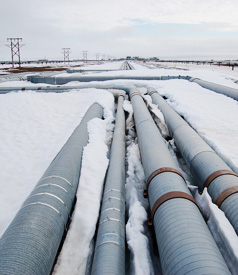
Truthout has spoken to employees and obtained documents that reveal that, "BP's Alaska Oilfield Plagued by Major Safety Issues."

Nearly 5,000 miles from the oil-spill catastrophe in the Gulf of Mexico, BP and its culture of cost-cutting are contributing to another environmental mess.

According to internal BP documents obtained by Truthout, and after interviewing more than a dozen employees over the past month, the Prudhoe Bay oil field, in a remote corner of North America on Alaska's north shore, is in danger.

After two serious oil spills and other mishaps, the BP employees fingered a long list of safety issues that have not been adequately addressed, making the Prudhoe Bay oilfield vulnerable to a devastating accident that potentially could rival the havoc in the Gulf.

"The condition of the [Prudhoe Bay] field is a lot worse and in my opinion a lot more dangerous," said Marc Kovac, who has worked for BP on Alaska's North Slope for more than three decades. "We still have hundreds of miles of rotting pipe ready to break that needs to be replaced. We are totally unprepared for a large spill."

Kovac, a mechanic and welder who is the steward of the United Steelworkers union local 4959, said a lot of employees share his feelings, but "don't want to risk their jobs for speaking out." Kovac said he was willing to take the risk because BP has been slow to deal with the Prudhoe Bay problems and that "many lives are at stake."

Some of the employees, speaking anonymously, said BP follows an "operate to failure" attitude.

Kovac said that means BP Alaska avoids spending money on "upkeep" and instead runs the equipment until it breaks down.

READ MORE>>>
The problem lies in the fact that the world is interconnected. What is happening in Alaska or the Gulf will ultimately effect each of us even though we live miles away from the devastation. A famous Cree Prophecy seems eerily appropriate at this time.
Only after the last tree has been cut down, Only after the last river has been poisoned, Only after the last fish has been caught, Only then will you find money cannot be eaten.

Saturday, June 12, 2010

The Vampires of Oil


Newsweek asks, "Why Is Dick Cheney Silent on the Oil Spill?" The former vice president is usually a vociferous defender of his time in government. But not on the disaster in the gulf.

When the Obama administration, or the media, or just about anybody contradicts Dick Cheney's views on national security, he is far from shy about responding. But facing a firestorm of criticism over the oil spill, he's been notably silent.

More than national security, energy policy and the oil industry might be considered Cheney's real areas of expertise. He was chairman and CEO of oil-services company Halliburton between 1995 and 2000. And, of course, he worked prominently on energy policy as vice president from 2000 to 2008.

Halliburton was working on the Deepwater Horizon rig just before it blew up, opening the well and sending oil gushing into the Gulf of Mexico. Some experts have speculated that the company may have been to blame for the explosion. The pro-oil atmosphere (and Cheney's continued links to Halliburton) during his vice presidency, have also come to the fore since the April 20 accident.

The criticisms center on a possible conflicts of interest and cronyism. Cheney received a $34 million payout when he left Halliburton to join George W. Bush's ticket in September 2000. But the Congressional Research Service found that he "retained ties" to the company into 2003, while in government, through "unexercised stock options and deferred salary."

In 2001 Cheney headed a team tasked with developing national energy policy. The Washington Post reported that many of those consulted were from big oil and gas companies, some also donors to the Bush campaign and the Republican Party. The task force's executive director, Andrew D. Lundquist, subsequently became a lobbyist representing companies who appeared before him—including, according to the Post, BP, Duke Energy, and the American Petroleum Institute. Critics accused the administration of cronyism, and argued that the National Energy Policy Report, issued by the White House in May 2001, was unfairly lax toward the "dirty energy" companies at the expense of renewable and sustainable alternatives.

In 2005 President Bush signed the Energy Policy Act, which retained the focus of Cheney's report, into law. It included what has become known as "the Halliburton loophole," which removed authority from the Environmental Protection Agency to regulate a potentially dangerous gas-drilling process invented by Halliburton.

These links, the fact that Cheney's former campaign press secretary Ann Womack-Colton has recently become BP's head of U.S. media relations, and the general pro-oil, anti-regulation atmosphere in the Bush years have not escaped the attention of the pundits. MSNBC's Chris Matthews highlighted the Halliburton-Cheney connection in an interview with Jay Leno on the BP spill. Frank Rich, in The New York Times, pointed out that the Interior Department degenerated into a "cesspool of corruption," under Bush and Cheney, and that the pair bequeathed Obama "a Minerals Management Service as broken as the Bush-Cheney FEMA exposed by Katrina."

His ears ringing with the cries of "Cheney's Katrina," a title many are striving to bestow on the gulf oil spill, one might expect the former VP to convene journalists for a speech, like he did in May last year at the right-wing American Enterprise Institute to talk about national security. That lengthy rebuttal was timed specially to coincide with a speech President Obama gave on the same topic—a ploy calculated to get the maximum press attention. The closest we have this time is Liz Cheney, Dick's daughter, arguing with Arianna Huffington on ABC's This Week.

We wondered why. Are the claims too substantial to refute? Is Cheney so incensed that he cannot trust himself to speak? Or, conversely, is he perhaps so sanguine about the entire issue that he doesn't feel it merits comment? We reached out to Cheney, via the American Enterprise Institute, to ask. But, perhaps unsurprisingly, there was no response by the time we posted this.

Do not expect Dick Cheney to comment on the oil spill. Given Cheney's history, he will not rise to the occasion but will sulk and hide in the crevices he calls home. However, it is time for accountability from BP and Halliburton.

Saturday, June 5, 2010

BP's oil gusher in the Gulf

Spin Terminology Explained (Satire)


What exactly is a "junk shot?" How about "top kill" or an "undersea plume?" The oil disaster in the Gulf of Mexico is introducing the world to all sorts of fascinating words and phrases from the world of Big Oil. Some of them can be a bit confusing, so as a public service to NaturalNews readers, I've published a short dictionary that provides the real meaning behind many of these new terms.

"Top Kill" - A technique used to kill everything on the TOP of the ocean using chemical dispersants that cause the dead animal bodies to sink to the BOTTOM of the ocean so they can't be caught on camera.

"Top Hat" - What BP executives will all be wearing at the huge banquet they will soon be holding to celebrate how they pulled off the environmental crime of the century without even a slap on the wrist (thanks to Big Government complicity).

"Blowout Preventer" - BP's public relations person who lies to the press to prevent a P.R. blowout from occurring. A blowout preventer preventer is any member of the press who asks tough questions.

"Junk Shot" - An effort to thrust shredded tires, golf balls and other trash into the hole to stop the oil flow. This is the oil industry's attempt to try to make the Gulf of Mexico look like the streets of Mexico City by filling it with trash.

"Chemical Dispersant" - A highly toxic chemical substance being pumped into the Gulf of Mexico by the hundreds of thousands of gallons in an effort to kill so much marine life that the toxicity of the oil itself seems small by comparison.

"Undersea Plume" - Rhymes with "doom." A term used to confuse mainstream news viewers who would be disturbed by the more accurate term, "Undersea VOLCANO of oil."

"Live Feed" - What BP calls a video loop which repeats a few choice frames over and over again and morphs them to create the illusion that it's actually a live video. The effect is further enhanced by adding a clock that counts off the seconds in real time in the lower right-hand corner. The public is now utterly hypnotized by these video loops, much like house cats watching ceiling fans.

"Mud" - A code word for crude oil. This is being repeated on the TV news when newscasters explain that the live video feed showing crude oil bursting out of the ocean floor is mostly just "mud." They actually mean oil. Mud, after all, does not explode from the ocean floor in a volcanic burst.

"According to plan" - A British Petroleum euphemism for "all f**ked up." As in, "The top kill procedure is going according to plan." The cleanup is going according to plan, too, it seems. As long as BP is in charge, everything is going according to plan. How dare you suggest they have no clue what they're doing...

"Barrel of oil" - An imaginary unit of oil volume that can be morphed into whatever size BP wishes it to be. At investors' meetings, the number of barrels of oil in the Gulf of Mexico magically becomes very large, but during oil spills, the number magically shrinks to appear much smaller.

"Cleanup workers" - Temporary workers hired by BP to comb the beaches in front of news cameras to make it appear like something useful is happening. BP has now promised to triple the number of active cleanup workers to nine.

"You will not be left behind" - A phrase uttered by President Obama, who, immediately after saying it, left everybody behind and took all of BPs beach cleaning crews with him, too. Obama has now returned to his golf game, where he claims to be working on the oil spill problem by aiming his golf balls in the direction of the Gulf of Mexico and hoping they will land in the gaping hole at the bottom of the ocean, thereby making them "junk shot."

An Addition:
Relief Wells: These will relieve the pocket books of BP.

Let's get serious!

Okay, everything above is just satire, but in reality this Gulf spill is serious business. Although we try to poke fun at the mistakes that were made in causing this to happen, the truth is that this situation is no laughing matter.

Climate Bill Is a Misnomer

It’s really a Nuclear Energy-Promoting, Oil Drilling-Championing, Coal Mining-Boosting Gift to Polluters

Via Public Citizen

Statement of Tyson Slocum, Director of Public Citizen’s Energy Program

After half a year of delay, Sens. John Kerry (D-Mass.) and Joe Lieberman (I-Conn.) are set to release their nuclear energy/cap-and-trade bill today. Until we see legislative text, we can comment only on the broad outline made available yesterday and an additional summary being circulated among legislative staff.

It’s not accurate to call this a climate bill. This is nuclear energy-promoting, oil drilling-championing, coal mining-boosting legislation with a weak carbon-pricing mechanism thrown in. What’s worse, it guts the Environmental Protection Agency’s (EPA) current authority to regulate greenhouse gases as pollutants under the Clean Air Act.

Here’s our take on what we know is in the new bill:

Nuclear Power Incentives

At its core, this legislation is all about promoting nuclear power and handing taxpayers the bill. Consider:

- Sections 1101 and 1105 would prioritize the needs of nuclear power corporations over the rights of citizens to have full, public hearings about the risks and dangers of locating nuclear power plants in their communities.

- Section 1102 increases loan guarantees primarily for nuclear power to a jaw-dropping $54 billion. These loans are a terrible deal for the taxpayer, especially considering the high risk of default that even the government acknowledges.

- Section 1103 provides $6 billion in taxpayer-subsidized risk insurance for 12 new nuclear reactors.

- Section 1121 allows nuclear power plant owners to write off their depreciation much faster. Section 1121 provides a 10 percent investment tax credit for new reactors.

- Section 1123 extends the Advanced Energy Project credit to nuclear reactors.

- Section 1124-6 allows municipal power agencies to derive certain tax, bond and grant benefits from investing in nuclear power.

Oil
Apparently oblivious to the ongoing disaster in the Gulf of Mexico, the legislation expands offshore drilling. In fact, all new offshore drilling, leasing and permitting should be halted.

Section 1202 allows states to keep 37.5 percent of oil and gas royalty money. That’s like saying because more rich people live in California and New York compared to Mississippi and New Mexico, those higher-income states should be able to keep more federal dollars raised from income taxes. Royalty revenue sharing is patently unfair – especially because the disaster in Gulf shows that an oil spill does not respect state boundaries.

Coal
Section 1412 establishes a carbon tax paid by ratepayers and collected by utilities to fund carbon capture and storage (CCS) – with no money allocated to rooftop solar or energy efficiency investments. Section 1431 will provide valuable emissions allowances for free to coal utilities pursuing CCS – an untested, risky strategy that benefits the coal industry and is gobbling up a lion’s share of subsidies that otherwise could go to renewable energy development.

Merchant coal power plants (whose rates are not regulated) will get roughly 5 percent of the free allowances, which will provide opportunities for them to gouge consumers.

And while the nuclear and coal industries will receive a lot of taxpayer money and loan guarantees, Section 1604 states that “voluntary” renewable energy markets are “efficient and effective programs” and states that “the policy of the United States is to continue to support the growth of these markets.” This is backward: Renewable energy should be getting the guarantees, rather than the coal and nuclear industries.

Offsets
The legislation allows entities to “reduce” their domestic greenhouse gas emissions by purchasing offsets from projects located in the U.S. and around the world. The recent offset crisis in Europe, where the offset market collapsed due to fraud, underscores the lack of accountability and transparency with offsets.

Consumer Protections
Rather than follow President Barack Obama’s cap-and-dividend plan, which would have required polluters to pay and would have distributed 80 percent of the money directly to families through the Making Work Pay tax credit, or the Cantwell-Collins CLEAR Act, which calls for distributing monthly checks to households, the Kerry-Lieberman approach relies on distributing valuable free allowances to utilities from 2013-2029, then requiring that utilities use the money “exclusively for the benefit of the ratepayers.” But Congress won’t be defining “benefit”; rather, 50 different state utility commissions will. Some will do a great job, but most will allow utilities to structure expensive energy efficiency programs that benefit shareholders more than ratepayers.

Wall Street
It appears that Wall Street may not have gotten everything it wanted – yet. The legislation appears to incorporate elements of S.1399, sponsored by Sen. Dianne Feinstein (D-Calif.), which creates an Office of Carbon Market Oversight at the Commodities Futures Trading Commission (CFTC), giving the agency authority to regulate spot and futures emission markets. It requires all entities seeking to trade emissions derivatives to register and be approved by the CFTC, and all transactions must be cleared through a CFTC-regulated Carbon Clearing Organization. This is a good start to ensure that Wall Street plays no role in gambling on climate policy.

Danger remains, however, in creating carbon trading markets open to non-energy producers. Strong regulations in place today may be easily subverted tomorrow, leaving Wall Street positioned to control our climate future.


Conclusion
The Kerry-Lieberman bill represents a missed opportunity. By meeting behind closed doors, the lawmakers empowered corporate polluters to play an oversized role in influencing the legislation to the detriment of the climate and consumers. President Obama had it right when he successfully campaigned on a theme of making polluters pay and delivering benefits directly to households.

We need a bill that does not incentivize failed and dangerous technologies like nuclear power and does not enrich utilities at the expense of consumers.

Public Citizen is a national, nonprofit consumer advocacy organization based in Washington, D.C. For more information, please visit www.citizen.org.

As citizens and consumers we need to let out legislators know that we need tighter regulation to protect our environment and absolutely no handouts to the oil, gas, coal, nuclear energy or money industries. Let them work for their money as they demand all of us to work for ours.

Wednesday, June 2, 2010

The Niger Delta Environmental Catastrophes

The price we have to pay for drilling oil today.

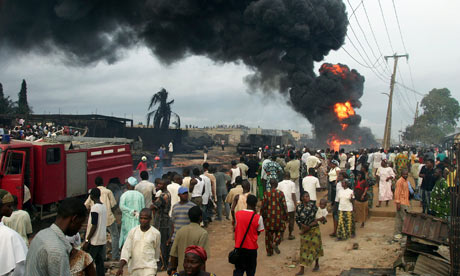
Burning pipeline, Lagos

A ruptured pipeline burns in a Lagos suburb after an explosion in 2008 which killed at least 100 people.

Photograph: George Esiri/Reuters

SHELL OIL

We reached the edge of the oil spill near the Nigerian village of Otuegwe after a long hike through cassava plantations. Ahead of us lay swamp. We waded into the warm tropical water and began swimming, cameras and notebooks held above our heads. We could smell the oil long before we saw it – the stench of garage forecourts and rotting vegetation hanging thickly in the air.

The farther we travelled, the more nauseous it became. Soon we were swimming in pools of light Nigerian crude, the best-quality oil in the world. One of the many hundreds of 40-year-old pipelines that crisscross the Niger delta had corroded and spewed oil for several months.

Forest and farmland were now covered in a sheen of greasy oil. Drinking wells were polluted and people were distraught. No one knew how much oil had leaked. "We lost our nets, huts and fishing pots," said Chief Promise, village leader of Otuegwe and our guide. "This is where we fished and farmed. We have lost our forest. We told Shell of the spill within days, but they did nothing for six months."

That was the Niger delta a few years ago, where, according to Nigerian academics, writers and environment groups, oil companies have acted with such impunity and recklessness that much of the region has been devastated by leaks.

In fact, more oil is spilled from the delta's network of terminals, pipes, pumping stations and oil platforms every year than has been lost in the Gulf of Mexico, the site of a major ecological catastrophe caused by oil that has poured from a leak triggered by the explosion that wrecked BP's Deepwater Horizon rig last month.

That disaster, which claimed the lives of 11 rig workers, has made headlines round the world. By contrast, little information has emerged about the damage inflicted on the Niger delta. Yet the destruction there provides us with a far more accurate picture of the price we have to pay for drilling oil today.

EXXONMOBIL
On 1 May this year a ruptured ExxonMobil pipeline in the state of Akwa Ibom spilled more than a million gallons into the delta over seven days before the leak was stopped. Local people demonstrated against the company but say they were attacked by security guards. Community leaders are now demanding $1bn in compensation for the illness and loss of livelihood they suffered. Few expect they will succeed. In the meantime, thick balls of tar are being washed up along the coast.
50 YEARS of CONTAMINATION
With 606 oilfields, the Niger delta supplies 40% of all the crude the United States imports and is the world capital of oil pollution. Life expectancy in its rural communities, half of which have no access to clean water, has fallen to little more than 40 years over the past two generations.

"The oil companies just ignore it. The lawmakers do not care and people must live with pollution daily. The situation is now worse than it was 30 years ago. Nothing is changing," said the writer Ben Ikari, a member of the Ogoni people.

"We see frantic efforts being made to stop the spill in the US," said Nnimo Bassey, Nigerian head of Friends of the Earth International. "But in Nigeria, oil companies largely ignore their spills, cover them up and destroy people's livelihood and environments. The Gulf spill can be seen as a metaphor for what is happening daily in the oilfields of Nigeria and other parts of Africa.

"This has gone on for 50 years in Nigeria. People depend completely on the environment for their drinking water and farming and fishing.

It is impossible to know how much oil is spilled in the Niger delta each year because the companies and the government keep that secret. However, two major independent investigations over the past four years suggest that as much is spilled at sea, in the swamps and on land every year as has been lost in the Gulf of Mexico so far.
TOTAL DEVASTATION

The scale of the pollution is mind-boggling. The government's national oil spill detection and response agency (Nosdra) says that between 1976 and 1996 alone, more than 2.4m barrels contaminated the environment. "Oil spills and the dumping of oil into waterways has been extensive, often poisoning drinking water and destroying vegetation. These incidents have become common due to the lack of laws and enforcement measures within the existing political regime," said a spokesman for Nosdra.

The sense of outrage is widespread. "There are more than 300 spills, major and minor, a year," said Bassey. "It happens all the year round. The whole environment is devastated. The latest revelations highlight the massive difference in the response to oil spills. In Nigeria, both companies and government have come to treat an extraordinary level of oil spills as the norm."

ENVIRONMENTAL IMPACT

Other voices of protest point out that the world has overlooked the scale of the environmental impact. Activist Ben Amunwa, of the London-based oil watch group Platform, said: "Deepwater Horizon may have exceed Exxon Valdez, but within a few years in Nigeria offshore spills from four locations dwarfed the scale of the Exxon Valdez disaster many times over. Estimates put spill volumes in the Niger delta among the worst on the planet, but they do not include the crude oil from waste water and gas flares. Companies such as Shell continue to avoid independent monitoring and keep key data secret."

Worse may be to come. One industry insider, who asked not to be named, said: "Major spills are likely to increase in the coming years as the industry strives to extract oil from increasingly remote and difficult terrains. Future supplies will be offshore, deeper and harder to work. When things go wrong, it will be harder to respond."

Judith Kimerling, a professor of law and policy at the City University of New York and author of Amazon Crude, a book about oil development in Ecuador, said: "Spills, leaks and deliberate discharges are happening in oilfields all over the world and very few people seem to care."

There is an overwhelming sense that the big oil companies act as if they are beyond the law. Bassey said: "What we conclude from the Gulf of Mexico pollution incident is that the oil companies are out of control.

"It is clear that BP has been blocking progressive legislation, both in the US and here. In Nigeria, they have been living above the law. They are now clearly a danger to the planet. The dangers of this happening again and again are high. They must be taken to the international court of justice."

The price of oil contamination has exceeded the benefits of oil drilling!

Sunday, May 30, 2010

Inconceivable or Forseeable


In 1979, the IXTOC I was an exploratory oil well in the Bay of Campeche of the Gulf of Mexico that suffered a blowout. The 1979 blowout resulted in the second largest oil spill and the largest accidental spill in history. The largest was the Gulf War oil spill during the first Gulf War.

That is until now.

The BP blow out in the Gulf of Mexico is eerily similar.
- Like the Deepwater Horizon spill, the Ixtoc I spill on June 3, 1979, involved the failure of a blowout-preventer device, a kind of emergency shutoff valve. In both cases, metal domes put over the well failed to stop the leak.
- And as they did in Mexico, BP crews are trying to stop the spill by drilling reliever wells horizontally through the seafloor, a technique that could take months.

- Pemex and a series of U.S. contractors struggled for months to stop the leak. One company managed to close the well casing, but the oil broke through below the seal and caused another blowout. Another contractor built a dome for the well that it called the Sombrero, Spanish for hat, but oil continued to seep from cracks in the sea floor.

- In August 1979, balls of sticky tar began washing up on the hotel beaches of South Padre Island in Texas. Crews scraped them up with construction equipment and giant vacuum cleaners, and the Coast Guard stretched a net across the Port Mansfield inlet to catch submerged tar balls.

- Pemex began drilling two horizontal relief wells soon after the spill in June 1979, but they did not reach the Ixtoc I well until November, five months later. The crews used the relief wells to pump mud and steel balls into the gusher, finally capping the leak on March 25, 1980.

- BP, which owns the well in the Deepwater Horizon spill, began drilling its own relief wells on May 2 and May 16, respectively. They will take about three months to complete, the company says.
Despite these similarities, BP officials are claiming that the apocalyptic failure of its deepwater exploratory rig was unforeseeable, unprecedented and inconceivable.

Climate Progress notes that the “I don’t think anybody” excuse has been used before.

“I don’t think anybody foresaw the circumstance that we’re faced with now.” — BP spokesman Steve Rinehart [AP 5/2/10]

“I don’t think anybody could have predicted that these people would take an airplane and slam it into the World Trade Center, take another one and slam it into the Pentagon; that they would try to use an airplane as a missile, a hijacked airplane as a missile.” — Condoleezza Rice [CNN, 5/16/02]

“The sort of occurrence that we’ve seen on the Deepwater Horizon is clearly unprecedented.” — BP spokesman David Nicholas [AP 4/30/10]

“I don’t think anybody anticipated the breach of the levees. They did anticipate a serious storm. But these levees got breached. And as a result, much of New Orleans is flooded. And now we are having to deal with it and will.” — President George W. Bush [GMA, 9/1/05]

BP did not build containment devices before disaster because it “seemed inconceivable” the blowout preventer would fail. — BP spokesman Steve Rinehart [AP 5/2/10]

“I don’t think anybody anticipated the level of violence that we’ve encountered. I guess the other area that I look at, in terms of an area where I think we were faced with difficulties we didn’t anticipate was the devastation that 30 years of Saddam’s rule had wrought, if you will, on the psychology of the Iraqi people.” — Vice President Dick Cheney, 6/19/06.

However, there is evidence that this event was very foreseeable.
Failure of blowout preventers.

There is evidence that the failure of underwater blowout preventers on oil rigs is common.
A 1999 report commissioned by the federal agency that oversees offshore drilling suggests failures of underwater blowout preventers designed to stop oil spills like the massive one threatening the Gulf Coast were far from unknown, the chairwoman of a key Senate panel.

Citing a Minerals Management Service
report, Sen. Maria Cantwell , D- Wash. , said there were 117 failures of blowout preventers during a two-year period in the late 1990s on the outer continental shelf of the United States .

The unclassified version of the 1999 report said the failures involved 83 wells drilled by 26 rigs in depths from 1,300 feet to 6,560 feet.

A similar report released by the agency in 1997 found that between 1992 and 1996 there were 138 failures of blowout preventers on underwater wells being drilled off Brazil , Norway , Italy and Albania .

Blowout preventers, which can weigh up to 500,000 pounds and stand 50 feet tall, are bolted on the top of a wellhead on the seafloor and in an emergency can cut off the flow of oil to prevent a gusher. The blowout preventers can be activated by throwing a switch on the drilling rig. They are also supposed to activate automatically in the event of a major problem or, in some cases, can be activated by acoustic sound waves produced from a ship on the surface.

No one is sure what caused the drilling rig Deepwater Horizon off the coast of Louisiana to burst into flames on April 20 and sink two days later into the Gulf. The accident left 11 workers missing and presumed dead and 17 others injured. The blowout preventer apparently failed to cap the well, allowing an estimated 210,000 gallons of oil to escape daily.

The cause of the explosion and fire is under investigation, and efforts to activate the blowout preventer 5,000 feet below the surface have, so far, been unsuccessful.

Climate Progress has a list of the forseeability factors.

Failures of blowout preventers and actual blowouts are common. Between 1992 and 1998 there were 319 failures of blowout preventers found in US offshore drilling, an average of 45 a year. [MMS, 1999] Between 1992 and 2006 there were at least 39 blowouts off the US coastline, 38 of them in the Gulf of Mexico. [MMS, 7/07] From 2007 to 2009 there were 19 blowouts, all in the Gulf of Mexico. [MMS]

The largest accidental oil spill in history was a Gulf of Mexico exploratory rig blowout. On June 3, 1979, the exploratory well IXTOC I blew out and ignited, burning down the platform. Divers later activated the blowout preventer to no avail.The well continued to spill oil at a rate of 10,000 to 30,000 barrels per day until it was finally capped on March 23, 1980. [NOAA]

A major deepwater blowout followed by a two-month spill occurred in 2009. In “one of Australia’s worst oil disasters,” a PTTEP oil rig blew out in the Montara oil field on August 21, 2009. Efforts to control the leaking rig set it on fire on November 1st, two days before the leak was finally plugged. Official estimates of the leak rate were five times higher than those of the oil company. [Wikipedia]

A ’spill of national significance’ exercise in 2002 concerned a major rig blowout in the Gulf of Mexico. Adm. Thad Allen led a “spill of national significance” exercise in 2002 that dealt with the scenario of an oil rig exploding off the coast of Louisiana, with an “uncontrollable discharge” of oil that lasted for a month. These training exercises take place every three years as mandated by the 1990 Oil Pollution Act, the most recent of which occurred in March, 2010.

Rachel Maddow shows how the BP disaster is very similar to previous events. WATCH:


In an appearance on "Face The Nation," Rep. Ed Markey (D-Mass.), chairman of a House energy committee investigating the oil spill, put into context BP's response to the Gulf disaster.
"I think they were either lying or incompetent. But either way,the consequences for the Gulf of Mexico are catastrophic."

"I have no confidence whatsoever in BP. I do not think they know what they are doing. .. I do not think people should really believe anything BP is saying in terms of the likelihood of anything that they are doing is going to turn out as they predicted."

"I think that without question, if the word 'criminal' should be used in terms of an environmental crime against our country, then what's going on in the Gulf of Mexico is going to qualify, yes."
If history has any relevance in this man-made disaster, the notion of a quick fix is inconceivable while further incompetence is foreseeable.

Wednesday, May 19, 2010

Limited Liability Bailout


Via Crooks and Liars:
Senate Republicans have stalled legislation that would require oil companies to pay fully for their accidents. Listen to Senator Inhofe (R-Oil Companies) push for Big Oil's ability to make obscene profits over safety:

You gotta love how these "Oh noes! Obama wants us to be socialists!" Republicans have no problem with a multi-national oil company privatizing their profits and socializing their costs. Why aren't the protesters who scream about bailouts not screaming about this?

Obama made a statement expressing his frustration:

"I am disappointed that an effort to ensure that oil companies pay fully for disasters they cause has stalled in the United States Senate on a partisan basis. This maneuver threatens to leave taxpayers, rather than the oil companies, on the hook for future disasters like the BP oil spill. I urge the Senate Republicans to stop playing special interest politics and join in a bipartisan effort to protect taxpayers and demand accountability from the oil companies.”

Transocean Ltd . , the owner of the rig leased by BP which is currently leaking oil into the Gulf of Mexico, has received $270 million in profit from insurance payouts after the disaster.

The amount, revealed during a conference call to analysts, was made because its insurance policy for Deepwater Horizon rig was greater than the value of the rig itself, the Sunday Times reports. The Times says Transocean has already received cash payment of $401 million and the rest is due in the coming weeks.

Unbelievable. Of course, that money has been turned around as part of a nice, fat $1B dividend to stockholders.
Rand Paul who just won the primary in Kentucky for the Republican Senate nomination recently spoke about the the bank bailout in an interview with Neil Cavuto.
We, as Republicans, don’t believe in bailing out failed businesses, much less about having the government [owning them]....
Rand Paul while proposing no bailout, also proposes to "cut regulations on bankers, health insurance companies and oil drillers."

If Paul doesn't support regulation but at the same time he also doesn't support bailouts, then what is his position on lifting
the liability cap on oil companies.

Sunday, May 16, 2010

Hoping for an 'Outside of the Box' Solution


Scientists tapped by the Obama administration to help fix the Gulf Coast oil spill.
From left to right: Richard Garwin, Tom Hunter, Alexander Slocum, Jonathan Katz and George Cooper

Via TPM: Mission Impossible: Obama Taps Crack Team Of Scientists To Do The Job BP Can't

President Obama's new plan to fix the Gulf oil spill is so crazy it just might work...

As BP's high-priced industry experts flail, the president has turned to a rag-tag band of big-think scientific renegades, and sent them on a mission to somehow MacGyver a way to stop up the leak -- before it's too late.

OK, maybe that's going a bit far. In fact, the news that Obama and his energy secretary, Steven Chu, have sent a team of leading physicists and engineers to the Gulf to work with BP offers further evidence of the administration's essentially technocratic approach to governance, and its faith in knowledge-based expertise. That might seem like common sense, but it represents a shift from the Bushies' faith in the problem-solving power of industry, and its willingness to let science take a backseat to the concerns of its religious base.

Still, asking one of the key inventors of the hydrogen bomb, along with an engineer who helped develop techniques for mining on Mars, counts as out-of-the-box thinking. Here's a quick rundown on the president's unlikely team:

The Old Hand: Richard Garvin

In 1951, 23-year old Richard Garwin was working at the Los Alomos nuclear laboratory,
when he was asked by Edward Teller to devise an experiment that would demonstrate the principle of "radiation implosion." Garwin's detailed sketch served as the basis for "Mike," an 80-ton device, that was detonated the following year as the world's first hydrogen bomb. "I wasn't the inventor," Garwin has said. "I was sort of the architect." In 1952, Garwin went to work for IBM -- where he remains a fellow emeritus -- on the understanding that he could spend a third of his time working with the federal government on national security issues. He's a recipient of the national medal of science, and a member of the JASON, an elite think tank that studies complex scientific problems on behalf of the U.S. government. In 1991, Garwin convened a symposium of experts to discus ways to stem oil flows from Kuwait wells, set on fire by Iraq during the Gulf War. For Garwin, now 82, could this be his last hurrah?

The Establishment Man: Tom Hunter

Tom Hunter yesterday announced his resignation as the president of Sandia National Laboratories, an outpost of the U.S. nuclear weapons complex that conducts high-level research for the National Nuclear Security Administration. He had been at Sandia since 1967, and served as president since 2005 -- a job that reportedly paid him $1.7 million a year. He has a Ph.D. in Nuclear Engineering from the University of Wisconsin. Hunter said yesterday he had no particular plans for what he'd be doing in retirement. That may have changed.

The Maverick Genius: Alexander Slocum

Alexander Slocum, a professor of mechanical engineering at Massachusetts Institute of Technology, teaches a world famous design and manufacturing class that culminates in a remote-controlled robot competition. He holds more than 60 patents for inventions relating to biotechnology, robotics and computer science, but his research interests also include "going faster on my snowboard, staying down longer SCUBA diving!," according to his website. A colleague told Bloomberg: "He has a lot of creative ideas. One in 10 are really brilliant ideas, but nine are dumb. You can't miss that one that is brilliant." Here's hoping genius strikes in the Gulf.

The No-Nonsense Engineer: George Cooper

George Cooper might have the most relevant experience for the mission at hand. A professor of engineering at UC Berkely, he spent much of his career in industrial research with Britain's National Physical Laboratory and now serves as Senior Petroleum Engineer at DOE's Lawrence Berkeley Laboratory. But he can branch out too: According to Bloomberg, he once worked with the National Aeronautics and Space Administration to adapt mining techniques for use on Mars.

The What-Am-I-Doing-Here? Guy: Jonathan Katz


Jonathan Katz, a physics professor at Washington University in St. Louis, is another member of JASON. But Katz's major research focus has been astrophysics, and in an interview today with a St. Louis paper -- conducted upon his return from a quick trip to the Gulf region -- he didn't seem confident that he had been much help with the mission. "I was honored to be invited and enjoyed the experience," said Katz. "Did I have anything much to contribute? I think I have some ideas for how to prevent this kind of thing from happening in the future, but I don't have anything very specific to offer on the present problems. It is very much in the hands of the real pros." Asked if he'd be willing to go back, Katz said: "I'd be happy to, but someone's got to send me an email or a phone call."

Time is of the essence!