When the Obama administration, or the media, or just about anybody contradicts Dick Cheney's views on national security, he is far from shy about responding. But facing a firestorm of criticism over the oil spill, he's been notably silent.
More than national security, energy policy and the oil industry might be considered Cheney's real areas of expertise. He was chairman and CEO of oil-services company Halliburton between 1995 and 2000. And, of course, he worked prominently on energy policy as vice president from 2000 to 2008.
Halliburton was working on the Deepwater Horizon rig just before it blew up, opening the well and sending oil gushing into the Gulf of Mexico. Some experts have speculated that the company may have been to blame for the explosion. The pro-oil atmosphere (and Cheney's continued links to Halliburton) during his vice presidency, have also come to the fore since the April 20 accident.
The criticisms center on a possible conflicts of interest and cronyism. Cheney received a $34 million payout when he left Halliburton to join George W. Bush's ticket in September 2000. But the Congressional Research Service found that he "retained ties" to the company into 2003, while in government, through "unexercised stock options and deferred salary."
In 2001 Cheney headed a team tasked with developing national energy policy. The Washington Post reported that many of those consulted were from big oil and gas companies, some also donors to the Bush campaign and the Republican Party. The task force's executive director, Andrew D. Lundquist, subsequently became a lobbyist representing companies who appeared before him—including, according to the Post, BP, Duke Energy, and the American Petroleum Institute. Critics accused the administration of cronyism, and argued that the National Energy Policy Report, issued by the White House in May 2001, was unfairly lax toward the "dirty energy" companies at the expense of renewable and sustainable alternatives.
In 2005 President Bush signed the Energy Policy Act, which retained the focus of Cheney's report, into law. It included what has become known as "the Halliburton loophole," which removed authority from the Environmental Protection Agency to regulate a potentially dangerous gas-drilling process invented by Halliburton.
These links, the fact that Cheney's former campaign press secretary Ann Womack-Colton has recently become BP's head of U.S. media relations, and the general pro-oil, anti-regulation atmosphere in the Bush years have not escaped the attention of the pundits. MSNBC's Chris Matthews highlighted the Halliburton-Cheney connection in an interview with Jay Leno on the BP spill. Frank Rich, in The New York Times, pointed out that the Interior Department degenerated into a "cesspool of corruption," under Bush and Cheney, and that the pair bequeathed Obama "a Minerals Management Service as broken as the Bush-Cheney FEMA exposed by Katrina."
His ears ringing with the cries of "Cheney's Katrina," a title many are striving to bestow on the gulf oil spill, one might expect the former VP to convene journalists for a speech, like he did in May last year at the right-wing American Enterprise Institute to talk about national security. That lengthy rebuttal was timed specially to coincide with a speech President Obama gave on the same topic—a ploy calculated to get the maximum press attention. The closest we have this time is Liz Cheney, Dick's daughter, arguing with Arianna Huffington on ABC's This Week.
We wondered why. Are the claims too substantial to refute? Is Cheney so incensed that he cannot trust himself to speak? Or, conversely, is he perhaps so sanguine about the entire issue that he doesn't feel it merits comment? We reached out to Cheney, via the American Enterprise Institute, to ask. But, perhaps unsurprisingly, there was no response by the time we posted this.
Sunday, June 20, 2010
Wednesday, June 16, 2010
Cheney's Secret
Mother Jones thinks that former V.P. Dick Cheney is having the last laugh regarding the U.S. energy policy that was molded and formed in secrecy during the Bush-Cheney era. "The Deepwater Horizon disaster raises new questions about the Bush administration's secret energy task force."
Dick Cheney hasn't made much time for television appearances lately. But in the weeks since the Deepwater Horizon unleashed a torrent of oil on the Gulf of Mexico, his name has been creeping back into the press. "The truth is that right now we have precisely the regulatory system that the Bush-Cheney administration wanted: full of loopholes, full of cronies and lobbyists filling the very agencies that are supposed to be overseeing the industry," liberal commentator Arianna Huffington said on ABC's This Week last Sunday. Cheney's daughter, Liz, was on hand to defend her father. "Arianna, I don't know what planet you live on," she shot back. "What you are saying has no relationship to the truth, no relationship to the facts."
The reality is a lot more complicated than that. Many of the policy and regulatory failures that laid the groundwork for the BP catastrophe can be traced back to the Bush-Cheney era. But so far, this question has received relatively little attention—mostly because the task force that developed the former administration's energy policy operated in extreme secrecy. Did the task force's decisions play a role in the BP spill? And could the Gulf disaster finally provoke new scrutiny of the task force's clandestine workings?
Cheney's secret energy task force.
The energy task force was created days after onetime oilman George W. Bush took office in 2001, and was headed by Cheney, a former CEO at Halliburton, one of the world's largest providers of oilfield products and services. For months, the task force solicited input on US energy policy. On May 16, 2001, the group issued its final report, which was submitted to Congress in June. But the participants and details of the discussions were kept tightly under wraps.
The open-government group Judicial Watch tried to pry details of the task force's deliberations from the administration in June, arguing that the sessions qualified as public information under the Federal Advisory Committee Act and the open-meetings law. The US General Accounting Office (GAO), the investigative arm of Congress, also sought information on which industry executives and lobbyists had attended the gatherings.
But in the first of many clashes over presidential secrecy, the White House rejected those requests, arguing that it was entitled to conduct the meetings behind closed doors thanks to executive privilege. Judicial Watch and the Sierra Club sued, but the Supreme Court ultimately sided with the administration. Though some information has trickled out in the years since, the vast majority of the task force's deliberations remain hidden from the public eye.
The task force position of deregulation of offshore drilling.
Here's what we know about the task force and offshore drilling. The Natural Resources Defense Council, an environmental group, was able to obtain 13,500 pages of heavily redacted documents that gave a glimpse into the role industry leaders played in shaping the administration's policies (NRDC also got a list of the documents (PDF) that the administration refused to turn over). In July 2007, the Washington Post got a list of the roughly 300 groups and individuals who met with task force staffers and, in some cases, Cheney himself.
BP officials were among those who "gave detailed energy policy recommendations" to the administration, though when that fact came to light, the company refused to comment on those meetings. We still don't know what specific policy areas BP execs weighed in on. Perhaps it's little surprise that BP recently hired Cheney's former press secretary, a public defender of the secret task force, to help the company with crisis communication after the spill.
But we do have a few more details about other oil industry players in the talks. Chevron's CEO contributed a detailed list(PDF) of ways in which the government could "eliminate federal barriers to increased energy supplies"—many of which were incorporated in the task force's final report. This included recommendations to ease federal permitting rules for energy development and a request that the administration support opening up new areas of the eastern Gulf of Mexico for offshore oil and gas development. Doing so, wrote Chevron CEO David O'Reilly, would "demonstrate a commitment to reject unjustified opposition to new energy leasing and development."
The American Petroleum Institute offered its own long list of suggestions for energy policy. A March 20, 2001, email from API to an official at the Energy Department included a draft executive order calling for all federal agencies to issue a detailed statement on any regulatory action that "adversely affects energy supply, distribution or use." It was nearly identical to the order Bush issued just two months later.
The connection between the task force and the Energy Policy and its effect.
Many of the recommendations from the task force report were adopted in the 2005 Energy Policy Act. That legislation provided $6 billion in subsidies for oil and gas development. Royalty payments for oil and gas development were waived in several regions of the US. Some companies were allowed to pay royalties with oil, rather than money—a less transparent system that was more vulnerable to abuse. The bill also provided $1.5 billion in direct payments to companies to incentivize drilling in deepwater wells, and curtailed the power of states to oversee oil and gas exploration off their coasts under the Coastal Zone Management Act.
In addition, the bill weakened environmental protections for offshore drilling, making it easier to exclude a broad range of exploration and drilling activities from analysis under the National Environmental Policy Act. This has been cited as the reason that the Deepwater Horizon site was not subjected to a thorough environmental analysis.
The task force's final report also presented a rosy picture of the offshore drilling industry. Newer oil and gas drilling methods, it said, "practically eliminate spills from offshore platforms" and "enhance worker safety, lower risk of blowouts, and provide better protection of groundwater resources." The report advocated lifting the moratorium on portions of the outer continental shelf, noting that "concerns over the potential impacts of oil spills have been a major factor behind imposition of the OCS moratoria." Bush lifted the executive moratorium in 2008, and the Democratic-controlled Congress allowed its own moratorium to expire.
Unanswered questions.
But there's a lot we still don't know. The task force recommendations included scaling back regulations and oversight of offshore drilling while expanding incentive programs and access to resources, many of which would come to pass in future legislation. But how much the task force may have guided decisions at federal agencies—in particular the notoriously lax Minerals Management Service (MMS)—is unclear. The administration's directives across the agencies actively discouraged any regulations or oversight that might hinder development of resources.
Among the many questions is what role the task force may have played in a 2003 decision by the MMS not to require offshore rigs to install an acoustic shut-off switch, a remote-controlled backup system that seals off an underwater well even if the rig above is destroyed. Countries like Norway and Brazil require this precaution, and MMS considered doing the same. But oil companies complained that the $500,000 devices were too expensive and, they argued, ineffective. Ultimately, MMS made the switches optional. The Deepwater Horizon was not outfitted with such a device, which could have prevented the spill. Other concerns include a failure to implement new cementing policies or act on known concerns about key components on drilling rigs.
Investigations without subpoena power.
The Department of Justice has launched criminal and civil investigations into the disaster, while a presidential commission is looking into both the spill and offshore drilling policy in general. That commission currently lacks subpoena power, though there's an effort underway in Congress to grant the commission that power. Numerous congressional committees have also launched probes of the spill. A congressional aide working for one of those committees indicated that there has been some discussion of revisiting the task force in those investigations, though no concrete steps to do so have been taken.
Open government advocates say this might be the appropriate time to push for more information about his task force. Mandy Smithberger, an investigator at the Project on Government Oversight, says that it's "definitely a ripe time" to find out more about what went on in the meetings. "I don't think you can understand how we got to where we are without looking back," she says.
"When you have a disaster of this magnitude, it raises the question, if in this whole secretive process, what was discussed, how much did the Bush administration ignore, how much did they allow the oil and gas industry to basically do what they wanted," says AnneWeismann, chief counsel at Citizens for Ethics and Responsibility in Washington. "Secrecy is so pernicious that it can continue to damage even when the administration is not in power."
Secrecy, deregulation, oil subsidies and a lack of accountability are just a few of the problems that have stemmed from the Bush-Cheney era energy policy. The oil spill in the Gulf of Mexico is now spreading and effecting the ecosystems across vast areas. So to has the energy policies of the previous administration infiltrated and caused loopholes and unbridled greed in the power play of oil and money.
Tuesday, June 15, 2010
To Call BP a Pig is to Insult Every Pig
Truthout has spoken to employees and obtained documents that reveal that, "BP's Alaska Oilfield Plagued by Major Safety Issues."
Nearly 5,000 miles from the oil-spill catastrophe in the Gulf of Mexico, BP and its culture of cost-cutting are contributing to another environmental mess.
According to internal BP documents obtained by Truthout, and after interviewing more than a dozen employees over the past month, the Prudhoe Bay oil field, in a remote corner of North America on Alaska's north shore, is in danger.
After two serious oil spills and other mishaps, the BP employees fingered a long list of safety issues that have not been adequately addressed, making the Prudhoe Bay oilfield vulnerable to a devastating accident that potentially could rival the havoc in the Gulf.
"The condition of the [Prudhoe Bay] field is a lot worse and in my opinion a lot more dangerous," said Marc Kovac, who has worked for BP on Alaska's North Slope for more than three decades. "We still have hundreds of miles of rotting pipe ready to break that needs to be replaced. We are totally unprepared for a large spill."
Kovac, a mechanic and welder who is the steward of the United Steelworkers union local 4959, said a lot of employees share his feelings, but "don't want to risk their jobs for speaking out." Kovac said he was willing to take the risk because BP has been slow to deal with the Prudhoe Bay problems and that "many lives are at stake."
Some of the employees, speaking anonymously, said BP follows an "operate to failure" attitude.
Kovac said that means BP Alaska avoids spending money on "upkeep" and instead runs the equipment until it breaks down.
READ MORE>>>
Only after the last tree has been cut down, Only after the last river has been poisoned, Only after the last fish has been caught, Only then will you find money cannot be eaten.
Monday, June 14, 2010
Headlines Regarding BP

BP Is Destroying Evidence and Censoring Journalists
BP is using federal agencies to shield itself from public accountability and is actually disappearing oiled wildlife. READ MOREBP Oil Disaster Stalls Climate Bill
You’d think that after a seemingly unstoppable oil spill in the Gulf of Mexico (official estimates are up to 50,000 barrels a day, as of yesterday) and the hottest spring on record (hello, climate change!), U.S. citizens and elected representatives would recognize that our country’s thirst for resources has consequences. READ MOREBP's 8 Dumbest Mistakes
It is now clear that the disastrous Deepwater Horizon oil spill was eminently preventable. And even since the April 20 rig fire, poor choices by BP have worsened an already dire situation.
READ MORE
The reason disasters like this happen is due to a lack of understanding that, though we may be at the top of the food chain, we are not separate from it. READ MORE
Saturday, June 12, 2010
The Vampires of Oil

Newsweek asks, "Why Is Dick Cheney Silent on the Oil Spill?" The former vice president is usually a vociferous defender of his time in government. But not on the disaster in the gulf.
Tuesday, June 8, 2010
Putting BP Execs to Good Use
Friday, June 4, 2010
Retiring an Old Phrase
Sign of the Times

Wednesday, June 2, 2010
The Niger Delta Environmental Catastrophes
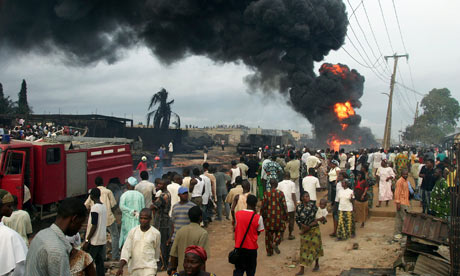
We reached the edge of the oil spill near the Nigerian village of Otuegwe after a long hike through cassava plantations. Ahead of us lay swamp. We waded into the warm tropical water and began swimming, cameras and notebooks held above our heads. We could smell the oil long before we saw it – the stench of garage forecourts and rotting vegetation hanging thickly in the air.
The farther we travelled, the more nauseous it became. Soon we were swimming in pools of light Nigerian crude, the best-quality oil in the world. One of the many hundreds of 40-year-old pipelines that crisscross the Niger delta had corroded and spewed oil for several months.
Forest and farmland were now covered in a sheen of greasy oil. Drinking wells were polluted and people were distraught. No one knew how much oil had leaked. "We lost our nets, huts and fishing pots," said Chief Promise, village leader of Otuegwe and our guide. "This is where we fished and farmed. We have lost our forest. We told Shell of the spill within days, but they did nothing for six months."
That was the Niger delta a few years ago, where, according to Nigerian academics, writers and environment groups, oil companies have acted with such impunity and recklessness that much of the region has been devastated by leaks.
In fact, more oil is spilled from the delta's network of terminals, pipes, pumping stations and oil platforms every year than has been lost in the Gulf of Mexico, the site of a major ecological catastrophe caused by oil that has poured from a leak triggered by the explosion that wrecked BP's Deepwater Horizon rig last month.
That disaster, which claimed the lives of 11 rig workers, has made headlines round the world. By contrast, little information has emerged about the damage inflicted on the Niger delta. Yet the destruction there provides us with a far more accurate picture of the price we have to pay for drilling oil today.
50 YEARS of CONTAMINATIONOn 1 May this year a ruptured ExxonMobil pipeline in the state of Akwa Ibom spilled more than a million gallons into the delta over seven days before the leak was stopped. Local people demonstrated against the company but say they were attacked by security guards. Community leaders are now demanding $1bn in compensation for the illness and loss of livelihood they suffered. Few expect they will succeed. In the meantime, thick balls of tar are being washed up along the coast.
With 606 oilfields, the Niger delta supplies 40% of all the crude the United States imports and is the world capital of oil pollution. Life expectancy in its rural communities, half of which have no access to clean water, has fallen to little more than 40 years over the past two generations.
"The oil companies just ignore it. The lawmakers do not care and people must live with pollution daily. The situation is now worse than it was 30 years ago. Nothing is changing," said the writer Ben Ikari, a member of the Ogoni people."We see frantic efforts being made to stop the spill in the US," said Nnimo Bassey, Nigerian head of Friends of the Earth International. "But in Nigeria, oil companies largely ignore their spills, cover them up and destroy people's livelihood and environments. The Gulf spill can be seen as a metaphor for what is happening daily in the oilfields of Nigeria and other parts of Africa.
"This has gone on for 50 years in Nigeria. People depend completely on the environment for their drinking water and farming and fishing.
It is impossible to know how much oil is spilled in the Niger delta each year because the companies and the government keep that secret. However, two major independent investigations over the past four years suggest that as much is spilled at sea, in the swamps and on land every year as has been lost in the Gulf of Mexico so far.
The scale of the pollution is mind-boggling. The government's national oil spill detection and response agency (Nosdra) says that between 1976 and 1996 alone, more than 2.4m barrels contaminated the environment. "Oil spills and the dumping of oil into waterways has been extensive, often poisoning drinking water and destroying vegetation. These incidents have become common due to the lack of laws and enforcement measures within the existing political regime," said a spokesman for Nosdra.
The sense of outrage is widespread. "There are more than 300 spills, major and minor, a year," said Bassey. "It happens all the year round. The whole environment is devastated. The latest revelations highlight the massive difference in the response to oil spills. In Nigeria, both companies and government have come to treat an extraordinary level of oil spills as the norm."
Other voices of protest point out that the world has overlooked the scale of the environmental impact. Activist Ben Amunwa, of the London-based oil watch group Platform, said: "Deepwater Horizon may have exceed Exxon Valdez, but within a few years in Nigeria offshore spills from four locations dwarfed the scale of the Exxon Valdez disaster many times over. Estimates put spill volumes in the Niger delta among the worst on the planet, but they do not include the crude oil from waste water and gas flares. Companies such as Shell continue to avoid independent monitoring and keep key data secret."
Worse may be to come. One industry insider, who asked not to be named, said: "Major spills are likely to increase in the coming years as the industry strives to extract oil from increasingly remote and difficult terrains. Future supplies will be offshore, deeper and harder to work. When things go wrong, it will be harder to respond."
Judith Kimerling, a professor of law and policy at the City University of New York and author of Amazon Crude, a book about oil development in Ecuador, said: "Spills, leaks and deliberate discharges are happening in oilfields all over the world and very few people seem to care."
There is an overwhelming sense that the big oil companies act as if they are beyond the law. Bassey said: "What we conclude from the Gulf of Mexico pollution incident is that the oil companies are out of control.
"It is clear that BP has been blocking progressive legislation, both in the US and here. In Nigeria, they have been living above the law. They are now clearly a danger to the planet. The dangers of this happening again and again are high. They must be taken to the international court of justice."
The price of oil contamination has exceeded the benefits of oil drilling!
Tuesday, June 1, 2010
Sunday, May 30, 2010
Unprecedented? Hardly!
Watch a compilation prepared by ThinkProgress:
On Thursday, May 27, Rep. George Miller (D-CA) responded to the myth that this catastrophe was unprecedented and thus unforeseeable:
Every time we have a catastrophic event like this involving British Petroleum or other parts of the oil and gas industry, we’re told that this is an unpredictable cascade of unforeseeable errors, that this is unprecedented, that nobody could have foreseen this. This is sort of like the bankers on Wall Street. Nobody could have foreseen the risks that they engineered themselves, so nobody’s responsible. I don’t believe this was some “black swan” or “perfect storm” event. There wasn’t something that could not have been foreseen. And I don’t think this is something you can promise will never happen again.
Inconceivable or Forseeable

In 1979, the IXTOC I was an exploratory oil well in the Bay of Campeche of the Gulf of Mexico that suffered a blowout. The 1979 blowout resulted in the second largest oil spill and the largest accidental spill in history. The largest was the Gulf War oil spill during the first Gulf War.
That is until now.
The BP blow out in the Gulf of Mexico is eerily similar.
- Like the Deepwater Horizon spill, the Ixtoc I spill on June 3, 1979, involved the failure of a blowout-preventer device, a kind of emergency shutoff valve. In both cases, metal domes put over the well failed to stop the leak.
- And as they did in Mexico, BP crews are trying to stop the spill by drilling reliever wells horizontally through the seafloor, a technique that could take months.
- Pemex and a series of U.S. contractors struggled for months to stop the leak. One company managed to close the well casing, but the oil broke through below the seal and caused another blowout. Another contractor built a dome for the well that it called the Sombrero, Spanish for hat, but oil continued to seep from cracks in the sea floor.
- In August 1979, balls of sticky tar began washing up on the hotel beaches of South Padre Island in Texas. Crews scraped them up with construction equipment and giant vacuum cleaners, and the Coast Guard stretched a net across the Port Mansfield inlet to catch submerged tar balls.
- Pemex began drilling two horizontal relief wells soon after the spill in June 1979, but they did not reach the Ixtoc I well until November, five months later. The crews used the relief wells to pump mud and steel balls into the gusher, finally capping the leak on March 25, 1980.
- BP, which owns the well in the Deepwater Horizon spill, began drilling its own relief wells on May 2 and May 16, respectively. They will take about three months to complete, the company says.
Climate Progress notes that the “I don’t think anybody” excuse has been used before.
“I don’t think anybody foresaw the circumstance that we’re faced with now.” — BP spokesman Steve Rinehart [AP 5/2/10]
However, there is evidence that this event was very foreseeable.“I don’t think anybody could have predicted that these people would take an airplane and slam it into the World Trade Center, take another one and slam it into the Pentagon; that they would try to use an airplane as a missile, a hijacked airplane as a missile.” — Condoleezza Rice [CNN, 5/16/02]
“The sort of occurrence that we’ve seen on the Deepwater Horizon is clearly unprecedented.” — BP spokesman David Nicholas [AP 4/30/10]
“I don’t think anybody anticipated the breach of the levees. They did anticipate a serious storm. But these levees got breached. And as a result, much of New Orleans is flooded. And now we are having to deal with it and will.” — President George W. Bush [GMA, 9/1/05]
BP did not build containment devices before disaster because it “seemed inconceivable” the blowout preventer would fail. — BP spokesman Steve Rinehart [AP 5/2/10]
“I don’t think anybody anticipated the level of violence that we’ve encountered. I guess the other area that I look at, in terms of an area where I think we were faced with difficulties we didn’t anticipate was the devastation that 30 years of Saddam’s rule had wrought, if you will, on the psychology of the Iraqi people.” — Vice President Dick Cheney, 6/19/06.
Failure of blowout preventers.
There is evidence that the failure of underwater blowout preventers on oil rigs is common.A 1999 report commissioned by the federal agency that oversees offshore drilling suggests failures of underwater blowout preventers designed to stop oil spills like the massive one threatening the Gulf Coast were far from unknown, the chairwoman of a key Senate panel.
Citing a Minerals Management Service report, Sen. Maria Cantwell , D- Wash. , said there were 117 failures of blowout preventers during a two-year period in the late 1990s on the outer continental shelf of the United States .
The unclassified version of the 1999 report said the failures involved 83 wells drilled by 26 rigs in depths from 1,300 feet to 6,560 feet.A similar report released by the agency in 1997 found that between 1992 and 1996 there were 138 failures of blowout preventers on underwater wells being drilled off Brazil , Norway , Italy and Albania .
Blowout preventers, which can weigh up to 500,000 pounds and stand 50 feet tall, are bolted on the top of a wellhead on the seafloor and in an emergency can cut off the flow of oil to prevent a gusher. The blowout preventers can be activated by throwing a switch on the drilling rig. They are also supposed to activate automatically in the event of a major problem or, in some cases, can be activated by acoustic sound waves produced from a ship on the surface.
No one is sure what caused the drilling rig Deepwater Horizon off the coast of Louisiana to burst into flames on April 20 and sink two days later into the Gulf. The accident left 11 workers missing and presumed dead and 17 others injured. The blowout preventer apparently failed to cap the well, allowing an estimated 210,000 gallons of oil to escape daily.
The cause of the explosion and fire is under investigation, and efforts to activate the blowout preventer 5,000 feet below the surface have, so far, been unsuccessful.
Climate Progress has a list of the forseeability factors.Failures of blowout preventers and actual blowouts are common. Between 1992 and 1998 there were 319 failures of blowout preventers found in US offshore drilling, an average of 45 a year. [MMS, 1999] Between 1992 and 2006 there were at least 39 blowouts off the US coastline, 38 of them in the Gulf of Mexico. [MMS, 7/07] From 2007 to 2009 there were 19 blowouts, all in the Gulf of Mexico. [MMS]
The largest accidental oil spill in history was a Gulf of Mexico exploratory rig blowout. On June 3, 1979, the exploratory well IXTOC I blew out and ignited, burning down the platform. Divers later activated the blowout preventer to no avail.The well continued to spill oil at a rate of 10,000 to 30,000 barrels per day until it was finally capped on March 23, 1980. [NOAA]
A major deepwater blowout followed by a two-month spill occurred in 2009. In “one of Australia’s worst oil disasters,” a PTTEP oil rig blew out in the Montara oil field on August 21, 2009. Efforts to control the leaking rig set it on fire on November 1st, two days before the leak was finally plugged. Official estimates of the leak rate were five times higher than those of the oil company. [Wikipedia]
A ’spill of national significance’ exercise in 2002 concerned a major rig blowout in the Gulf of Mexico. Adm. Thad Allen led a “spill of national significance” exercise in 2002 that dealt with the scenario of an oil rig exploding off the coast of Louisiana, with an “uncontrollable discharge” of oil that lasted for a month. These training exercises take place every three years as mandated by the 1990 Oil Pollution Act, the most recent of which occurred in March, 2010.
"I think they were either lying or incompetent. But either way,the consequences for the Gulf of Mexico are catastrophic."If history has any relevance in this man-made disaster, the notion of a quick fix is inconceivable while further incompetence is foreseeable.
"I have no confidence whatsoever in BP. I do not think they know what they are doing. .. I do not think people should really believe anything BP is saying in terms of the likelihood of anything that they are doing is going to turn out as they predicted."
"I think that without question, if the word 'criminal' should be used in terms of an environmental crime against our country, then what's going on in the Gulf of Mexico is going to qualify, yes."
Monday, May 24, 2010
Your WTF Moment!
The issue of Justice!
I guess if you live long enough you'll get to see it all.
On Thursday a federal judge gave James O'Keefe a stern talking to about his deception in entering a US Senator's office and trying to vandalize and muck about with the telephones. What could have been felony charges were reduced to misdemeanors by influential GOP lawyers previously and after the stern talking to - O'Keefe avoided trial.
Meanwhile in Georgia, a 14-year-old autistic boy with the mental function of a third-grader will face felony charges of terrorism for drawing a stick figure with a gun aimed at another stick figure with a teacher's name above it.
Sounds about right.
A guy named Rand Paul and another guy named John Stossel both agree that civil rights should not be forced upon private businesses because a free market is more effective than legislation. A free market is about freedom and freedom is about everyone having the freedom not to be free or making other people less free. Oh, both these guys think the minimum wage is a bad thing and will drive business - out of business - because paying workers a decent wage is not profitable.
Well, that makes sense.
The issue of Politics!
A CBS news crew tried to film oil hitting Louisiana shores but got stopped by BP contractors and the Coast Guard and were told BP had not given permission to be there and film. BP = British Petroleum told an American News Organization that they did not have permission to land and film on American soil. But not to worry, I read somewhere that President Obama had harsh words and a stern warning to BP to get this oil disaster taken care of - ASAP!
I guess that will teach them, eh!
The issue of Corporate Finance!
The corporations that caused the greatest financial disaster in American history have faced no criminal charges and no real changes in how they pay bonuses and perks to their executives. In fact, perks are rising. And remember that commission, looking into AIG? They said to move along now, nothing to see.
But I understand President Obama is forming a commission to look into BP about that oil disaster so that should even things out. Right? I wonder if he had to get permission from BP or Sarah Palin to do that?
I almost forgot, financial stocks rose on news of the Senate passing Financial Reform on to conference. If Wall Street likes it, how bad could it be? Like Healthcare? No.
The issue of War!
President Obama gave a commencement speech to West Point. You should read it because frankly it chilled me to the bone to hear how the wars all started, why they continue and what is ahead on the horizon - more of the same but not as much.
I don't get it.
We need a signal for distress?
How upside down is this country?
I mean, come on folks. Chris Matthews is considered a leading liberal? The guy who ranted and railed against Clinton and Gore, who fell in love with George Bush's flight suit macho package only to turn around with a thrill up his leg for Obama and now he's a liberal? The only thing liberal about Matthews is the amount of wine he pours himself on the veranda of his multi-million dollar Nantucket house.
We are literally drowning Louisiana and the Gulf Coast in oil with very little action to stop it. We got pissed at George Bush for letting New Orleans drown during Katrina and now President Obama appears reluctant to interfere with the free market of Big Oil.
This has to be your moment of: WTF, over?
We are making sure teenagers go to jail but people of privilege skate.
Corporations are god and citizens as worker bees for the greater greed.
If you want freedom, start a business. If you want civil rights, stick with your own kind. Party like it's 1951!
And be sure to thank CNN for warning us about the new Miss America with that great headline: Miss USA: Muslim Trailblazer or Hezbollah Spy?
Apparently BP hates Arizona because the free market of Big Oil hires these folks in Florida. I'm sure it has nothing to do with minimum wage or regulations or big government impeding the free market or...?
We used to hang Old Glory upside down as a signal for distress.
No need for that these days.
The only reason to hang the flag upside down is to match America.
All together now, WTF!!!!