Showing posts with label Oil Spills. Show all posts

Wednesday, June 2, 2010

The Niger Delta Environmental Catastrophes

The price we have to pay for drilling oil today.

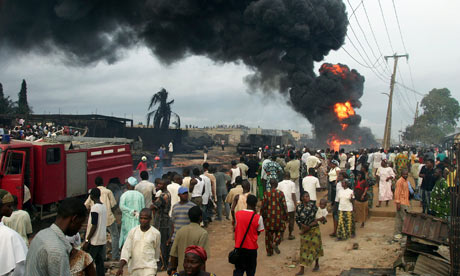
Burning pipeline, Lagos

A ruptured pipeline burns in a Lagos suburb after an explosion in 2008 which killed at least 100 people.

Photograph: George Esiri/Reuters

SHELL OIL

We reached the edge of the oil spill near the Nigerian village of Otuegwe after a long hike through cassava plantations. Ahead of us lay swamp. We waded into the warm tropical water and began swimming, cameras and notebooks held above our heads. We could smell the oil long before we saw it – the stench of garage forecourts and rotting vegetation hanging thickly in the air.

The farther we travelled, the more nauseous it became. Soon we were swimming in pools of light Nigerian crude, the best-quality oil in the world. One of the many hundreds of 40-year-old pipelines that crisscross the Niger delta had corroded and spewed oil for several months.

Forest and farmland were now covered in a sheen of greasy oil. Drinking wells were polluted and people were distraught. No one knew how much oil had leaked. "We lost our nets, huts and fishing pots," said Chief Promise, village leader of Otuegwe and our guide. "This is where we fished and farmed. We have lost our forest. We told Shell of the spill within days, but they did nothing for six months."

That was the Niger delta a few years ago, where, according to Nigerian academics, writers and environment groups, oil companies have acted with such impunity and recklessness that much of the region has been devastated by leaks.

In fact, more oil is spilled from the delta's network of terminals, pipes, pumping stations and oil platforms every year than has been lost in the Gulf of Mexico, the site of a major ecological catastrophe caused by oil that has poured from a leak triggered by the explosion that wrecked BP's Deepwater Horizon rig last month.

That disaster, which claimed the lives of 11 rig workers, has made headlines round the world. By contrast, little information has emerged about the damage inflicted on the Niger delta. Yet the destruction there provides us with a far more accurate picture of the price we have to pay for drilling oil today.

EXXONMOBIL
On 1 May this year a ruptured ExxonMobil pipeline in the state of Akwa Ibom spilled more than a million gallons into the delta over seven days before the leak was stopped. Local people demonstrated against the company but say they were attacked by security guards. Community leaders are now demanding $1bn in compensation for the illness and loss of livelihood they suffered. Few expect they will succeed. In the meantime, thick balls of tar are being washed up along the coast.
50 YEARS of CONTAMINATION
With 606 oilfields, the Niger delta supplies 40% of all the crude the United States imports and is the world capital of oil pollution. Life expectancy in its rural communities, half of which have no access to clean water, has fallen to little more than 40 years over the past two generations.

"The oil companies just ignore it. The lawmakers do not care and people must live with pollution daily. The situation is now worse than it was 30 years ago. Nothing is changing," said the writer Ben Ikari, a member of the Ogoni people.

"We see frantic efforts being made to stop the spill in the US," said Nnimo Bassey, Nigerian head of Friends of the Earth International. "But in Nigeria, oil companies largely ignore their spills, cover them up and destroy people's livelihood and environments. The Gulf spill can be seen as a metaphor for what is happening daily in the oilfields of Nigeria and other parts of Africa.

"This has gone on for 50 years in Nigeria. People depend completely on the environment for their drinking water and farming and fishing.

It is impossible to know how much oil is spilled in the Niger delta each year because the companies and the government keep that secret. However, two major independent investigations over the past four years suggest that as much is spilled at sea, in the swamps and on land every year as has been lost in the Gulf of Mexico so far.
TOTAL DEVASTATION

The scale of the pollution is mind-boggling. The government's national oil spill detection and response agency (Nosdra) says that between 1976 and 1996 alone, more than 2.4m barrels contaminated the environment. "Oil spills and the dumping of oil into waterways has been extensive, often poisoning drinking water and destroying vegetation. These incidents have become common due to the lack of laws and enforcement measures within the existing political regime," said a spokesman for Nosdra.

The sense of outrage is widespread. "There are more than 300 spills, major and minor, a year," said Bassey. "It happens all the year round. The whole environment is devastated. The latest revelations highlight the massive difference in the response to oil spills. In Nigeria, both companies and government have come to treat an extraordinary level of oil spills as the norm."

ENVIRONMENTAL IMPACT

Other voices of protest point out that the world has overlooked the scale of the environmental impact. Activist Ben Amunwa, of the London-based oil watch group Platform, said: "Deepwater Horizon may have exceed Exxon Valdez, but within a few years in Nigeria offshore spills from four locations dwarfed the scale of the Exxon Valdez disaster many times over. Estimates put spill volumes in the Niger delta among the worst on the planet, but they do not include the crude oil from waste water and gas flares. Companies such as Shell continue to avoid independent monitoring and keep key data secret."

Worse may be to come. One industry insider, who asked not to be named, said: "Major spills are likely to increase in the coming years as the industry strives to extract oil from increasingly remote and difficult terrains. Future supplies will be offshore, deeper and harder to work. When things go wrong, it will be harder to respond."

Judith Kimerling, a professor of law and policy at the City University of New York and author of Amazon Crude, a book about oil development in Ecuador, said: "Spills, leaks and deliberate discharges are happening in oilfields all over the world and very few people seem to care."

There is an overwhelming sense that the big oil companies act as if they are beyond the law. Bassey said: "What we conclude from the Gulf of Mexico pollution incident is that the oil companies are out of control.

"It is clear that BP has been blocking progressive legislation, both in the US and here. In Nigeria, they have been living above the law. They are now clearly a danger to the planet. The dangers of this happening again and again are high. They must be taken to the international court of justice."

The price of oil contamination has exceeded the benefits of oil drilling!

Sunday, May 30, 2010

Inconceivable or Forseeable


In 1979, the IXTOC I was an exploratory oil well in the Bay of Campeche of the Gulf of Mexico that suffered a blowout. The 1979 blowout resulted in the second largest oil spill and the largest accidental spill in history. The largest was the Gulf War oil spill during the first Gulf War.

That is until now.

The BP blow out in the Gulf of Mexico is eerily similar.
- Like the Deepwater Horizon spill, the Ixtoc I spill on June 3, 1979, involved the failure of a blowout-preventer device, a kind of emergency shutoff valve. In both cases, metal domes put over the well failed to stop the leak.
- And as they did in Mexico, BP crews are trying to stop the spill by drilling reliever wells horizontally through the seafloor, a technique that could take months.

- Pemex and a series of U.S. contractors struggled for months to stop the leak. One company managed to close the well casing, but the oil broke through below the seal and caused another blowout. Another contractor built a dome for the well that it called the Sombrero, Spanish for hat, but oil continued to seep from cracks in the sea floor.

- In August 1979, balls of sticky tar began washing up on the hotel beaches of South Padre Island in Texas. Crews scraped them up with construction equipment and giant vacuum cleaners, and the Coast Guard stretched a net across the Port Mansfield inlet to catch submerged tar balls.

- Pemex began drilling two horizontal relief wells soon after the spill in June 1979, but they did not reach the Ixtoc I well until November, five months later. The crews used the relief wells to pump mud and steel balls into the gusher, finally capping the leak on March 25, 1980.

- BP, which owns the well in the Deepwater Horizon spill, began drilling its own relief wells on May 2 and May 16, respectively. They will take about three months to complete, the company says.
Despite these similarities, BP officials are claiming that the apocalyptic failure of its deepwater exploratory rig was unforeseeable, unprecedented and inconceivable.

Climate Progress notes that the “I don’t think anybody” excuse has been used before.

“I don’t think anybody foresaw the circumstance that we’re faced with now.” — BP spokesman Steve Rinehart [AP 5/2/10]

“I don’t think anybody could have predicted that these people would take an airplane and slam it into the World Trade Center, take another one and slam it into the Pentagon; that they would try to use an airplane as a missile, a hijacked airplane as a missile.” — Condoleezza Rice [CNN, 5/16/02]

“The sort of occurrence that we’ve seen on the Deepwater Horizon is clearly unprecedented.” — BP spokesman David Nicholas [AP 4/30/10]

“I don’t think anybody anticipated the breach of the levees. They did anticipate a serious storm. But these levees got breached. And as a result, much of New Orleans is flooded. And now we are having to deal with it and will.” — President George W. Bush [GMA, 9/1/05]

BP did not build containment devices before disaster because it “seemed inconceivable” the blowout preventer would fail. — BP spokesman Steve Rinehart [AP 5/2/10]

“I don’t think anybody anticipated the level of violence that we’ve encountered. I guess the other area that I look at, in terms of an area where I think we were faced with difficulties we didn’t anticipate was the devastation that 30 years of Saddam’s rule had wrought, if you will, on the psychology of the Iraqi people.” — Vice President Dick Cheney, 6/19/06.

However, there is evidence that this event was very foreseeable.
Failure of blowout preventers.

There is evidence that the failure of underwater blowout preventers on oil rigs is common.
A 1999 report commissioned by the federal agency that oversees offshore drilling suggests failures of underwater blowout preventers designed to stop oil spills like the massive one threatening the Gulf Coast were far from unknown, the chairwoman of a key Senate panel.

Citing a Minerals Management Service
report, Sen. Maria Cantwell , D- Wash. , said there were 117 failures of blowout preventers during a two-year period in the late 1990s on the outer continental shelf of the United States .

The unclassified version of the 1999 report said the failures involved 83 wells drilled by 26 rigs in depths from 1,300 feet to 6,560 feet.

A similar report released by the agency in 1997 found that between 1992 and 1996 there were 138 failures of blowout preventers on underwater wells being drilled off Brazil , Norway , Italy and Albania .

Blowout preventers, which can weigh up to 500,000 pounds and stand 50 feet tall, are bolted on the top of a wellhead on the seafloor and in an emergency can cut off the flow of oil to prevent a gusher. The blowout preventers can be activated by throwing a switch on the drilling rig. They are also supposed to activate automatically in the event of a major problem or, in some cases, can be activated by acoustic sound waves produced from a ship on the surface.

No one is sure what caused the drilling rig Deepwater Horizon off the coast of Louisiana to burst into flames on April 20 and sink two days later into the Gulf. The accident left 11 workers missing and presumed dead and 17 others injured. The blowout preventer apparently failed to cap the well, allowing an estimated 210,000 gallons of oil to escape daily.

The cause of the explosion and fire is under investigation, and efforts to activate the blowout preventer 5,000 feet below the surface have, so far, been unsuccessful.

Climate Progress has a list of the forseeability factors.

Failures of blowout preventers and actual blowouts are common. Between 1992 and 1998 there were 319 failures of blowout preventers found in US offshore drilling, an average of 45 a year. [MMS, 1999] Between 1992 and 2006 there were at least 39 blowouts off the US coastline, 38 of them in the Gulf of Mexico. [MMS, 7/07] From 2007 to 2009 there were 19 blowouts, all in the Gulf of Mexico. [MMS]

The largest accidental oil spill in history was a Gulf of Mexico exploratory rig blowout. On June 3, 1979, the exploratory well IXTOC I blew out and ignited, burning down the platform. Divers later activated the blowout preventer to no avail.The well continued to spill oil at a rate of 10,000 to 30,000 barrels per day until it was finally capped on March 23, 1980. [NOAA]

A major deepwater blowout followed by a two-month spill occurred in 2009. In “one of Australia’s worst oil disasters,” a PTTEP oil rig blew out in the Montara oil field on August 21, 2009. Efforts to control the leaking rig set it on fire on November 1st, two days before the leak was finally plugged. Official estimates of the leak rate were five times higher than those of the oil company. [Wikipedia]

A ’spill of national significance’ exercise in 2002 concerned a major rig blowout in the Gulf of Mexico. Adm. Thad Allen led a “spill of national significance” exercise in 2002 that dealt with the scenario of an oil rig exploding off the coast of Louisiana, with an “uncontrollable discharge” of oil that lasted for a month. These training exercises take place every three years as mandated by the 1990 Oil Pollution Act, the most recent of which occurred in March, 2010.

Rachel Maddow shows how the BP disaster is very similar to previous events. WATCH:


In an appearance on "Face The Nation," Rep. Ed Markey (D-Mass.), chairman of a House energy committee investigating the oil spill, put into context BP's response to the Gulf disaster.
"I think they were either lying or incompetent. But either way,the consequences for the Gulf of Mexico are catastrophic."

"I have no confidence whatsoever in BP. I do not think they know what they are doing. .. I do not think people should really believe anything BP is saying in terms of the likelihood of anything that they are doing is going to turn out as they predicted."

"I think that without question, if the word 'criminal' should be used in terms of an environmental crime against our country, then what's going on in the Gulf of Mexico is going to qualify, yes."
If history has any relevance in this man-made disaster, the notion of a quick fix is inconceivable while further incompetence is foreseeable.

Monday, May 24, 2010

Your WTF Moment!

Republican video activist James O'Keefe on FoxNews, 01/26/10.  (image: FoxNews)
Republican video activist James O'Keefe on FoxNews, 01/26/10. (image: FoxNews)

John Cory shows the incongruity of too many situations.

The issue of Justice!

I guess if you live long enough you'll get to see it all.

On Thursday a federal judge gave James O'Keefe a stern talking to about his deception in entering a US Senator's office and trying to vandalize and muck about with the telephones. What could have been felony charges were reduced to misdemeanors by influential GOP lawyers previously and after the stern talking to - O'Keefe avoided trial.

Meanwhile in Georgia, a 14-year-old autistic boy with the mental function of a third-grader will face felony charges of terrorism for drawing a stick figure with a gun aimed at another stick figure with a teacher's name above it.

Sounds about right.

The issue of Money!

A guy named Rand Paul and another guy named John Stossel both agree that civil rights should not be forced upon private businesses because a free market is more effective than legislation. A free market is about freedom and freedom is about everyone having the freedom not to be free or making other people less free. Oh, both these guys think the minimum wage is a bad thing and will drive business - out of business - because paying workers a decent wage is not profitable.

Well, that makes sense.

The issue of Politics!

A CBS news crew tried to film oil hitting Louisiana shores but got stopped by BP contractors and the Coast Guard and were told BP had not given permission to be there and film. BP = British Petroleum told an American News Organization that they did not have permission to land and film on American soil. But not to worry, I read somewhere that President Obama had harsh words and a stern warning to BP to get this oil disaster taken care of - ASAP!

I guess that will teach them, eh!

The issue of Corporate Finance!

The corporations that caused the greatest financial disaster in American history have faced no criminal charges and no real changes in how they pay bonuses and perks to their executives. In fact, perks are rising. And remember that commission, looking into AIG? They said to move along now, nothing to see.

But I understand President Obama is forming a commission to look into BP about that oil disaster so that should even things out. Right? I wonder if he had to get permission from BP or Sarah Palin to do that?

I almost forgot, financial stocks rose on news of the Senate passing Financial Reform on to conference. If Wall Street likes it, how bad could it be? Like Healthcare? No.

The issue of War!

President Obama gave a commencement speech to West Point. You should read it because frankly it chilled me to the bone to hear how the wars all started, why they continue and what is ahead on the horizon - more of the same but not as much.

I don't get it.

We need a signal for distress?

How upside down is this country?

I mean, come on folks. Chris Matthews is considered a leading liberal? The guy who ranted and railed against Clinton and Gore, who fell in love with George Bush's flight suit macho package only to turn around with a thrill up his leg for Obama and now he's a liberal? The only thing liberal about Matthews is the amount of wine he pours himself on the veranda of his multi-million dollar Nantucket house.

We are literally drowning Louisiana and the Gulf Coast in oil with very little action to stop it. We got pissed at George Bush for letting New Orleans drown during Katrina and now President Obama appears reluctant to interfere with the free market of Big Oil.

This has to be your moment of: WTF, over?

We are making sure teenagers go to jail but people of privilege skate.

Corporations are god and citizens as worker bees for the greater greed.

If you want freedom, start a business. If you want civil rights, stick with your own kind. Party like it's 1951!

And be sure to thank CNN for warning us about the new Miss America with that great headline: Miss USA: Muslim Trailblazer or Hezbollah Spy?

Apparently BP hates Arizona because the free market of Big Oil hires these folks in Florida. I'm sure it has nothing to do with minimum wage or regulations or big government impeding the free market or...?

We used to hang Old Glory upside down as a signal for distress.

No need for that these days.

The only reason to hang the flag upside down is to match America.

All together now, WTF!!!!

Wednesday, May 19, 2010

Limited Liability Bailout


Via Crooks and Liars:
Senate Republicans have stalled legislation that would require oil companies to pay fully for their accidents. Listen to Senator Inhofe (R-Oil Companies) push for Big Oil's ability to make obscene profits over safety:

You gotta love how these "Oh noes! Obama wants us to be socialists!" Republicans have no problem with a multi-national oil company privatizing their profits and socializing their costs. Why aren't the protesters who scream about bailouts not screaming about this?

Obama made a statement expressing his frustration:

"I am disappointed that an effort to ensure that oil companies pay fully for disasters they cause has stalled in the United States Senate on a partisan basis. This maneuver threatens to leave taxpayers, rather than the oil companies, on the hook for future disasters like the BP oil spill. I urge the Senate Republicans to stop playing special interest politics and join in a bipartisan effort to protect taxpayers and demand accountability from the oil companies.”

Transocean Ltd . , the owner of the rig leased by BP which is currently leaking oil into the Gulf of Mexico, has received $270 million in profit from insurance payouts after the disaster.

The amount, revealed during a conference call to analysts, was made because its insurance policy for Deepwater Horizon rig was greater than the value of the rig itself, the Sunday Times reports. The Times says Transocean has already received cash payment of $401 million and the rest is due in the coming weeks.

Unbelievable. Of course, that money has been turned around as part of a nice, fat $1B dividend to stockholders.
Rand Paul who just won the primary in Kentucky for the Republican Senate nomination recently spoke about the the bank bailout in an interview with Neil Cavuto.
We, as Republicans, don’t believe in bailing out failed businesses, much less about having the government [owning them]....
Rand Paul while proposing no bailout, also proposes to "cut regulations on bankers, health insurance companies and oil drillers."

If Paul doesn't support regulation but at the same time he also doesn't support bailouts, then what is his position on lifting
the liability cap on oil companies.

Sunday, May 16, 2010

Hoping for an 'Outside of the Box' Solution


Scientists tapped by the Obama administration to help fix the Gulf Coast oil spill.
From left to right: Richard Garwin, Tom Hunter, Alexander Slocum, Jonathan Katz and George Cooper

Via TPM: Mission Impossible: Obama Taps Crack Team Of Scientists To Do The Job BP Can't

President Obama's new plan to fix the Gulf oil spill is so crazy it just might work...

As BP's high-priced industry experts flail, the president has turned to a rag-tag band of big-think scientific renegades, and sent them on a mission to somehow MacGyver a way to stop up the leak -- before it's too late.

OK, maybe that's going a bit far. In fact, the news that Obama and his energy secretary, Steven Chu, have sent a team of leading physicists and engineers to the Gulf to work with BP offers further evidence of the administration's essentially technocratic approach to governance, and its faith in knowledge-based expertise. That might seem like common sense, but it represents a shift from the Bushies' faith in the problem-solving power of industry, and its willingness to let science take a backseat to the concerns of its religious base.

Still, asking one of the key inventors of the hydrogen bomb, along with an engineer who helped develop techniques for mining on Mars, counts as out-of-the-box thinking. Here's a quick rundown on the president's unlikely team:

The Old Hand: Richard Garvin

In 1951, 23-year old Richard Garwin was working at the Los Alomos nuclear laboratory,
when he was asked by Edward Teller to devise an experiment that would demonstrate the principle of "radiation implosion." Garwin's detailed sketch served as the basis for "Mike," an 80-ton device, that was detonated the following year as the world's first hydrogen bomb. "I wasn't the inventor," Garwin has said. "I was sort of the architect." In 1952, Garwin went to work for IBM -- where he remains a fellow emeritus -- on the understanding that he could spend a third of his time working with the federal government on national security issues. He's a recipient of the national medal of science, and a member of the JASON, an elite think tank that studies complex scientific problems on behalf of the U.S. government. In 1991, Garwin convened a symposium of experts to discus ways to stem oil flows from Kuwait wells, set on fire by Iraq during the Gulf War. For Garwin, now 82, could this be his last hurrah?

The Establishment Man: Tom Hunter

Tom Hunter yesterday announced his resignation as the president of Sandia National Laboratories, an outpost of the U.S. nuclear weapons complex that conducts high-level research for the National Nuclear Security Administration. He had been at Sandia since 1967, and served as president since 2005 -- a job that reportedly paid him $1.7 million a year. He has a Ph.D. in Nuclear Engineering from the University of Wisconsin. Hunter said yesterday he had no particular plans for what he'd be doing in retirement. That may have changed.

The Maverick Genius: Alexander Slocum

Alexander Slocum, a professor of mechanical engineering at Massachusetts Institute of Technology, teaches a world famous design and manufacturing class that culminates in a remote-controlled robot competition. He holds more than 60 patents for inventions relating to biotechnology, robotics and computer science, but his research interests also include "going faster on my snowboard, staying down longer SCUBA diving!," according to his website. A colleague told Bloomberg: "He has a lot of creative ideas. One in 10 are really brilliant ideas, but nine are dumb. You can't miss that one that is brilliant." Here's hoping genius strikes in the Gulf.

The No-Nonsense Engineer: George Cooper

George Cooper might have the most relevant experience for the mission at hand. A professor of engineering at UC Berkely, he spent much of his career in industrial research with Britain's National Physical Laboratory and now serves as Senior Petroleum Engineer at DOE's Lawrence Berkeley Laboratory. But he can branch out too: According to Bloomberg, he once worked with the National Aeronautics and Space Administration to adapt mining techniques for use on Mars.

The What-Am-I-Doing-Here? Guy: Jonathan Katz


Jonathan Katz, a physics professor at Washington University in St. Louis, is another member of JASON. But Katz's major research focus has been astrophysics, and in an interview today with a St. Louis paper -- conducted upon his return from a quick trip to the Gulf region -- he didn't seem confident that he had been much help with the mission. "I was honored to be invited and enjoyed the experience," said Katz. "Did I have anything much to contribute? I think I have some ideas for how to prevent this kind of thing from happening in the future, but I don't have anything very specific to offer on the present problems. It is very much in the hands of the real pros." Asked if he'd be willing to go back, Katz said: "I'd be happy to, but someone's got to send me an email or a phone call."

Time is of the essence!