Showing posts with label Insurance Companies. Show all posts

Saturday, March 27, 2010

The Negative of For Profit Healthcare

Newborn with Birth Defect Denied Coverage

Health Care Provider Tells Texas Family Baby's Artery Problem is a Pre-Existing Condition; Won't Pay for Surgery

(CBS) For newborn Houston Tracy, the historic health care overhaul came too late.

Houston, born March 15 at a Texas hospital, suffers from a defect in his arteries. When his parents, Doug and Kim, applied to have his corrective surgery covered under their insurance, they were denied, with their carrier claiming Houston had a pre-existing condition, reports CBS station KTVT.

The Tracys are fighting the decision by Blue Cross and Blue Shield of Texas.

"They kept saying it's preexisting, it's preexisting, but I don't know how it can be preexisting on a baby that was just born," Doug Tracy said. "If it's mandated that everyone have health insurance, than how can one be denied?"

Legislation passed this week by Congress and signed by President Obama that would end the practice of denying coverage to patients with pre-existing conditions does not go into effect until September.

The congenital heart defect causes the two major vessels that carry blood away from the heart to become switched.

"He was born with what's called transposition of the great arteries," Doug Tracy said. "It's heart wrenching; I hated it."

The Tracy's are both small business owners and do not carry health insurance for themselves. They do carry insurance on their two other children and tried to get insurance for Houston, but they found out Wednesday his coverage was denied.

The health care provider declined to comment specifically on the Tracys' case, and released this statement to KTVT:

"We will work closely with our customers to keep them informed of any changes that may result from the new law. We will continue to review the bill's requirements on our business and their respective time frames to ensure full compliance."

The Forth Worth Star-Telegram received this explanation from Blue Cross Blue Shield of Texas:

Our policy is that if a family has existing coverage with us, a baby can be added to the contract within 31 days without the need for underwriting to assess the baby's eligibility."

The condition Houston has is rarely detected before birth.

"My whole pregnancy was simple, it was easy, no complications, doctor visits were great," Houston's mother, Kim Tracy, said. "Perfect sonograms, great little pictures and then, he wasn't perfect."

Houston had life-saving surgery at Cook's Children's Medical Center in Fort Worth shortly after being born.

"He's doing really good," his mother said with a smile. "he's a little tough guy."

Why aren't all the right-wing anti-government people who believe that health reform legislation will get between them and their doctor not upset and screaming and holding rallies that insurance companies are truly the clog in the wheel of health care?

I don't get it!

Tuesday, March 2, 2010

The Insurance Money Game


Insurance companies have been raising the cost of premiums and blaming the hike on medical costs. Firedoglake [FDL] shows how the insurance companies are lying to the American public.

The insurance companies have been taking an incredible amount of heat lately for their stunning rate increases. Anthem kicked things off with their 39% increases in California, but these were not isolated hikes. WellPoint, Anthem’s parent company, is increasing rates by double digits in at least 11 states. And other big insurance companies are hiking rates in at least half a dozen more states.

Insurance company CEOs have been called to testify before Congress, with more hearings to come. This has put the industry on the defensive and they’ve taken to the media to deflect criticism and explain their rate hikes. Their spin centers on one talking point, elucidated by Angela Braly, CEO of WellPoint, in today’s Wall Street Journal:

WellPoint Inc. Chief Executive Angela Braly is facing her biggest test yet as the nation’s largest health insurer comes under fire for its plans to raise rates as much as 39% in California.

So far, Ms. Braly has chosen to fight back. Instead of issuing a Toyota-style apology, she is turning her critics’ argument around, citing rising health-care costs driven by doctors and hospitals, which she says aren’t addressed by current health-overhaul bills.

The strategy, on display last week during a contentious House hearing focused on the rate increase, could get another airing Wednesday, when Ms. Braly and other top health-insurance executives are expected to appear before the Obama administration’s top health official to discuss health-care premiums.

The idea that insurance rate hikes are driven by increases in the underlying cost of medical care has also been pushed by AHIP, the insurance industry’s top lobbying front group.

Given the health insurance industry’s duplicity on everything having to do with the health care system and their role in it, it shouldn’t surprise anyone to find out that this talking point is a straight up lie.

A new report from Health Care for America Now sets the facts straight [pdf]. As Richard Kirsch, National Campaign Director, explained to reporters on a call today:

From 2000 to 2008, insurance premiums went up 97% for families and 90% for individuals. In the same time period, payments to providers like hospitals and doctors only went up 72%. Even worse, underlying medical inflation, calculated from the Consumer Price Index, went up only 39%.

In short, over the last eight years premiums almost doubled, but medical inflation went up only 40%. Premiums rose two times faster, and over three times faster than wages, which only rose 29% in the same time period. [...]

So while it’s true the cost of medical care is rising faster than inflation, and it’s also true doctors and hospitals are making more profit than they used to (the difference between medical inflation and what insurance companies pay to doctors), insurance companies are raising their rates much faster than even that - over 20% faster than the amount they are paying doctors and two times the amount the underlying cost of care is rising.

To put it another way, insurance companies are making more profit than ever (and they are making record profits) because they are raising their prices faster than their costs.

These rate increases are all part of the insurance industry’s plan to squeeze more profit out of your premium dollars.

The underlying cost of medical care is not driving insurance rate hikes. Greed is the singular driving factor at work. And our health care system must be reformed to fix this glaring, deadly problem.

UPDATE

The insurance companies have fired back, taking issue with the data used to determine the rate at which health insurance rates have climbed. To determine these rate increases, the report used data from the Kaiser Family Foundation, the gold standard for this type of informationgoing back many years. It goes without saying that we stand by the data and the report’s conclusion.

Which means they have more money to spend on perks. For example, Anthem spent $27 million on 103 executive retreats to places like Hawaii in 2007 and 2008 alone. In fact according to the report, from 2000 to 2008 insurance companies spent $716.4 billion of premium dollars on administrative costs, CEO salaries, and investor profit, almost enough to pay for the entire health reform bill.

It's time to change the system and take the profit out of health care.

Tuesday, February 9, 2010

When Life is Sacred and When It's Not!


The right-wing, Sarah Palin, Rep. Michelle Bachman, Limbaugh and Glenn were claiming that Obama's health care plan would bring on 'death panels.' They were trying to scare the public into believing that any changes to the present health care system, by the Democrats, would be a threat to their lives. Of course, their claims were bogus.


But in reality, there are real 'death panels.'They are the insurance companies whose decisions override the treating doctor's decision on whether a drug or procedure is medically necessary. These death panels/insurance companies are already working to deprive needed care to patients.

Via Think Progress
The United States is the only industrialized nation without cradle-to-the-grave, universal health care. In no other developed country would a child with cancer have to go without care because an insurance company decided it was not profitable enough to cover him.

Kyler Van Nocker has neuroblastoma, which is a very rare form of childhood cancer that targets the nervous system and creates tumors throughout the body.

Unfortunately, his health insurer, HealthAmerica, refused to pay for one form of treatment doctors believe could save his life (MIBG treatment) because they consider it “investigational/experimental” since it has yet to be approved by the FDA.

Yet in April 2008, the insurer approved cheaper treatment for Van Nocker that was also “experimental,” prompting Philadelphia Daily News columnist Ronnie Polaneczky to ask, “So why, pray tell, is HealthAmerica playing the ‘experimental therapy’ card in the case of the MIBG treatment Kyler now needs? Gee, money couldn’t have anything to do with the decision, could it?”
Here's a recap:
The insurance company, HealthAmerica, is denying treatment to Kyler, a 5 year old boy with cancer. Kyler's doctors say this treatment is medically necessary to save his life. Otherwise, he will die! HealthAmerica says this treatment is "experimental" but had previously approved a cheaper experimental treatment that put Kyler's cancer in remission for 1 year.

The death panel fury was over doctors being paid for the time they spent to discuss end-of-life issues with patients. The doctors weren't denying any care to their patients. The doctors weren't denying any treatment to their patients.

The denial of treatment by an insurance company to a 5 year old boy with cancer will most probably result in the death of the child.
Where is the rage of Palin, Bachman, the Tea Baggers and the right-wing over the denial of treatment for a child...for that matter for anyone. Why wouldn't they want to change a system that is completely broken and ineffective. Don't they believe that every life is sacred?

UPDATE: The MIBG is working.

Children's Hospital, where Kyler receives much of his care, proceeded with two rounds of MIBG therapy for Kyler - at a cost of $110,000 - despite the VanNockers' inability to pay for it. (CHOP hopes that HealthAmerica will reconsider or that Medicaid will cover the MIBG cost; the VanNockers are Medicaid-eligible because they are bankrupt by medical costs).

That doesn't mean Kyler is out of the woods. His serious diagnosis ensures that his prognosis will always be uncertain.

But for now, because his internationally renowned neuroblastoma doctors, not his insurance company, is making the medical decisions, Kyler might make it to his sixth birthday in November.

Saturday, December 19, 2009

Pros & Cons of Senate Healthcare Bill


The Democrats now have 60 votes for Health Care Bill. As with the debate over the technicalities of the bill, there are varied opinions on the effectiveness of this legislation.

Howard Dean, Keith Olbermann and Markos Moulitsas (that's Kos, of DailyKos) are opposed to this version of the health care bill.
Dr. Howard Dean says this is "basically the Mitt Romney bill in Massachusetts except it doesn't insure as high a percentage of people." Dean reiterates his view that it is necessary to kill the Senate bill and start all over.

Keith Olbermann says, "The men of the current moment have lost to the mice of history...They must now not make the defeat worse by passing a hollow shell of a bill for the sake of a big signing ceremony...President Obama...Sir, kill this mutated version of the bill."

Kos says that Massachusetts is an "example of a state with mandates, but no cost control. And the results, thus far, aren't encouraging. Monopolies don't make a habit of passing on the savings to consumers without being forced to by 1) government regulations, or 2) real competition. We have neither in this Senate bill...So not only does a mandate-centric health "reform" plan not control costs, but also continues to leave people it pretends to cover in the dust, too poor to afford steep co-pays and deductibles. Bravo, Senate Democrats. It's hard to see how you could screw this up any worse...
Firedoglake thinks this bill is even more insidious with Emperor Ben Nelson to Women: All Your Uterus Are Belong to Me.

graphic: twolf1

graphic: twolf1

Robert Reich says that We are Slouching Toward Health Care Reform.
We are slouching toward health-care reform that's better than nothing but far worse than we had imagined it would be. Even those of us who have seen legislative sausage-making up close, even those of us who never make the perfect the enemy of the better, are concerned. That two or three senators are able to extort as much as they have is appalling. Why hasn't Reid forced much of the bill into reconciliation, requiring only 51 votes? Why has the President been so cowed? In all likelihood, the White House and the Dems eventually will get a bill they can call "reform," but they will not be able to say with straight faces that the reform is a significant improvement over the terrible system we already have.

On Bill Moyers Journal, Robert Kuttner of the American Prospect and Matt Taibbi of Rolling Stone both agree that the Senate health care bill is a bad one. But Kuttner believes the bill should pass, while Taibbi thinks it should be killed."

BILL MOYERS: Yes or no. If you were a senator, would you vote for this Senate health care bill?

MATT TAIBBI: No.

BILL MOYERS: Bob?

ROBERT KUTTNER: Yes.

The video is a must see. Here's the full transcript; here's the full video.

Thursday, December 17, 2009

not Health, not Care, not Reform

Keith Olbermann's Special comment on HR 3590 the Senate Health Care Reform Bill.

Visit msnbc.com for breaking news, world news, and news about the economy


A few nuggets of Olbermann sanity:
The men of the current moment have lost to the mice of history.

They must now not make the defeat worse by passing a hollow shell of a bill for the sake of a big signing ceremony.

They've done it for the money, lots and lots of money.

The American insurance cartel is the 'Death Panel' and this Senate bill does nothing to destroy it.

Pre-existing conditon...you know 'Being Alive!'

Who do we have to blame for this? There are enough villans to go around. Grassley (R-IA)...DeMint (R-SC), Baucus (D-MT), Nelson (D-NE)...for lots and lots of money..and Lieberman (I-CN)...has become a Senatorial prostitute.

And sadly, the President of the United States has not provided the leadership his office demands.

Mr. President, the line between compromise and compromised is a thin one.

Sir, if they're going to call you a socialist no matter what you do, you have been given full unfettered freedom to do what you know is just.

So why not give the haters, as the saying goes, something to cry about?

...this is the equivalent of medical mobster protection money.

This bill is less fetish and more bondage.

President Obama...Sir, kill this mutated version of the bill.

The golden rule of heath care reform...First, 'Do No Harm.'

Monday, November 23, 2009

The Real Culprits are the Insurance Companies


The Republicans, the teabaggers, the cable pundits, Fox News and the the wing-nuts have been basing part of their argument against a public option on a tale of fear and deception. They are promoting the idea that Congress and the government will get in between you and your doctor and therefore, will make crucial life and death decisions. This is just an off-shoot of the "death panel" farce.


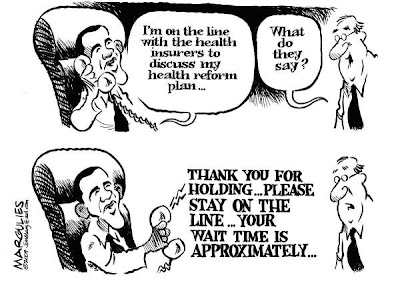
The truth is that right now health insurers stand between patients and their doctors.
One of the most common right-wing memes used by opponents of health care reform is that progressive solutions to America’s health care problems place “Washington bureaucrats firmly between you and your doctor.” Again and again, conservatives have deployed this meme to demagogue the health care debate.

However, the reality is there already is someone standing between you and your doctor: health insurance companies. Single mother Ellen Hayden knows this from experience. After losing her mother at the age of 7 from breast cancer, Hayden has done everything she can to get regular mammograms. Following an abnormal mammogram, her doctor recommended that she have an MRI. After the scan, her insurer, Blue Cross Blue Shield, refused to pay for the procedure and is also refusing to pay for a follow-up second MRI her doctor has suggested.

Ned Helms, a former health insurance industry executive who now works at the University of New Hampshire, told Sea Coast Online that this is Hayden’s case is an example of “insurance people” getting between patients and their doctors:

“It’s understandable that this is an emotional issue because most patients believe that ‘nothing is going to stand between me and what I want to get done,’” said Ned Helms, a former health insurance industry executive and director of the N.H. Institute of Health Policy and Practice at the University of New Hampshire. [...]

“We have this notion in our political debate and popular culture that we can’t have reform because that means that government bureaucrats will make decisions but we already have insurance people playing that role,” said Helms.
Helms went on to say that one of the major obstacles to attaining proper reform is the way insurance companies often “write their own rules for the road.” Late last year, former Cigna executive Wendell Potter left his 15-year career at the major health insurer and joined the fight for universal health care. He told Bill Moyers last July that politicians who warn about the government getting between patients and their doctors are “ideologically aligned with the [health insurance] industry.”
It is time for the Democrats to change the frame.

Where are they? Oh that's right they're trying to get Republicans to join them in a bipartisan way. Which means that the Democrats will negotiate away most of what is important to change our present 'for-profit' healthcare system where the insurance companies write all the rules.

Tuesday, August 4, 2009

OLBERMANN: Not 'Blue Dogs'...Just 'DOGS'

Olbermann On Health Care Reform: Legislators for Sale!


Speaking to the Blue Dogs collectively:

I warn you all. You were not elected to create a Democratic majority.

You were elected to restore this country.You were not elected to serve the corporations and the trusts who the government has enabled for the last eight years.

You were elected to serve the people.

And if you fail to pass or support this legislation, the full wrath of the progressive and the moderate movements in this country will come down on your heads. Explain yourselves not to me, but to them.

They elected you, and in the blink of an eye, they will replace you.

If you will behave as if you are Republicans - as if you are the prostitutes of our system - you will be judged as such.

And you will lose not merely our respect. You will lose your jobs!

Every poll, every analysis, every vote, every region of this country supports health care reform, and the essential great leveling agent of a government-funded alternative to the unchecked duopoly of profiteering private insurance corporations.

Cross us all at your peril...

Crooks & Liars has the story: Calling Blue Dogs Out!

From Countdown Aug. 3, 2009, Keith's Special Comment on health care reform. Michael Moore wrote this today about the Special Comment:

It is nothing short of brilliant -- and if all of America were to hear what he is going to reveal tonight, we are certain the vast majority of Americans would be on the phone to their elected representative immediately, calling for an end to the private, for-profit, rip-off health insurance companies who have wrecked our country.

Olbermann writes:

Tonight I will present what I believe is the longest Special Comment I have ever aired, naming names and citing dollar amounts to call out the politicians -- Republicans and Democrats alike -- who are paid by the Health Care Monopolies to bring to life one of my favorite quotes, the observation of the Belgian essayist Maurice Maeterlinck...

Some of the highlights.

PBS pointed out that the health and insurance industries are spending more than a million, 400 thousand dollars a day, just to destroy the "public option" - the truly non-profit, wieldy, round-up and not round-down, government, from helping you pay your medical bills with about a billionth of the recklessness with which it is still paying Halliburton and its spinoffs to kill your kids.

And much of this money is going to, and through, Republicans. But that's the real point tonight. Not all of it is going through Republicans...

[.....]

Congressman Mike Ross of Arkansas.Leader of the Blue Dogs in the House. You're the guy demanding a guarantee that Reform won't add to the deficit. I'm guessing you forgot to demand that about, say, Iraq.
You're a Democrat, you say, Congressman?

You saw what Sandy Barham said? Sandy Barham is 62 years old, she's got a bad heart, and she's hoping her valves will hold together for three more years until Medicaid kicks in, because she can't afford insurance. Not just for herself, mind you. For her employees. She needs the public option. So do those six people who work at that restaurant of hers, Congressman Ross. And why should you give a crap?

Because Sandy Barham's restaurant is the Broadway Railroad Café, and it is at 123 West First Street North in Prescott, Arkansas.
Prescott, Arkansas, Congressman Ross.

Your home town. You are Sandy Barham's congressman. Hers, Sir. Not Blue Cross's and Blue Shield's, even if they do insure 75 percent of the state and they own you.


Monday, August 3, 2009

How Corporate Media has Helped the GOP and the Blue Dog Dems


Joshua Holland thinks that the health care debate has been hijacked by the health care industry as well as the Republicans and the Blue Dog Democrats. Then corporate media successfully spreads their "frame" of the debate.
Tragically, Republicans, the health care industry and business-friendly "Blue Dog" Democrats have largely been able to frame the terms of the debate, with a substantial assist from the corporate-owned media.

They've successfully focused the health care debate on the short-term costs to the federal government's bottom line, obscuring the potential impact that a meaningful realignment of the health care system would have on the economy as a whole. In so doing, opponents of reform have hoodwinked much of the public into believing that investments in America's national health care system will wind up costing individuals more than they had gained from the effort.

In fact, they've done such a good job that much of the discourse has revolved around what is arguably one of the least-relevant aspects of the proposals being debated in Congress: whether they "cost too much" or are "deficit neutral" in terms of their impact on the federal budget over the next 10 years.

Much of that discussion has been fueled by a series of estimates issued by the Congressional Budget Office -- estimates based on incomplete drafts of the legislation now moving through Congress. Yet, by and large, the mainstream media have dutifully repeated the spin without mentioning that the critics are touting the CBO's preliminary projections as definitive and final.

Unfortunately, Congressional leaders have not sought the opinions of progressive reformers. Instead they have done everything to "mollify" the Blue Dog Dems and the Republicans who are "cozy" with the "disease-care" industry that desperately needs to be reformed.
Just consider the "public insurance option." While progressives were promised a "robust" public insurance program that would be open to all comers, what emerged from the Senate HELP Committee and from the leaders of three House committees was a pale shadow of what had been touted during last fall's campaign season.
So don't blame the Obama Administration for this mess.
Next time you see some congressional meat-puppet on TV discussing how much a plan will cost, or lamenting its limited potential for cost containment, keep in mind that it's his or her ideology that is directly to blame for those shortcomings.

It's only because of pressure from industry groups, Republicans and Blue Dog Dems that congressional leaders took single-payer off the table (and threw advocates out of the room) and gave us a limited public insurance option -- a pale shadow of what reformers had been promised.

Now, those same forces are bent on killing an already-watered-down proposal. If they succeed, we can expect more human suffering, more outlandish increases in premiums, more people being denied care, an increase in the numbers of uninsured and a continued drag on the American economy.

Why is it that people who really need health care are so willing to believe the insurance executives and those doing their bidding when the root of the health care problem stems from their very decisions and policies?

Tuesday, July 21, 2009

In the Words of Wendell Potter

Wendell Potter knows the insurance business. He was a former top executive of CIGNA, one of the nation’s largest health insurance companies. He has recently begun exposing the health insurance industry’s "dirty secrets." The following article by Mr. Potter is in part an explanation of why he "left his job" and why he is "speaking out."

Wendell Potter to Congress:Go Ahead, Please Make Our Day

Politico is reporting that Congressional Republicans want to force their colleagues in the House and Senate who vote for a public insurance option as part of health care reform to enroll in that public plan when it becomes available.

I think Democrats ought to call their bluff and pledge to be the first to sign up. If they do, they will have to shove me out of line. I would love to have the option of enrolling in a public plan that offers a decent standard benefit package at a more affordable price. I am sick and tired of knowing that only 80 cents of every dollar I pay in premiums to my private insurer goes to pay doctors and hospitals for care they provide. (This figure is down from 95 cents in 1993 before the industry came to be dominated by a cartel of hugh for-profit insurance companies like the two I used to work for.) I am eager not to have to donate 20 cents of every premium dollar to cover my insurer's sales, marketing and underwriting expenses and to help make the CEO and the big institutional investors and Wall Street hedge fund managers even more obscenely rich than they already are, thanks to the inflated premiums we have to pay.

Here's what Politico reported:

Rep. John Fleming (R-La.), a family physician, kicked off the quixotic bid last week, urging House members to give up their right to participate in the much-revered Federal Employees Health Benefits Program if they support a government-run program as part of the health care reform package.

Sens. John McCain of Arizona and Tom Coburn of Oklahoma are pushing the same concept in the Senate, preparing separate amendments that would require members -- and maybe even their staffs -- to sign up for the public option. With Democrats firmly in control of Congress, the idea is not likely to gain traction. Proponents of the public plan say the resolution would do exactly what Republicans have warned against, undermining the private insurance system by moving people into a public plan.

But the effort has caught fire in the right-wing blogosphere and on talk radio, serving as a rallying point for conservatives opposed to one of the top priorities of Democrats... Newt Gingrich's Center for Health Transformation is promoting Fleming's resolution on its website and started an online petition titled "Good Enough for Congress."

After Democrats call their bluff, I would counter with this: Every member of Congress who votes against the public insurance option must enroll in one of the high-deductible plans like the one that CIGNA forced me into a few years ago, against my wishes. (I am a former CIGNA employee, so CIGNA was both my employer and my insurance company.)

Opponents of health care reform raise the specter of the government forcing us out of health care plans that we like. In reality, our employers and insurers are doing this to us already. While employed at CIGNA, I was in a PPO that I liked, until the company decided a few years ago to force all if its employees out of their HMOs and PPOs and Point of Service plans and into what the industry refers to, misleadingly and euphemistically, as "consumer-driven" plans. It was a take-it-or-leave-it deal. If I didn't want to enroll in the high-deductible plan that CIGNA offered, I could join the growing ranks of the uninsured or try to get coverage through the individual market. That wasn't really an option. I was in my 50s and could not find a decent plan that I could afford, because insurers are free to gouge us when we reach a certain age.

In a high-deductible plan, enrollees have to spend a lot more money out of their own pockets before their insurance coverage kicks in than they had to spend in their HMOs and PPOs. These plans are fine for people who are young, healthy, and not accident-prone. and wealthy. It also helps to have a better-than-average income. In other words, a high-deductible plan might be exactly what you're looking for if you don't really need decent insurance now and can afford to shell out thousands of dollars of your own money in the event you get hit by a bus. The rest of us, however, might want to steer clear of this sort of plan -- if we had the choice.

More and more companies are doing what CIGNA did -- forcing their employees out of the plans they like and into plans they don't. Another big insurer, United Healthcare, did the same thing to its employees a few years ago. If it hasn't happened to you yet, just wait. Insurers are eager to send HMOs and PPOs to the ash heap of insurance history, which is where they sent traditional indemnity plans several years ago.

On second thought, it might be good to give members of Congress who vote against a public insurance option the choice of enrolling in one of the limited-benefit plans being promoted these days by insurers -- including the huge for-profit insurance companies that now dominate the industry. The premiums for these plans are a little lower than plans that offer comprehensive coverage, but they often don't cover things most of us have grown to expect. Little things like hospitalization. Such a deal.

Now you see why the insurance industry insists on being able to charge older folks a lot more for coverage than younger folks and why it is insisting on "benefit design flexibility." They want to have the flexibility to "design" and force us into plans that cover less and less and cost us more and more. That, readers, is what your private insurance company has in store for you if Congress fails to pass meaningful health care reform legislation.

By the way, insurers including CIGNA are now also marketing these limited-benefit, high-deductible plans as "voluntary." This means that your employer would allow you to enroll in these type of plans at the workplace but make you pay the entire amount of the premium. That's right, employers in the future will not have to contribute one thin dime toward your coverage. Future, heck, many are already there. A growing number of employers are already "offering" these plans to their employees. CIGNA offers such coverage under the brand name Starbridge, which "enables companies to offer a limited-benefit plan that is affordable and does not require employer contribution." The underwriting guidelines for Starbridge make it available only to employers who have at least 70 percent annual employee turnover and who have fewer than 65 percent female employees. Also, the average age of the workforce has to be 40 or younger. You're right if you think the profit margins on these plans are high. How could they not be? Cha-ching!

I encourage every member of Congress, Republicans as well as Democrats, to do a little research into what Big Insurance has in store for us before voting on legislation this summer or fall.

This is why I left my job and why I am speaking out.


Wendell Potter is the Senior Fellow on Health Care for the Center for Media and Democracy in Madison, Wisconsin.

Amy Goodman Interviews Wendell Potter

Amy Goodman interviewed Wendell Potter on July 16, 2009 for Democracy Now! radio.

Wendell Potter is the former CIGNA health insurance executive who is now Senior Fellow on Health Care with the Center for Media and Democracy. He is blowing the whistle on his former industry's lobby and PR tactics. The entire interview can be viewed online. Here is a snippet:

AMY GOODMAN: What is the game plan of the health insurance industry?

WENDELL POTTER: Well, the game plan is based on scare tactics. And, of course, the thing they fear most is that the country will at some point gravitate toward a single-payer plan. That's the ultimate fear that they have. But they know that right now that is not something that's on the legislative table. And they've been very successful in making sure that it isn't. They fear even the public insurance option that's being proposed, that was part of President Obama's campaign platform, his healthcare platform. And they'll pull out all the stops they can to defeat that. And they'll be working with their ideological allies, with the business community, with conservative pundits and editorial writers, to try to scare people into thinking that embracing a public health insurance option would lead us down the slippery slope toward socialism and that you will be, in essence, putting a government bureaucrat between you and your doctor. That is—you know, they've used those talking points for years, and in years past they've always worked.

Saturday, July 18, 2009

The Insurance Companies are Getting Rich from Health Care

A must read article by Bill Moyers and Michael Winship, "Oysters for Health Care."

This is a story of health care and two Americans; a tale of two citizens, if you will.

This week, Regina Benjamin was nominated by President Obama as our next surgeon general, charged with educating Americans on medical issues and overseeing the United States Public Health Service. She was the first African American woman to head a state medical society, a member of the board of trustees of the American Medical Association and last year was named the recipient of a MacArthur Foundation genius award.

But more important, she’s a country doctor, a family physician along the Gulf Coast of Alabama, serving the poor and uninsured – white, black and Asian. After Hurricane Katrina destroyed her clinic – the second time a hurricane had done so – she mortgaged her own home to rebuild it. The day it was to reopen, a fire burned the clinic to the ground. Moving to a trailer, Dr. Benjamin and her staff never missed a day of work.

Stan Wright, the tobacco-chewing mayor of Bayou La Batre, the small shrimp-fishing community in which Dr. Benjamin practices, told National Public Radio, “She’ll do whatever she’s gotta do to make sure everyone’s taken care of.”

Benjamin will no doubt bring that same ethic to the fight for health care reform. When President Obama announced her nomination in a Rose Garden ceremony Monday, Dr. Benjamin said, “These are trying times in the health care field, and as a nation, we have reached a sobering realization. Our health care system simply cannot continue on the path that we're on. Millions of Americans can't afford health insurance or they don't have the basic health services available where they live.”

Although the clinic has not been able to give Dr. Benjamin a salary for years – Mayor Wright says she’s owed over $300,000 – she buys medicine for her patients out of her own pocket.

In fact, many of the folks in Regina Benjamin’s bayou town are so poor that sometimes she’s paid with a pint of oysters or a couple of fish. She’s fine with that. And she makes house calls.

Now meet H. Edward Hanway, the chairman and CEO of CIGNA, the country’s fourth largest insurance company. At the beginning of the year, CIGNA blamed hard economic times when it announced the layoff of 1100 employees, but it reported first quarter profits of $208 million on revenues of nearly $5 billion. Mr. Hanway has announced his retirement at the end of the year, and the living will be easy, financially at least. He made $11.4 million in 2008, according to the Associated Press, and some years more than that.

That’s a lot of oysters, although he lags behind Ron Williams, the CEO of Aetna Insurance, who made $17.4 million last year, or John Hammergren, the head of McKesson, the biggest health care company in the world. His compensation was $29.7 million.

Here’s the difference. To Dr. Regina Benjamin, health care is a public service, helping people in need with grace and compassion. To Ed Hanway and his highly paid friends, it’s big business, a commodity to be sold to those who can afford it. And woe to anyone who gets between them and the profits they reap from sick people.

That’s what Wendell Potter, the former CIGNA executive turned health care reform advocate, told us on last week’s edition of BILL MOYERS JOURNAL.

“Just about every time there has been significant legislation before Congress, the industry has been able to kill it,” he said. “Yeah, the status quo works for them. They don't like to have any regulation forced on them or laws forced on them. They don't want to have any competition from the federal government, or any additional regulation from the federal government. They say they will accept it. But the behavior is that they will not.”

As we reported last week, that behavior includes spending nearly a million and a half a day to make sure health care reform comes out their way. Over the years they’ve lavished millions on the politicians who are writing and voting on health care reform. Now it’s payback time.

Proposed legislation finally is coming out of House and Senate committees, and Thursday’s LOS ANGELES TIMES reported “signs that the debate was moving into a more bruising phase in which insurance companies, hospitals and others fight to shape the details of legislative provisions that affect them.”

It’s going to get ugly, especially now that some Democrats, according to ABC News, are contemplating new taxes on health insurance and phamaceutical companies to help pay for reform, perhaps as much as $100 billion worth.

In other words, no more Mister Nice Guy. Those TV commericials you’ve been seeing from the health care companies about their generosity and miracles of modern medicine are about to change, as the opposition shifts gears from charm to alarm. It’s the war against the Clinton health care plan all over again.

This time, don’t let them scare you. “It should not be this hard for doctors and other health care providers to care for their patients,” Dr. Regina Benjamin said when she was nominated this week. “It shouldn’t be this expensive for Americans to get health care in this country.”

Wednesday, July 1, 2009

Lowering the Cost of Health Insurance

Chris Bowers finds a flaw in the argument many politicians are making against a public option in health care reform legislation.

The main goal of health care reform is to lower the cost of health insurance. Apropos, Olympia Snowe thinks that the problem with a public health insurance option is that a public option would... wait for it... lower the cost of health insurance:

In an Associated Press interview in Portland, Snowe said it would be unfair to include a government-run health insurance option that would take effect immediately.

"If you establish a public option at the forefront that goes head-to-head and competes with the private health insurance market ... the public option will have significant price advantages," she said.

Well, duh. That is the whole point. You can't lower the price of health insurance unless you start offering lower-priced health insurance. It's a tautology.

So, naturally, during the fight to lower the price of health insurance, so-called moderate Senators think that the problem with the public option is that it would... lower the price of health insurance. While it may be news to so-called moderate Senators, protecting the crappy products of large corporations is not their job description.

It is pretty amazing that many moderates and industry figures are actually arguing that the problem with including a public option in health care reform legislation is that a public option would lower the cost of health insurance. Clearly, they have a different view of the purpose of health care reform than most Americans.

Now for an easy question. Who are these politicians trying to help...the public or the corporations?

Saturday, June 13, 2009

Public Health Option

A few thoughts on the Public Health Option:

Fact-Checking Republican Attacks Against The Public Option

During his speech in Green Bay, Wisconsin, President Obama reiterated his support for the public health option. “One of the options in the exchange should be a public insurance option — because if the private insurance companies have to compete with a public option, it will keep them honest and help keep prices down,” Obama said.

Indeed, a new public health insurance plan could restore competition into the consolidated health insurance market, lower health care premiums, lead the way in innovation, and improve health quality.

Republicans have mischaracterized the public option as a “government takeover” of health care.

Karl Rove penned an editorial in the Wall Street Journal attacking the public health care option. Rove’s ‘myths’ echo the poll-tested talking points of Frank Luntz and other conservatives determined to protect the private insurer’s monopoly over coverage and deny Americans choice. Below is a fact-check of Rove’s assertions. [Download a PDF version.]

Myth 1: A public option is unnecessary.
Myth 2: Private competition in Medicare Part D has reduced costs.
Myth 3: A public plan would shift costs to Americans with private insurance.
Myth 4: A public plan will lead to a welfare state.
Myth 5: The public option is too expensive.
Myth 6: Americans will be forced into a public option.
Myth 7: The public option would put a bureaucrat between you and your doctor.

MYTH 1: A public option is unnecessary: “It’s unnecessary. Advocates say a government-run insurance program is needed to provide competition for private health insurance. But 1,300 companies sell health insurance plans. That’s competition enough.” [WSJ, 6/11/2009]

TRUTH: Insurer and hospital markets are dominated by large insurers and provider systems. Private insurers rarely negotiate with dominant hospital systems and typically pass on the higher costs to beneficiaries in the form of higher premiums. Already, “1 in 6 metropolitan areas in a 2008 study of more than 300 U.S. markets is dominated by a single health insurer that controls at least 70% of consumers enrolled in health maintenance organizations or preferred provider organizations.” Such consolidation negates any real competition. Without it, insurers don’t negotiate prices and boost their profits. In fact, “there have been over 400 health care mergers in the last 10 years,” and premiums have risen “nearly eight times faster than average U.S. incomes.” A public plan could, in an environment of head-to-head competition, push private insurance companies to negotiate more aggressively with providers and dramatically lower health care spending.” [Urban Institute, 10/03/2008; LA Times, 4/09/2009]

MYTH 2: Private competition in Medicare Part D has reduced costs: “The results of robust private competition to provide the Medicare drug benefit underscore [the ability of private competition to lower prices]. When it was approved, the Congressional Budget Office estimated it would cost $74 billion a year by 2008. Nearly 100 providers deliver the drug benefit, competing on better benefits, more choices, and lower prices. So the actual cost was $44 billion in 2008 — nearly 41% less than predicted. No government plan was needed to guarantee competition’s benefits.” [WSJ, 6/11/2009]

TRUTH: Medicare Part D beneficiaries have experienced significant cost increases. According to a recent analysis by the Kaiser Family Foundation shows “significant increases in premiums, costsharing amounts, use of specialty tiers, and utilization management restrictions since 2008 that could have important implications for beneficiaries’ access to needed medications and out-of-pocket expenses.” [KFF, 6/2009]

MYTH 3: A public plan would shift costs to Americans with private insurance: “Second, a public option will undercut private insurers and pass the tab to taxpayers and health providers just as it does in existing government-run programs. For example, Medicare pays hospitals 71% and doctors 81% of what private insurers pay.” [WSJ, 6/11/2009]

TRUTH: Private insurer payments promote medical inefficiency. A new public option will change the way the health care reimbursement system so that we pay for value, not volume and reward efficient providers. According to MedPAC, Medicare rates are adequate and consistent with the efficient delivery of services. In fact, over-payments by private insurers to health-care providers drives up overall costs. “Hospitals which didn’t rely on high payment rates from private insurers ‘are able, in fact, to control their costs and reduce their costs when they need to’ and ‘combine low costs with quality.’” [WSJ, 3/17/2009]

MYTH 4: A public plan will lead to a welfare state:“If Democrats enact a public-option health-insurance program, America is on the way to becoming a European-style welfare state.” [WSJ, 6/11/2009]

TRUTH: Americans will choose a public health insurance plan from a menu of different options. The private insurance market isn’t going anywhere. Private insurers will play an important role in providing more integrated coverage options than the public plan and would retain a “brand advantage” (in the same way that a lot of people rather have the branded drug than the generic) for consumers. Private insurers who “offer a superior product through high levels of efficiency, satisfaction in consumer preferences and ease of access to quality medical services” will thrive in a reformed market. [Urban Institute, 10/03/2008]

MYTH 5: The public option is too expensive: “Fourth, the public option is far too expensive. The cost of Medicare — the purest form of a government-run “public choice” for seniors — will start exceeding its payroll-tax “trust fund” in 2017. The Obama administration estimates its health reforms will cost as much as $1.5 trillion over the next 10 years. It is no coincidence the Obama budget nearly triples the national debt over that same period.” [WSJ, 6/11/2009]

TRUTH: A public option will lower family premiums. If a public plan is “far too expensive” and has higher premiums, then Americans will not enroll. But if a public plan offers lower premiums, it will motivate private insurers to lower their costs. As a result, health care costs would decrease across the board.

MYTH 6: Americans will be forced into a public option: “Government-run health insurance would crater the private insurance market, forcing most Americans onto the government plan.” [WSJ, 6/11/2009]

TRUTH: The government would not force Americans to purchase coverage from the public plan, but Rove would force everyone under 65 to enroll with a private insurer. Rove is essentially arguing that the public plan would work too well. It would use its inherent efficiencies to lower family premiums and force private insurers to aggressively negotiate on behalf of their beneficiaries.

MYTH 7: The public option would put a bureaucrat between you and your doctor: “The public option puts government firmly in the middle of the relationship between patients and their doctors.” [WSJ, 6/11/2009]

TRUTH: A public option improves the doctor-patient relationship. Existing reform legislation explicitly preserves the doctor-patient relationship. As a draft of the HELP bill notes, “a strong doctor-patient relationship is essential to the practice of medicine, and patents have a right to an effective doctor patient relationships…Doctors, nurses, and other health professional have the right to judge what is best for their patients.” Moreover, the public plan’s payment innovations would reward doctors for providing quality care and spending more time listening to their patients. [HELP Legislation, 6/09/2009]

Read more »

Keeping Them Honest
By Paul Krugman

But the devil is in the details. Health reform will fail unless we get serious cost control — and we won’t get that kind of control unless we fundamentally change the way the insurance industry, in particular, behaves. So let me offer Congress two pieces of advice:

1) Don’t trust the insurance industry.

2) Don’t trust the insurance industry.
But how can we have fundamental reform of what Mr. Obama calls a “broken system” if the current players stay in place? The answer is supposed to lie in a combination of regulation and competition.

What’s still not settled, however, is whether regulation will be supplemented by competition, in the form of a public plan that Americans can buy into as an alternative to private insurance.

Now nobody is proposing that Americans be forced to get their insurance from the government. The “public option,” if it materializes, will be just that — an option Americans can choose. And the reason for providing this option was clearly laid out in Mr. Obama’s letter: It will give Americans “a better range of choices, make the health care market more competitive, and keep the insurance companies honest.”

Be warned, however. The insurance industry will do everything it can to avoid being held accountable.

At first the insurance lobby’s foot soldiers in Congress tried to shout down the public option with the old slogans: private enterprise good, government bad.

At this point, however, they’re trying to kill the public option in more subtle ways. The most recent ruse is the proposal for a “trigger” — the public option will only become available if private insurers fail to meet certain performance criteria. The idea, of course, is to choose those criteria to ensure that the trigger is never pulled.

And here’s the thing. Without an effective public option, the Obama health care reform will be simply a national version of the health care reform in Massachusetts: a system that is a lot better than nothing but has done little to address the fundamental problem of a fragmented system, and as a result has done little to control rising health care costs. Read more »

Battle over Public Option to Private Insurance Plans
By Din McCanne, MD

The insurance industry contends that a public plan would provide “unfair” competition to the private plans, just as the private Medicare Advantage plans had to be granted large overpayments to counter the “unfair” advantage of the traditional public Medicare program. It is surprising how many others perpetuate this framing that the private insurers should be granted extra tax dollars in order to level the playing field with a more efficient government health financing system. The real unfairness is gifting taxpayer funds to the private insurers.

So what is being proposed as a compromise public insurance option? Let’s have the government set up a private insurance-style PPO, and require it to copy the private sector business model of taking away choice through restricted provider lists, expanding administrative functions including the necessity of marketing its product, competing on benefits and cost-sharing provisions, and engaging in all of the other non-beneficial excesses of the marketplace. Just to be absolutely certain that the public option has all of the flaws of the private health plans, Len Nichols would put up even stronger firewalls between the government administrators and the government’s own public option disguised as a private plan. And this ridiculous effort to “level” the playing field is all for the benefit of… not the patients… but the insurers! Read more »

Four Reasons Why the Public Health Care Option is Irrefutable
By Cenk Uygur, The Young Turks
Politicians who talk about compromising on it have no policy ground to stand on. Without the public option, there is no health care reform.

Here are four indisputable reasons why the public option must be part of the healthcare proposal:

1. The government doesn't have to advertise. No marketing budget means less costs to pass down to the consumer.

2. The government will not take a profit. That is about 10-30% of costs wiped out immediately. Private companies by their nature will add a certain percentage to the product for their own profit. That comes directly out of our pocket. An option that doesn't take profit also doesn't take as much money from us.

3. The government will have enormous negotiating leverage with drug companies and health care providers, so they can drive down the costs to the consumer even more.

4. It is an option! If it turns out that the government option does not work as well or costs more, no problem, just use the private insurance you have now. This is only an option you have in a more competitive market. Who can argue with that?

There are legitimate concerns that progressives have with the public option. It is not single payer. The government does not pick up the tab. You still have to pay a premium and the current system is largely maintained. But I think this is better than single payer. It gives us a choice and allows the market to dictate which system works better in the healthcare industry - public or private.
Read more »