Showing posts with label Health Care. Show all posts

Sunday, April 3, 2011

The Path to Single Payer Health Care

Joe Heller - Green Bay Press-Gazette - Socialism-COLOR - English - socialism, health care, medicine, universal, single payer, obama

Rachel Maddow talks about Vermont's "Medicare for all" single payer plan. With a Democratic Governor, and a Democratic controlled Senate and House, Vermont is heading toward a "single payer" plan for healthcare. Essentially Medicare for all!!! WATCH:


Via Crooks and Liars:
Vermont is now moving towards passing a single payer health care plan in their state. President Obama recently stated his support for allowing waivers for states that want to implement single payer health plans before the date of 2017 called for in the Affordable Care Act. And as Rachel Maddow noted here, despite all of their rhetoric about how Republicans supposedly have better ideas for how to reform our health care system, we're not seeing any of these red states step up in the manner Vermont has and offer any alternatives like we're seeing in Vermont.
Let's hope other states follow Vermont's lead.

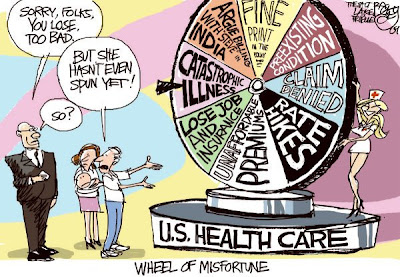
Pat Bagley - Salt Lake Tribune - Private Health Insurers - English - Private, health, insurance, Public, option, Government, Obama, Health Care, Pharmacy, Doctors, barack, Congress, Government Sponsored, Single payer

Sunday, February 20, 2011

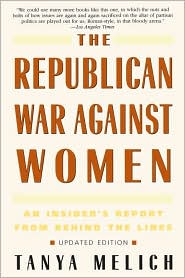
Shocking..Appalling...GOP's War on Women

“If you aren't completely appalled then you haven't been paying attention”


This war is not new. GOP strategists are escalating the Republican War Against Women that has been going on since the '80s.  However, this new wave of attacks also has a front of women voicing their opposition to the feminist agenda.
Palin and her mama grizzlies are a twenty-first century upgrading of the backlash against women and minorities strategy that put Ronald Reagan, George H. W. Bush and Bush II in the White House. These angry women are the bait, stirring a pot of discontent against the Obama Presidency. Their candidacies are the first act in a plan by the Republican right—now joined by its Tea Party allies and supply-side libertarians—to run the Republican party .
Their goal is the White House and a radical redirection of American government that will rollback much of the New Deal and Great Society policies. They seek repeal of many of the laws of the last thirty years that opened opportunities for those left out of America's mainstream— women, minorities, gays and immigrants.
It is engineered by a new generation of Republican tacticians who have built their strategy on the foundation laid in the original Republican War Against Women. That earlier crew—composed of Reagan's campaign team, new right and religious right leaders—orchestrated the defeat of the Equal Rights Amendment, opposed affirmative action, federal money for child care and numerous policies aimed at making life better for women and their families.
The centerpiece of this war has always been women's reproductive health. Through the 1970s and 1980s, abortion was its principal issue. Now they have expanded their opposition to stem cell research and contraception.
For these 2010 angry women candidates, opposition to abortion remains the keystone of their political philosophy. But they downplayed abortion in their campaigns, instead attacking big government spending and high taxes.
Don't be fooled, the 'Good Ole Boys' are still in control
The strategic aim of this newest version of the backlash strategy is to weaken the Democrat's attraction to its strongest constituency, women voters. This year it had three parts:
1- To energize large numbers of Republican women voters through the campaigns of the radical Republican women candidates.
2- To use this Republican female energy to attract independent women who occasionally voted Republican and want lower taxes and less government.
3- To make Democratic women feel a sense of hopelessness, to encourage a lack of enthusiasm for voting, to alienate them from Obama.
What is surprising is how long it took this male-dominated, backlash political machine to recognize that the path to control of state houses, Congress and the White House was with feisty right-wing women candidates.
The Republican War against Woman has not ended. But it's got Palin, Michele Bachmann, re-elected to her Minnesota congressional seat, and now Nikki Haley and Susana Martinez leading it. 
1) Republicans not only want to reduce women's access to abortion care, they're actually trying to redefine rape. After a major backlash, they promised to stop. But they haven't yet. Shocker.
2) A state legislator in Georgia wants to change the legal term for victims of rape, stalking, and domestic violence to "accuser." But victims of other less gendered crimes, like burglary, would remain "victims."
3) In South Dakota, Republicans proposed a bill that could make it legal to murder a doctor who provides abortion care. (Yep, for real.)
4) Republicans want to cut nearly a billion dollars of food and other aid to low-income pregnant women, mothers, babies, and kids. 
5) In Congress, Republicans have a bill that would let hospitals allow a woman to die rather than perform an abortion necessary to save her life.
6) Maryland Republicans ended all county money for a low-income kids' preschool program. Why? No need, they said. Women should really be home with the kids, not out working.
7) And at the federal level, Republicans want to cut that same program, Head Start, by $1 billion. That means over 200,000 kids could lose their spots in preschool.
8) Two-thirds of the elderly poor are women, and Republicans are taking aim at them too. A spending bill would cut funding for employment services, meals, and housing for senior citizens.
9) Congress just voted for a Republican amendment to cut all federal funding from Planned Parenthood health centers, one of the most trusted providers of basic health care and family planning in our country.
10) And if that wasn't enough, Republicans are pushing to eliminate all funds for the only federal family planning program. (For humans. But Republican Dan Burton has a bill to provide contraception for wild horses. You can't make this stuff up).
Nope, you can't make this stuff up.  It is real, it is powerful and it cannot be dismissed.

Sources:

1. "'Forcible Rape' Language Remains In Bill To Restrict Abortion Funding," The Huffington Post, February 9, 2011

"Extreme Abortion Coverage Ban Introduced," Center for American Progress, January 20, 2011

2. "Georgia State Lawmaker Seeks To Redefine Rape Victims As 'Accusers,'" The Huffington Post, February 4, 2011

3. "South Dakota bill would legalize killing abortion doctors," Salon, February 15, 2011

4. "House GOP Proposes Cuts to Scores of Sacred Cows," National Journal, February 9, 2011

5. "New GOP Bill Would Allow Hospitals To Let Women Die Instead Of Having An Abortion," Talking Points Memo, February 4, 2011

6. "Republican Officials Cut Head Start Funding, Saying Women Should be Married and Home with Kids," Think Progress, February 16, 2011

7. "Bye Bye, Big Bird. Hello, E. Coli," The New Republic, Feburary 12, 2011

8. "House GOP spending cuts will devastate women, families and economy," The Hill, February 16, 2011
http://thehill.com/blogs/congress-blog/economy-a-budget/144585-house-gop-spending-cuts-will-devastate-women-families-and-economy-

9. "House passes measure stripping Planned Parenthood funding," MSNBC, February 18,2011
http://firstread.msnbc.msn.com/_news/2011/02/18/6080756-house-passes-measure-stripping-planned-parenthood-funding

"GOP Spending Plan: X-ing Out Title X Family Planning Funds," Wall Street Journal, February 9, 2011

10. Ibid.

"Birth Control for Horses, Not for Women," Blog for Choice, February 17, 2011

Monday, June 14, 2010

Health Care is a Right

Barbara Bush attends the Lela Rose Spring 2010 Fashion Show at  Bryant Park on September 13, 2009 in New York, New York. (Photo by Jason  Kempin/Getty I
Getty

Barbara Bush, the 28-year-old daughter of former President George W. Bush, sounded more like a Democrat according to Chris Wallace of Fox News.

Yesterday, President Bush’s 28-year old daughter Barbara was named Fox News Sunday’s “Power Player of the Week” for her work as co-founder of Global Health Corps, a group of young professionals promoting global health equality. During the interview with Fox, Barbara Bush’s comments on health care sounded like, as host Chris Wallace put it, “a mission statement from the Obama White House”:

BARBARA BUSH: Why do basically people with money have good health care and why do people that live on lower salaries not have good health care? You know, health should be a right for everyone. [...]

WALLACE: What do you think of Obama health care reform?

BUSH: That is a good question. And obviously, the health care reform bill, you know, was highly debated by a lot of people. And I guess I’m glad that, you know, a bill was passed.

WATCH:


She hasn't fallen far from the female side of the Bush tree. Recently, Laura Bush told Larry King that she supports abortion rights and gay marriage.

It is interesting that Fox's Chris Wallace was quite polite to Barbara Bush, given that she had strayed from the Republican talking points on health care. At least he didn't accuse her of being a socialist!

Wednesday, March 17, 2010

Demand a Vote on the Public Option

Via Democracy Now!

Within the Democratic Caucus, opponents of the healthcare bill range from right-leaning Democrats, who want to include harsh anti-abortion measures or who think it’s too expensive, as well progressive Democrats, who are insisting on a public option.

But now a number of Democrats who have decided to vote for the bill have also signed onto the Public Option Act, a measure that would allow people under sixty-five to buy into Medicare. The bill, also known as the Medicare You Can Buy Into Act, was introduced on the House floor last week by Florida Congress member Alan Grayson.

Join Congressman Alan Grayson in calling for a vote on the Medicare buy-in.

Read the letter and sign onto the petition today!

Go to: wewantmedicare.com

Thursday, December 17, 2009

Andy Borowitz Nails It

Details of Healthcare Plan Revealed

WASHINGTON (The Borowitz Report) - The United States Senate today unveiled details of its health care plan, tentatively called CompromiseCareTM:

  • Under CompromiseCareTM, people with no coverage will be allowed to keep their current plan.
  • Medicare will be extended to 55-year-olds as soon as they turn 65.
  • You will have access to cheap Canadian drugs if you live in Canada.
  • States whose names contain vowels will be allowed to opt out of the plan.
  • You get to choose which doctor you cannot afford to see.
  • You will not have to be pre-certified to qualify for cremation.
  • A patient will be considered "pre-existing" if he or she already exists.
  • You'll be free to choose between medications and heating fuel.
  • Patients can access quality health care if they can prove their name is "Lieberman."
You will have access to natural remedies, such as death.

Tuesday, September 1, 2009

Flaws in Healthcare

In order to read Matt Taibbi's article in the Rolling Stone magazine, Sick and Wrong, you need to buy the magazine. But by clicking below you can see 3 videos.

In the first video, Taibbi explains the high administration costs of the present health care system. The second video talks about how the Democrats got on the defense on the issue of health care. The third video speaks to the issue of the "individual mandate" where insurance coverage is mandatory.

What this article also shows is that the healthcare bill that Congress is now considering is not the change that the American people need. The losers are the American people and the winners are the insurance companies, Big Pharma and the corporations with big money.
America’s disastrous health care system is responsible for incalculable amounts of illness, death, lost productivity and federal deficit — not to mention anxiety, anger and disgrace. And it’s not going to get fixed, writes Matt Taibbi in the new issue of Rolling Stone, because it’s encased in another failed system: the U.S. government. Rather than attempt to remedy the problem this summer, our government sat down and demonstrated its dizzying ineptitude. “We might look back on this summer someday and think of it as the moment when our government lost us for good,” writes Taibbi. “It was that bad.”

Taibbi breaks down the five steps Congress took to be sure no bill would pass — aiming low, gutting the public option, packing it with loopholes, providing no leadership and blowing the math — in his story, which is available on stands now. In a series of video interviews for RollingStone.com, Taibbi explores one of our system’s most severe flaws, explains how the government wedged itself into an awkwardly damning position, and looks at how the proposed bill would change the ordinary American’s life.

Perhaps the biggest flaw in the American health care system is that 31 percent of costs are associated with administration and paperwork. Here Taibbi examines the easiest way to eliminate the red tape:

Taibbi on how the Democrats wound up on the defensive — and theories that the government struck a sideline deal with the pharmaceutical industry:

Inside the “individual mandate” that would require people to buy insurance and how the bill might make conditions worse than before:

Is anyone angry yet? You should be. Once again the American people are getting the shaft on healthcare while insurance companies will make more money than ever. Just thinking about it is enough to get you sick!

Friday, August 28, 2009

Truth in Advertising

Proposed Health Care Bumper Stickers:
* My Other Car Is A Health Insurance Payment

* My Death Panel Is An HMO

* One Nation, Underinsured

* My Car Has Better Insurance Than I Do

* Underinsured Baby On Board


* Hate Socialism? Repeal Medicare!!


* It's Okay.... Congress Has GREAT Insurance


* Kill Healthcare! 30,000 Lobbyists Can't Be Wrong!


* Every Time A Claim Is Denied An Adjuster Gets His Wings
Pass to on to Everyone!!!!

Rep. Anthony Weiner: A Very Sane and Sensible Voice

How About the 'Kennedy Public Option Plan'

Joe Conason at Salon notes that, Ted Kennedy wanted the public option.

Forty years ago he began the quest for universal healthcare that became the cause of his life when he introduced his first bill outlining that goal. His final bequest to the Senate is the Affordable Health Choices Act, his version of the Obama administration's reform proposals, which was passed by the Health, Education, Labor and Pensions Committee last month. Republicans now say that if Kennedy had not been forced by illness to relinquish the chairmanship of that committee, he would have negotiated away the strongest provisions of that bill to win passage.

Kennedy's Republican friends should not make that disingenuous argument in his lamented absence. Lest there be any doubt about what he truly wanted, his bill includes a robust public option along with all the insurance reforms and cost controls that the president has endorsed since this process began.

How would he have handled the intransigence and dishonesty of the Republican opposition? We know that he could shout as well as whisper — and that he could be partisan as well as bipartisan. He believed that the time for incremental changes had passed. He was ready to fight. The tragedy of his death is not only that he didn't see the triumph he had dreamed, but that he fell before he could lead the nation to that final victory. Now that victory will have to be won in his name.

David Waldman from Daily Kos suggests that we, Name the Public Option After Kennedy, Not a Watered Down Bill.

The temptation to name the health care reform bill after fallen health care champion Sen. Ted Kennedy (D-MA) is as understandable as it is overwhelming. But with the bill currently still at the mercy of players who are, shall we say, not as clearly dedicated to a product that offers the kind of help Kennedy envisioned, I suggest that we not offer them the opportunity to attach his name to anything less than a bill he would have fought for.

So while it's undoubtedly in that spirit that the Progressive Change Campaign Committee and others have begun their drive to honor Kennedy's memory by demanding that the HELP Committee's bill be passed and named after him, I suggest that it serves us and the Senator's memory better if our essential element -- a strong public option -- carries his name instead.

With the Kennedy Health Care Plan intact in the bill, there's no reason the legislative vehicle that creates it cannot also bear his name. But while there's still a fight ahead about just what will be in this bill, if we're going to lend Ted Kennedy's name to something, let it be done in a way that keeps him in the fight to fulfill his vision right to the last, and which keeps his name on people's lips when they are finally able to take their families to the doctor without fear of financial ruin, saying, "We're covered by the Kennedy Plan."
Possibly there are a few Republicans who have guts to join Democrats in order to pass a Healthcare bill which includes a the 'Kennedy Public Option Plan'.

Monday, August 24, 2009

"Gang of Six"


Baucus (left) and Grassley hatch a plan

The dictionary defines the word "gang" as an organized group of criminals. Robert Reich wants to know why are 3 Republicans and 3 Democrats, led by Senator Max Baucus and known as the "Gang of Six", Deciding Health Care for Three Hundred Million of Us.

Last night, the so-called "gang of six" -- three Republican and three Democratic senators on the Senate Finance Committee -- met by conference call and, according to Senator Max Baucus, the committee's chair, reaffirmed their commitment "toward a bipartisan health-care reform bill" (read: less coverage and no public insurance option). The Washington Post reports that the senators shared tales from their home states, where some have been besieged by protesters angry about a potential government takeover of the nation's health care system.

It's come down to these six senators. The House has reported a bill as has another Senate committee, but all eyes are fixed on Senate Finance -- and on these three Dems and three Republicans, in particular. But who, exactly, anointed these six to decide the fate of the nation's health care?

I don't get it. Of the three Republicans in the gang, the senior senator is Charles Grassley. In recent weeks, Grassley has refused to debunk the rumor that the House's health-care bill will spawn "death panels," empowered to decide whether the sick and old get to live or die. At an Iowa town meeting last Tuesday Grassley called the president and Speaker Nancy Pelosi "intellectually dishonest" for claiming the opposite. On Thursday Grassley told the Washington Post that Congress should scale back its efforts to overhaul health care in the wake of intense anger at town hall meetings. But -- wait -- the anger is largely about distortions such as the "death panels" that Grassley refuses to debunk.

This week on Fox News Grassley termed the House bill "the Pelosi Bill," and called it "a government takeover of heath care, exploding the deficit because it's not paid for and it's got high taxes in it."

I really don't get it. We have a Democratic president in the White House. Democrats control sixty votes in the Senate, enough to overcome a filibuster. It is possible to pass health care legislation through the Senate with 51 votes (that's what George W. Bush did with his tax cut plan). Democrats control the House. The Speaker of the House, Nancy Pelosi, is a tough lady. She has said there will be no health care reform bill without a public option.

So why does the fate of health care rest in Grassley's hands?

It's not even as if the gang represents America. The three Dems on the gang are from Montana, New Mexico, and North Dakota -- states that together account for just over 1 percent of Americans. The three Republicans are from Maine, Wyoming, and Iowa, which together account for 1.6 percent of the American population.

So, I repeat: Why has it come down to these six? Who anointed them? Apparently, the White House. At least that's what I'm repeatedly being told by sources both on the Hill and in the administration. "The Finance Committee is where the action is. They'll tee-up the final bill," says someone who should know.

The Gang needs to be kicked out!

Robert Reich is the nation's 22nd Secretary of Labor and a professor at the University of California at Berkeley.


Tuesday, August 4, 2009

Latent Racism?


Leslie Savan talks about, Race, Lies and Health Scares:
...Maybe the real question is, What is it about health care that brings out the latent racism in the GOP?

The answer is simple: For two or three generations, Republicans have defeated progressive reform of the health care system by hinting that it would mean redistributing wealth from whites to blacks. As Beck himself said, practically redefining "welfare queen" as "healthcare queen": "Everything that is getting pushed through Congress, including this health care bill, are transforming America, and they're all driven by President Obama's thinking on one idea: reparations."

Nevertheless, when we see that Obama's poll numbers have dropped back to the margin of victory he had in the election and have even gone underwater on his handling of health care, it really shouldn't make us give up on the prospect of reform. [...]

The Daily Kos/Research 2000 poll showing that 58 percent of Republicans either don't believe Obama was born in the U.S. or aren't sure (compared to 7 percent for Dems and 17 for independents), confirms Bill Maher's formulation: Not all Republicans are racist, but if you are a racist these days, you're probably a Republican. [...]

But watching the Republican Party morph into the National Association for the Advancement of White People should give us all hope, not despair: Anything that brings 'em out of the closet and gets 'em running naked through the streets shouting, "I'm the victim here, dammit!" will only ensure their minority status over the long run.

OLBERMANN: Not 'Blue Dogs'...Just 'DOGS'

Olbermann On Health Care Reform: Legislators for Sale!


Speaking to the Blue Dogs collectively:

I warn you all. You were not elected to create a Democratic majority.

You were elected to restore this country.You were not elected to serve the corporations and the trusts who the government has enabled for the last eight years.

You were elected to serve the people.

And if you fail to pass or support this legislation, the full wrath of the progressive and the moderate movements in this country will come down on your heads. Explain yourselves not to me, but to them.

They elected you, and in the blink of an eye, they will replace you.

If you will behave as if you are Republicans - as if you are the prostitutes of our system - you will be judged as such.

And you will lose not merely our respect. You will lose your jobs!

Every poll, every analysis, every vote, every region of this country supports health care reform, and the essential great leveling agent of a government-funded alternative to the unchecked duopoly of profiteering private insurance corporations.

Cross us all at your peril...

Crooks & Liars has the story: Calling Blue Dogs Out!

From Countdown Aug. 3, 2009, Keith's Special Comment on health care reform. Michael Moore wrote this today about the Special Comment:

It is nothing short of brilliant -- and if all of America were to hear what he is going to reveal tonight, we are certain the vast majority of Americans would be on the phone to their elected representative immediately, calling for an end to the private, for-profit, rip-off health insurance companies who have wrecked our country.

Olbermann writes:

Tonight I will present what I believe is the longest Special Comment I have ever aired, naming names and citing dollar amounts to call out the politicians -- Republicans and Democrats alike -- who are paid by the Health Care Monopolies to bring to life one of my favorite quotes, the observation of the Belgian essayist Maurice Maeterlinck...

Some of the highlights.

PBS pointed out that the health and insurance industries are spending more than a million, 400 thousand dollars a day, just to destroy the "public option" - the truly non-profit, wieldy, round-up and not round-down, government, from helping you pay your medical bills with about a billionth of the recklessness with which it is still paying Halliburton and its spinoffs to kill your kids.

And much of this money is going to, and through, Republicans. But that's the real point tonight. Not all of it is going through Republicans...

[.....]

Congressman Mike Ross of Arkansas.Leader of the Blue Dogs in the House. You're the guy demanding a guarantee that Reform won't add to the deficit. I'm guessing you forgot to demand that about, say, Iraq.
You're a Democrat, you say, Congressman?

You saw what Sandy Barham said? Sandy Barham is 62 years old, she's got a bad heart, and she's hoping her valves will hold together for three more years until Medicaid kicks in, because she can't afford insurance. Not just for herself, mind you. For her employees. She needs the public option. So do those six people who work at that restaurant of hers, Congressman Ross. And why should you give a crap?

Because Sandy Barham's restaurant is the Broadway Railroad Café, and it is at 123 West First Street North in Prescott, Arkansas.
Prescott, Arkansas, Congressman Ross.

Your home town. You are Sandy Barham's congressman. Hers, Sir. Not Blue Cross's and Blue Shield's, even if they do insure 75 percent of the state and they own you.


Monday, August 3, 2009

How Corporate Media has Helped the GOP and the Blue Dog Dems


Joshua Holland thinks that the health care debate has been hijacked by the health care industry as well as the Republicans and the Blue Dog Democrats. Then corporate media successfully spreads their "frame" of the debate.
Tragically, Republicans, the health care industry and business-friendly "Blue Dog" Democrats have largely been able to frame the terms of the debate, with a substantial assist from the corporate-owned media.

They've successfully focused the health care debate on the short-term costs to the federal government's bottom line, obscuring the potential impact that a meaningful realignment of the health care system would have on the economy as a whole. In so doing, opponents of reform have hoodwinked much of the public into believing that investments in America's national health care system will wind up costing individuals more than they had gained from the effort.

In fact, they've done such a good job that much of the discourse has revolved around what is arguably one of the least-relevant aspects of the proposals being debated in Congress: whether they "cost too much" or are "deficit neutral" in terms of their impact on the federal budget over the next 10 years.

Much of that discussion has been fueled by a series of estimates issued by the Congressional Budget Office -- estimates based on incomplete drafts of the legislation now moving through Congress. Yet, by and large, the mainstream media have dutifully repeated the spin without mentioning that the critics are touting the CBO's preliminary projections as definitive and final.

Unfortunately, Congressional leaders have not sought the opinions of progressive reformers. Instead they have done everything to "mollify" the Blue Dog Dems and the Republicans who are "cozy" with the "disease-care" industry that desperately needs to be reformed.
Just consider the "public insurance option." While progressives were promised a "robust" public insurance program that would be open to all comers, what emerged from the Senate HELP Committee and from the leaders of three House committees was a pale shadow of what had been touted during last fall's campaign season.
So don't blame the Obama Administration for this mess.
Next time you see some congressional meat-puppet on TV discussing how much a plan will cost, or lamenting its limited potential for cost containment, keep in mind that it's his or her ideology that is directly to blame for those shortcomings.

It's only because of pressure from industry groups, Republicans and Blue Dog Dems that congressional leaders took single-payer off the table (and threw advocates out of the room) and gave us a limited public insurance option -- a pale shadow of what reformers had been promised.

Now, those same forces are bent on killing an already-watered-down proposal. If they succeed, we can expect more human suffering, more outlandish increases in premiums, more people being denied care, an increase in the numbers of uninsured and a continued drag on the American economy.

Why is it that people who really need health care are so willing to believe the insurance executives and those doing their bidding when the root of the health care problem stems from their very decisions and policies?

Thursday, July 9, 2009

Public Option with "Trigger"

The last few weeks the media and the politicians have all been focusing on the public option in a health care plan. Steve Benen notes that a "public option would improve the system by lowering costs, expanding access, and using competition to improve efficiency."

The President likes the idea of a public option. Obama has even stated that, "I am pleased by the progress we're making on health care reform and still believe, as I've said before, that one of the best ways to bring down costs, provide more choices, and assure quality is a public option that will force the insurance companies to compete and keep them honest. I look forward to a final product that achieves these very important goals."

For those who are not fans of the public option there has been talk of a "trigger." Olympia Snowe, the Senator from Maine, wants to prolong the public option with a "trigger mechanism."
According to the Associated Press, Sen. Olympia Snowe (R-ME)--a potentially key moderate on the Senate Finance Committee--hasn't forsworn signing on to a health reform bill that includes a public option. But she's holding out to see it affixed to a "trigger mechanism," which would, in theory, give insurance companies a years-long window to lower costs on their own and only "trigger" the public option if they failed to do so.

"If you establish a public option at the forefront that goes head-to-head and competes with the private health insurance market ... the public option will have significant price advantages," Snowe said. But this was her argument against making the public option available as soon as the bill becomes law.

So why would anyone want to wait longer to see if insurance companies can bring down health care costs when the system being used hasn't worked?

Those who like the idea of a "trigger" argue that if we pass a reform package and private insurers can lower costs, expand access, and improve efficiency on their own, we wouldn't need a public option. It's better, they say, to wait for the system to get really awful before utilizing a public option to make things better.

The problem should be obvious: if proponents of such an idea realize that a public option would necessarily improve the overall system -- and they must, otherwise there would be no need for the trigger to kick in when things got even worse -- then why deliberately delay implementation of the part of the policy that lawmakers already realize would help?

Or, put another way, if Snowe knows a public option is a good idea, there's no reason to push it off to some arbitrary date in the future, as the system deteriorates in the interim.

Why is Rahm Emanuel now raising the idea of the "trigger"?
White House Chief of Staff Rahm Emanuel irked quite a few members of his own party yesterday when he told the Wall Street Journal how flexible the administration is on health care reform. To hear Emanuel tell it, the White House would accept a "triggers" provision favored by some centrist Republicans, and isn't wedded to a public option.

As luck would have it, Emanuel also headed to Capitol Hill yesterday afternoon for a meeting with some of the same lawmakers he'd just annoyed with his comments. Roll Call reported that the president's chief of staff got an earful, but "reassured" Democrats that the White House still wants a public option in the reform package.

Progressive Caucus Co-Chairwoman Lynn Woolsey (D-Calif.) warned Emanuel that he would lose the caucus' votes if the White House compromised on the issue and included a "trigger" that could delay a public insurance plan indefinitely. The trigger idea is backed by conservative Democrats but is anathema to liberals.

"We have compromised enough, and we are not going to compromise on any kind of trigger game," Woolsey said she told Emanuel. "People clapped all over the place. We mean it, and not just progressives."

Emanuel wants to negotiate? Who is he negotiating with...the Republicans who don't want to change the for-profit system of health care..or the insurance companies who don't want to change the for-proft system of health care? There seems to be no wiggle room!

Monday, June 8, 2009

Big Pharma, Insurance, Corporate Healthcare and Us!

Please read the following two interesting and very important articles on the status of healthcare in this country.

How Pharma and Insurance Intend to Kill the Public Option, And What Obama and the Rest of Us Must Do...
By Robert Reich

I'ved poked around Washington today, talking with friends on the Hill who confirm the worst: Big Pharma and Big Insurance are gaining ground in their campaign to kill the public option in the emerging health care bill.

You know why, of course. They don't want a public option that would compete with private insurers and use its bargaining power to negotiate better rates with drug companies. They argue that would be unfair. Unfair? Unfair to give more people better health care at lower cost? To Pharma and Insurance, "unfair" is anything that undermines their profits.

So they're pulling out all the stops -- pushing Democrats and a handful of so-called "moderate" Republicans who say they're in favor of a public option to support legislation that would include it in name only. One of their proposals is to break up the public option into small pieces under multiple regional third-party administrators that would have little or no bargaining leverage. A second is to give the public option to the states where Big Pharma and Big Insurance can easily buy off legislators and officials, as they've been doing for years. A third is bind the public plan to the same rules private insurers have already wangled, thereby making it impossible for the public plan to put competitive pressure on the insurers.

Max Baucus, Chair of Senate Finance (now exactly why does the Senate Finance Committee have so much say over health care?) hasn't shown his cards but staffers tell me he's more than happy to sign on to any one of these.

Read more
Everyone hates corporate healthcare-- now, public demand could really change it...By Jim Hightower
Now is the time for boldness! Instead, we're getting Baucusness. Sen. Max Baucus, that is--Montana Democrat, chair of the Senate Finance Committee, and frequent spear-carrier for the corporate agenda. He has now been tapped to handle Obama's promised rewrite of America's warped, ineffective, and exorbitantly expensive health-care system.

This should be a dream job for the Democratic leadership. Consumers despise today's corporatized medical structure. So do doctors, nurses, and other health-care workers. So do businesses that provide health-care coverage for their employees. The insurance-company-dominated system is so unpopular that swine flu enjoys a higher public-approval rating! A Pew Research Center poll taken in March 2009 shows that the American people don't merely want the current system fixed, they want it overhauled--76% say it must either be "fundamentally changed" or "completely rebuilt."

What an opportune moment this is for Obama to do something BIG for America--a rare, Rooseveltian moment in which the president and Congress have the chance (and duty) to rise above business as usual, to respond for once to the people's interest, to create a universal public service that would actually move our society a couple of strides closer to America's egalitarian ideals of fairness, justice, and opportunity for all.

Luckily, the "something big" is readily at hand. It's called a "single-payer" health-care system--a structural reform that has been successfully implemented in several countries, as well as in our own Medicare and veterans health programs. By expanding this system nationally, every person in our land would be assured good-quality care. No longer would profiteering insurance corporations control entry, dictating which doctors we can use (and what treatments they can provide), gouging us with ever-rising premiums and co-pays, and ripping off a third of our nation's health-care dollars for things that have nothing to do with either health or care--including ridiculous CEO pay packages, excess profits, massive billing bureaucracies, useless advertising hustles, posh headquarters, lobbying expenses, etc.

With the single-payer plan, we'd regain the right to go to the doctors and hospitals of our choosing, and doctors would regain authority over patient care. As the plan's name suggests, the difference is not in who delivers the care, but in how our health-care professionals get paid. Rather than the wasteful, autocratic middleman structure that now separates us patients from our providers (generating paperwork costs of some $350 billion a year), a no-frills, government-administered public fund would pay everyone's health-care bills directly--eliminating the interferences and overcharges of arrogant and avaricious insurance behemoths. Full coverage for all, less cost. Makes sense.

So, just prior to last month's opening Senate hearing, which was billed as a "round-table discussion" to air all viewpoints about how to reform the system, what was the one caveat laid down by Baucus? "Everything is on the table with the exception of single-payer," spake the chairman. "This country is not going to adopt single-payer, at least not at this time," he ruled with a royal wave of his hand.

Sheesh. Just when we need political boldness worthy of the ages, Baucus starts us off with his own Profile in Pusillanimity.

Then, on the first day of public testimony, the chairman backed up his weak-kneed approach to reform with, of all things, a show of force. As insurance giants and other representatives of corporatized health care were seated to testify, eight uninvited doctors, nurses, and other advocates of single-payer arose from the audience to protest their exclusion from the forum. "We want a seat at the table," shouted one protester. Rather than engaging these banned citizens on the merits, Baucus retorted, "We want police," summoning the capitol cops to arrest those who had so rudely interrupted his show. With the threat of unscripted democratic dialogue safely restrained, Chairman Baucus then turned to those who remained and said, "I want you to know I care deeply about your views."

Read more

So it is up you to let your Representatives know what to do. As Robert Reich suggests, "Let your representative and senators know you want a public option without conditions or triggers -- one that gives the public insurer bargaining leverage over drug companies, and pushes insurers to do what they've promised to do."

Sunday, June 7, 2009

Health Insurance and Bankruptcy


Health Insurance is a number one issue for the public as well as for the Obama Administration. A new study found that personal bankruptcies have a direct link to medical costs. Having health insurance is by no means an answer.

From MSNBC:
Costly illnesses trigger about half of all personal bankruptcies, and most of those who go bankrupt because of medical problems have health insurance, according to findings from a Harvard University study to be released Wednesday.
From CNN: Story Highlights
  • Study: More than 60 percent of bankruptcies are linked to medical bills
  • Three-quarters of people with a medically-related bankruptcy had health insurance
  • Researcher: "You're one illness away from financial ruin in this country"
  • Situation likely to worsen: study was done a year before recession
Simply stated, there are three major problems to our current system of for profit medical insurance:
1. Numerous uninsured due to cost, job, etc
2. Insured but medical procedure or Rx not covered
3. Insured but
due to job lose or illness etc become uninsured
Our health care system needs real & thoughtful change. 'For profit' health care has not, is not and will not work for everyone.

Monday, March 30, 2009

Blacklisting by Health Insurers

An article on the cost of health care reveals how health insurers secretly blacklist people with certain ailments.

Trying to buy health insurance on your own and have gallstones? You'll automatically be denied coverage. Rheumatoid arthritis? Automatic denial. Severe acne? Probably denied. Do you take metformin, a popular drug for diabetes? Denied. Use the anti-clotting drug Plavix or Seroquel, prescribed for anti-psychotic or sleep problems? Forget about it.

This confidential information on some insurers' practices is available on the Web -- if you know where to look.

What's more, you can discover that if you lie to an insurer about your medical history and drug use, you will be rejected because data-mining companies sell information to insurers about your health, including detailed usage of prescription drugs.

These issues are moving to the forefront as the Obama administration and Congress gear up for discussions about how to reform the healthcare system so that Americans won't be rejected for insurance.

Tuesday, March 17, 2009

Health Care Choices

In the following article about health care, The Promise and Perils of "Compromise," Joshua Holland puts our choices in perspective.

The New York Times takes a look at Massachusetts' ground-breaking push towards universal health care, and what it found offers some interesting insight for national health policy.

Three years ago, Massachusetts enacted perhaps the boldest state health care experiment in American history, bringing near-universal coverage to the commonwealth with Paul Revere speed.
To make it happen, Democratic lawmakers and Gov. Mitt Romney, a Republican, made an expedient choice, deferring until another day any serious effort to control the state's runaway health costs.
The day of reckoning has arrived. Threatened first by rapid early enrollment in its new subsidized insurance program and now by a withering economy, the state's pioneering overhaul has entered a second, more challenging phase.
Thanks to new taxes and fees imposed last year, the health plan's jittery finances have stabilized for the moment. But government and industry officials agree that the plan will not be sustainable over the next 5 to 10 years if they do not take significant steps to arrest the growth of health spending.

By all means, read the whole thing. Here are a few points which I think stand out.

First, there are two ways of looking at this. You can see Massachusetts' experience with its "Commonwealth Care" program as evidence that bringing everyone to the table -- including a 'disease care' industry whose ultimate goal is profits rather than a healtheir society -- results in a muddled policy where the number of people with health coverage might expand, but lacking any serious effort to contain costs, the ultimate policy remains unsustainable.

This appears to be the direction Obama has promised in tackling health care reform. As the Washington Post reported a couple of weeks ago:

Obama's opening gambit to dramatically expand the health-care system has attracted surprising notes of support from insurers, hospitals and other players in the powerful medical lobby ... The lure for the industry is the prospect of tens of millions of new customers: If Obama succeeds in fulfilling his pledge to cover many more Americans, those newly insured people will get checkups, purchase medicine, undergo physical therapy and get surgeries they cannot afford today.

As long as our health care system remains one of the world's great rip-offs, insuring tens of millions of uninsured people, while the right thing to do, just isn't feasible over the long term. The incentives have to change.

The other way to look at it is that this kind of incrementalism offers the opportunity to do things that might not have been politically possible otherwise. The Times again:

Those who led the 2006 effort said it would not have been feasible to enact universal coverage if the legislation had required heavy cost controls. The very stakeholders who were coaxed into the tent -- doctors, hospitals, insurers and consumer groups -- would probably have been driven into opposition by efforts to reduce their revenues and constrain their medical practices, they said.
Now those stakeholders and the state government have a huge investment to protect.

Once established -- once everyone's on board with "a huge investment to protect" -- then these programs can be improved, as Massachusetts is now pushing to do with its policy:

With Washington watching, the state's leaders are again blazing new trails. Both Gov. Deval Patrick, Mr. Romney's Democratic successor, and a high-level state commission have set out to revamp the way public and private insurers reimburse physicians and hospitals.
They want a new payment method that rewards prevention and the effective control of chronic disease, instead of the current system, which pays according to the quantity of care provided. By late spring, the commission is expected to recommend such a system to the legislature.
If Massachusetts becomes the first state to make this conversion, health policy experts argue that it would be as audacious an achievement as universal coverage.
The commission is looking at various options, but all would do away with the fee-for-service system, which provides perverse incentives by paying physicians and hospitals for each patient visit. The changes under consideration include reimbursing for episodes of care rather than individual visits and bundling payments to groups of providers who would together take responsibility for a patient's health.
Blue Cross and Blue Shield of Massachusetts, the state's largest insurer, recently devised an innovative model that pays doctors a flat fee per patient, with adjustments for age, gender and health status, and then adds bonus payments for high standards of care.

The other point that stands out is that despite its obvious flaws, Massachusetts' program has had a major impact on the population of that state:

The state expects to spend $595 million more on its health insurance programs this year than in 2006, a 42 percent increase. But about 432,000 people have gained coverage, leaving only 2.6 percent of the population without insurance, according to a recent state survey. At only one-sixth the national average, that is by far the lowest rate in any state.
Massachusetts achieved its high coverage rates by mandating in its landmark law that almost every resident have health insurance, and that all but the smallest businesses make some contribution toward their employees' costs. Those who do not enroll but are deemed able to afford insurance can be fined up to $1,068 in the 2009 tax year.
To make the mandated insurance affordable, the state subsidizes premiums for those earning up to three times the federal poverty level, or $66,150 for a family of four. Massachusetts already had a law requiring insurers to accept all applicants regardless of their health status.
Although nearly 60 percent of the newly insured are covered by public programs, Massachusetts also seems to be a rare state where the percentage of employers offering health benefits is actually growing. And the state government has realized substantial savings, worth about $250 million last year, from lower payments to hospitals for uncompensated care for the uninsured and underinsured.

Finally, while the disease management industry claims that it can't possibly turn a profit with all this meddlesome government interference, Massachusetts' Governor Deval Patrick appears to have damaged that argument with a bit of tough talk.

Mr. Patrick has shown signs of playing tough with the state's hospitals and insurers. Responding in January to a series in The Boston Globe that exposed how the state's most influential hospitals negotiate high reimbursement rates, Mr. Patrick announced that he would explore whether the state could regulate insurance premiums.
"Frankly, it's very hard for the average consumer, or frankly the average governor, to understand how some of these companies can have the margins they do and the annual increases in premiums that they do," Mr. Patrick said in an interview. "At some level, you've just got to say, 'Look, that's just not acceptable, and more to the point, it's not sustainable.'"
The threat seems to have been heard. Insurers seeking to participate in the state's subsidized insurance program, Commonwealth Care, recently submitted bids so low that officials announced last week that they would keep premiums flat in the coming year. That may provide cover for the program as the state seeks ways to fill a nearly $4 billion gap in its 2010 budget.

Apparently, the mere threat of cost controls helps Big Health find ways to control costs.

Expect more out this week on Massachusetts' health care mandate, with at least one major reprot being released on its applicability to national policy.