Showing posts with label Socialism. Show all posts

Monday, November 7, 2011

The Conservative Misconception of Socialism

Today, for the Tea Party Republicans the new 'red scare' in society is the concept of Socialism. Conservatives have created a negative niche by equating 'Liberalism' with 'Socialism.' In order to educate the conservative side of the political scale, Nurse Pam does an excellent job "Explaining Socialism to a Republican."

I was talking recently with a new friend who I’m just getting to know. She tends to be somewhat conservative, while I lean more toward the progressive side.

When our conversation drifted to politics, somehow the dreaded word “socialism” came up. My friend seemed totally shocked when I said “All socialism isn’t bad”. She became very serious and replied “So you want to take money away from the rich and give to the poor?” I smiled and said “No, not at all. Why do you think socialism mean taking money from the rich and giving to the poor?

“Well it is, isn’t it?” was her reply.

I explained to her that I rather liked something called Democratic Socialism, just as Senator Bernie Sanders, talk show host Thom Hartman, and many other people do. Democratic Socialism consists of a democratic form of government with a mix of socialism and capitalism. I proceeded to explain to her the actual meaning terms “democracy” and “socialism”.

Democracy is a form of government in which all citizens take part. It is government of the people, by the people, and for the people.

Socialism is where we all put our resources together and work for the common good of us all and not just for our own benefit. In this sense, we are sharing the wealth within society.

Of course when people hear that term, “Share the wealth” they start screaming, “OMG you want to rob from the rich and give it all to the poor!” But that is NOT what Democratic Socialism means.

To a Democratic Socialist, sharing the wealth means pooling tax money together to design social programs that benefit ALL citizens of that country, city, state, etc.

The fire and police departments are both excellent examples of Democratic Socialism in America. Rather than leaving each individual responsible for protecting their own home from fire, everyone pools their money together, through taxes, to maintain a fire and police department. It’s operated under a non-profit status, and yes, your tax dollars pay for putting out other people’s fires. It would almost seem absurd to think of some corporation profiting from putting out fires. But it’s more efficient and far less expensive to have government run fire departments funded by tax dollars.

Similarly, public education is another social program in the USA. It benefits all of us to have a taxpayer supported, publicly run education system. Unfortunately, in America, the public education system ends with high school. Most of Europe now provides low cost or free college education for their citizens. This is because their citizens understand that an educated society is a safer, more productive and more prosperous society. Living in such a society, everyone benefits from public education.

When an American graduates from college, they usually hold burdensome debt in the form of student loans that may take 10 to even 30 years to pay off. Instead of being able to start a business or invest in their career, the college graduate has to send off monthly payments for years on end.

On the other hand, a new college graduate from a European country begins without the burdensome debt that an American is forced to take on. The young man or woman is freer to start up businesses, take an economic risk on a new venture, or invest more money in the economy, instead of spending their money paying off student loans to for-profit financial institutions. Of course this does not benefit wealthy corporations, but it does greatly benefit everyone in that society.

EXAMPLE American style capitalistic program for college: If you pay (average) $20,000 annually for four years of college, that will total $80,000 + interest for student loans. The interest you would owe could easily total or exceed the $80,000 you originally borrowed, which means your degree could cost in excess of $100,000.

EXAMPLE European style social program for college: Your college classes are paid for through government taxes. When you graduate from that college and begin your career, you also start paying an extra tax for fellow citizens to attend college.

Question - You might be thinking how is that fair? If you’re no longer attending college, why would you want to help everyone else pay for their college degree?

Answer - Every working citizen pays a tax that is equivalent to say, $20 monthly. If you work for 40 years and then retire, you will have paid $9,600 into the Social college program. So you could say that your degree ends up costing only $9,600. When everyone pools their money together and the program is non-profit, the price goes down tremendously. This allows you to keep more of your hard earned cash!

Health care is another example: If your employer does not provide health insurance, you must purchase a policy independently. The cost will be thousands of dollars annually, in addition to deductible and co-pays.

In Holland, an individual will pay around $35 monthly, period. Everyone pays into the system and this helps reduce the price for everyone, so they get to keep more of their hard earned cash.

In the United States we are told and frequently reminded that anything run by the government is bad and that everything should be operated by for-profit companies. Of course, with for-profit entities the cost to the consumer is much higher because they have corporate executives who expect compensation packages of tens of millions of dollars and shareholders who expect to be paid dividends, and so on.

This (and more) pushes up the price of everything, with much more money going to the already rich and powerful, which in turn, leaves the middle class with less spending money and creates greater class separation.

This economic framework makes it much more difficult for average Joes to ”lift themselves up by their bootstraps” and raise themselves to a higher economic standing.

So next time you hear the word “socialism” and “spreading the wealth” in the same breath, understand that this is a serious misconception.

Social programs require tax money and your taxes may be higher. But as you can see everyone benefits because other costs go down and, in the long run, you get to keep more of your hard earned cash!

Democratic Socialism does NOT mean taking from the rich and giving to the poor. It works to benefit everyone so the rich can no longer take advantage of the poor and middle class.

There is a misconception spread by conservatives that lower taxes will lower individual costs. By spreading this misconception, the rich pay less tax, the middle class pay more while social services, that benefit everyone, get cut. The rich get richer while the poor and middle class have less money and less services. What is that called? It is called 'trickle down economy' and time and time again it has been proven not to work.

Friday, April 23, 2010

No to Socialsm, Yes to Corporatocracy!


The Tea Bag Movement, the Republican Party and the right-wing pundits are all claiming that Obama and the Democrats are socialists. Let's call these groups the 'anti-socialists.' They believe that Obama wants government ownership of everything. They claim that people should be able to control their own destinies, their own economic choices and their own health care. They are against government regulation and against social assistance. But, what history has shown is that without sufficient regulation, society becomes very unbalanced.

For example, in the 19th century the Robber Barons took advantage of an unregulated banking and commercial system. They amassed enormous personal wealth. In response to the Great Depression of 1929, Congress enacted banking regulations in 1933 known as the Glass–Steagall Act which introduced banking reforms. It wasn't until 1999, that certain provisions that prohibited a bank holding company from owning other financial companies were repealed by the Gramm–Leach–Bliley Act.

It was the Glass-Steagall Act that prohibited any one institution from consolidating an
investment bank, a commercial bank, and an insurance company into one entity. The Gramm-Leach-Bliley Act then allowed commercial banks, investment banks, securities firms, and insurance companies to consolidate. A bi-partisan congress passed the Gramm–Leach–Bliley Act and President Clinton signed it into law.

Recently, President Bill Clinton said that even before the repeal of Glass-Steagall the principles of the legislation had been breached. "Clinton said he regretted not trying to regulate derivatives."
“On derivatives, yeah I think they were wrong and I think I was wrong to take [their advice] because the argument on derivatives was that these things are expensive and sophisticated and only a handful of investors will buy them and they don’t need any extra protection, and any extra transparency. The money they’re putting up guarantees them transparency.” [...]

Clinton said he regretted not trying to regulate derivatives, but that Republicans would have stood in the way. “Now, I think if I had tried to regulate them because the Republicans were the majority in the Congress, they would have stopped it. But I wish I should have been caught trying. I mean, that was a mistake I made.”

That brings us to today.

During a recent interview on Bill Moyers Journal with economists James Kwak and Simon Johnson, Bill Moyers discussed with his guests the devastating financial crisis of '08. The discussion focused on "whether the financial powers are more profitable, and more resistant to regulation than ever."
Bill Moyers: Let me get to the blunt conclusion you reach in your book. You say that two years after the devastating financial crisis of '08 our country is still at the mercy of an oligarchy that is bigger, more profitable, and more resistant to regulation than ever. Correct?

Simon Johnson: Absolutely correct, Bill. The big banks became stronger as a result of the bailout. That may seem extraordinary, but it's really true. They're turning that increased economic clout into more political power. And they're using that political power to go out and take the same sort of risks that got us into disaster in September 2008.

Bill Moyers: And your definition of oligarchy is?

Simon Johnson: Oligarchy is just- it's a very simple, straightforward idea from Aristotle. It's political power based on economic power. And it's the rise of the banks in economic terms, which we document at length, that it'd turn into political power. And they then feed that back into more deregulation, more opportunities to go out and take reckless risks and-- and capture huge amounts of money.

Bill Moyers: And you say that these this oligarchy consists of six megabanks. What are the six banks?

James Kwak: They are Goldman Sachs, Morgan Stanley, JPMorgan Chase, Citigroup, Bank of America, and Wells Fargo.

Bill Moyers: And you write that they control 60 percent of our gross national product?

James Kwak: They have assets equivalent to 60 percent of our gross national product. And to put this in perspective, in the mid-1990s, these six banks or their predecessors, since there have been a lot of mergers, had less than 20 percent. Their assets were less than 20 percent of the gross national product.

Bill Moyers: And what's the threat from an oligarchy of this size and scale?

Simon Johnson: They can distort the system, Bill. They can change the rules of the game to favor themselves. And unfortunately, the way it works in modern finance is when the rules favor you, you go out and you take a lot of risk. And you blow up from time to time, because it's not your problem. When it blows up, it's the taxpayer and it's the government that has to sort it out.

Bill Moyers: So, you're not kidding when you say it's an oligarchy?

James Kwak: Exactly. I think that in particular, we can see how the oligarchy has actually become more powerful in the last since the financial crisis. If we look at the way they've behaved in Washington. For example, they've been spending more than $1 million per day lobbying Congress and fighting financial reform. I think that's for some time, the financial sector got its way in Washington through the power of ideology, through the power of persuasion. And in the last year and a half, we've seen the gloves come off. They are fighting as hard as they can to stop reform.

Simon Johnson: I know people react a little negatively when you use this term for the United States. But it means political power derived from economic power. That's what we're looking at here. It's disproportionate, it's unfair, it is very unproductive, by the way. Undermines business in this society. And it's an oligarchy like we see in other countries.
Today, six banks control 60% of the Gross National Product (GNP) which according to Simon Johnson and James Kwak is considered an oligarchy.

This brings us back to the 'anti-socialists.' They are extremely fearful. They rant and rave that President Obama wants the federal government to own all means of production. Although they accept their medicare payments and social security checks, they have railed against the recent health care legislation even though it is an insurance company for-profit health care plan.

What is the anti-socialist position on the issue of economics and banking regulation? Are the anti-socialists content with an oligarchy of our banking industry? Are they ranting and raving, yelling and screaming, demonstrating against the corporate oligarchy (corporatocracy) of banking? Are they outraged that only 6 banks own 60% of GNP?

Sarah Palin:
Palin apparently thinks that the solution to our economic mess in the United States is less government regulation rather than more to rein the bankers and Wall Street in for their bad behavior.
Tea Party:
This movement is against stronger regulation. As Republicans softened their stance against the financial regulation bill, tea partyers reacted by lashing out against the GOP.

GOP Conservatives:
For conservatives the best bank regulation is no regulation. Conservatives, of course, think we need less regulation, not more.
Judging from the rallies on Wall Street yesterday, the capitalists haven't bought into the GOP talking points about socialism quite to the extent of the Glenn Beck/Rush Limbaugh crowd of modern day Know Nothings. But if you think the conservatives dig in on healthcare reform, just watch them on financial reform-- the real line in the sand for the representatives of institutionalized Greed and Selfishness.

After foot (and knuckle) dragging all year, the GOP was left out of the final legislation entirely-- although far, far too many of their reactionary demands were met as Dodd and the Democrats compromised with good sense for no reason, unless currying favor with the banksters is considered reasonable in Inside the Beltway Democratic circles. Yesterday the Senate Banking Committee approved Dodd's financial overhaul legislation 13-10, without a single Republican vote.

The 10 crooked, bribe-taking handmaidens of the Wall Street banks who have vowed to throw themselves under the bus of progress are Richard Shelby (R-AL- $5,213,130), Robert Bennett (R-UT- $2,354,767), Jim Bunning (R-KY- $2,580,305), Mike Crapo (R-ID- $1,728,513), Bob Corker (R-TN- $3,058,330), Jim DeMint (R-SC- $2,463,860), David Diapers Vitter (R-LA- $2,083,149), Mike Johanns (R-NE- $687,621), Kay Bailey Hutchison (R-TX- $4,702,438) and Judd Gregg (R-NH- $1,077,149).

Dodd says his bill will end taxpayer-funded bailouts of companies supposedly "too big to fail," regulate-- for the first time-- the multitrillion-dollar derivatives market, and bring long-overdue consumer protection to financial products. The Republicans have watered down the most important aspects of real reform and are expected to filibuster the eventual bill, no matter how weak and crappy the Democrats make it to please them. Sound familiar?
WATCH Fox News explain the Republican position.


Are you confused yet? Totally. The Fox News guy says that there are already enough laws on the books to handle every economic situation. Both he and Professor Bill Black seem to be blaming the economic situation on both Obama, Geithner and the Democrats. But on April 3, 2009, Bill Black was interviewed by Bill Moyers. Here is what he had to say.
Click HERE to watch the program.
BILL MOYERS: If I wanted to go looking for the parties to this, with a good bird dog, where would you send me? WILLIAM K. BLACK: Well, that's exactly what hasn't happened. We haven't looked, all right? The Bush Administration essentially got rid of regulation, so if nobody was looking, you were able to do this with impunity and that's exactly what happened. Where would you look? You'd look at the specialty lenders. The lenders that did almost all of their work in the sub-prime and what's called Alt-A, liars' loans.
The anti-socialists want small government, individual liberty, and free markets. They don't want any banking regulation. They don't want government control. Yet, what we now have is a corporate oligarchy which controls our economic system and inhibits individual freedoms and free markets.

The right-wing motto has now become: No to Socialism, Yes to
Corporatocracy!

Saturday, April 17, 2010

The Roots of the Tea Party Money


Yasha Levine has a compelling essay about the Koch brothers and their funding of the Tea Party in her article, "The Roots of Stalin in the Tea Party Movement." She states that the root of the money which has funded the Tea Party is from the Koch family whose money was originally made by business dealing with Stalin.
The Koch family, America's biggest financial backers of the Tea Party, would not be the billionaires they are today were it not for the godless empire of the USSR.
The Tea Party movement's dirty little secret is that its chief financial backers owe their family fortune to the granddaddy of all their hatred: Stalin's godless empire of the USSR. The secretive oil billionaires of the Koch family, the main supporters of the right-wing groups that orchestrated the Tea Party movement, would not have the means to bankroll their favorite causes had it not been for the pile of money the family made working for the Bolsheviks in the late 1920s and early 1930s, building refineries, training Communist engineers and laying down the foundation of Soviet oil infrastructure.
Here is a better historical fact, one that the Kochs don't like to repeat in public: the family's initial wealth was not created by the harsh, creative forces of unfettered capitalism, but by the grace of the centrally planned economy of the Soviet Union. The Koch family, America's biggest pushers of the free-market Tea Party revolution, would not be the billionaires they are today were it not for the whim of one of Stalin's comrades.
Debunking the Tea Party movement's "grassroots" base while acknowledging its far-right foundation.

I first learned about the Kochs in February 2009, when my colleague Mark Ames and I were looking into the strange origins of the then-nascent Tea Party movement. Our investigation led us again and again to a handful of right-wing advocacy groups directly tied to the Kochs. We were the first to connect the dots and debunk the Tea Party movement's "grassroots" front, exposing it as billionaire-backed astroturf campaign run by free-market advocacy groups FreedomWorks and Americans For Prosperity, both of which are closely linked to the Koch brothers.

But the Tea Party movement -- and the Koch family's obscene wealth -- go back more than half a century, all the way to grandpa Fredrick C. Koch, one of the founding members of the far-right John Birch Society which was convinced that socialism was taking over America through unions, colored people, Jews, homosexuals, the Kennedys and even Dwight D. Eisenhower.

The Koch family's enormous socialist wealth comes from years of dealings with the Russians which started in 1920 and continued until the late 1950's. In 1956, after a business trip to the Soviet Union, Fred Koch became vocal about his fear of communists.
According to a 1956 AP article, Fred Koch was among 11 prominent residents of Wichita, Kansas who traveled to Moscow "in an effort to convince the Russian people that Soviet propaganda about capitalists is untrue." Sounds like the perfect cover for a business trip.

Fred Koch came back a pissed-off anti-communist and joined up with the right-wing Birchers. He bankrolled a John Birch Society chapter in Wichita and attempted to open a Bircher bookstore, which wasn't too popular and had to close. He warned of a massive communist conspiracy to take control of America, saying that the Reds were eroding American universities, churches, political parties, the media and every branch of government.

Fred Koch's paranoia continued to spiral out of control until his ticker quit in 1967. But by that time his son, Charles G. Koch, had already taken over control of the family business. He appropriated his father's communist paranoia and made it the basis of the family's free-market business philosophy.
But with every story there is always a twist. Great wealth from a strong relationship with a Communist country leading to fear mongering of Communism, and then a family rift leading to whistleblower allegations of theft.

Today, it operates thousands of miles of pipelines in the United States, refines 800,000 barrels of crude oil daily, buys and sells the most asphalt in the nation, is among the top 10 cattle producers, and is among the 50 largest landowners. Koch Industries also poured hundreds of millions of dollars into right-wing organizations like Institute for Humane Studies, the Cato Institute, the Mercatus Center at George Mason University, the Bill of Rights Institute, the Reason Foundation, Citizens for a Sound Economy and the Federalist Society -- all of them promoting the usual billionaire-friendly ideas of the free market, deregulation and smaller government.

If that expansion looks too fast to be legit, that's because it was.

William Koch, the third brother who had a falling-out with Charles and David back in the '80s over Charles' sociopathic management style, appeared on "60 Minutes" in November 2000 to tell the world that Koch Industries was a criminal enterprise: "It was – was my family company. I was out of it," he says. "But that’s what appalled me so much... I did not want my family, my legacy, my father’s legacy to be based upon organized crime."

Charles Koch’s racket was very simple, explained William. With its extensive oil pipe network, Koch Industries' role as an oil middleman--it buys crude from someone’s well and sells it to a refinery--makes it easy to steal millions of dollars worth of oil by skimming just a little off the top of each transaction, or what they call “cheating measurements” in the oil trade. According to William, wells located on federal and Native American lands were the prime targets of the Koch scam.

"What Koch was doing was taking all these measurements and then falsifying them on the run sheets," said Bill Koch. "If the dipstick measured five feet 10 inches and one half inch, they would write down five feet nine and one half inches."

That may not sound like much, but Bill Koch said it added up. "Well, that was the beauty of the scheme. Because if they’re buying oil from 50,000 different people, and they’re stealing two barrels from each person. What does that add up to? One year, their data showed they stole a million and a half barrels of oil."

In 1999, William decided to take his brothers down. He sued Koch Industries in civil court under the False Claims Act, which allows whistleblowers to file suit on behalf of the federal government. William Koch accused the company of stealing hundreds of millions of dollars in oil from federal lands.

At the trial, 50 former Koch gaugers testified against the company, some in video depositions. They said employees even had a term for cheating on the measurements. "We in the company referred to it as the Koch Method because it was a system for cheating the producer out of oil," said one of the gaugers, Mark Wilson.

Ah, finally! Have we stumbled onto the secret to the family’s success? At the bottom of it all, is the Koch Method that funds all the libertarians nothing but old-fashioned theft? Or, as Koch hero Ludwig von Mises might ask, "Is the Koch Method just an unceasing sequence of single thefts?"

The Tea Party has tried to promote a grass-roots image. But then again, reality has nothing to do with this movement.

Wednesday, December 23, 2009

The Way the Game is Played


Michele Bachmann: The New Welfare Queen

Michele Bachmann who has complained that health care reform and any government handout is nothing more than socialism. Michele Bachmann who whipped up "the so-called tea-baggers with stories of death panels and rationed health care." That very same Michele Bachmann has been accepting money from the government.
Bachmann’s financial disclosure forms indicate that her personal stake in the family farm is worth up to $250,000. They also show that she has been earning income from the farm business, and that the income grew in just a few years from $2,000 to as much as $50,000 for 2008. This has provided her with a second government-subsidized income to go with her job as a government-paid congresswoman who makes $174,000 per year (in addition to having top-notch government medical benefits).
Wait a second. Isn't that what she calls SOCIALISM?

According to Yasha Levine, Michele Bachmann "has called for a revolution against what she sees as Barack Obama’s attempted socialist takeover of America..." Michele Bachmann has been saying that presidential policy is “reaching down the throat and ripping the guts out of freedom.”

Yes, Michele Bachmann "has been padding her bank account with taxpayer money."

I would call that SACRILEGE!!!

But she's not the only one. Nope, other Republicans and Democrats, who have been so vocal against what they see as government buy-outs, have been taking government subsidy checks.

According to Levine, "Bachmann isn’t the only welfare recipient on Capitol Hill. As it turns out, there is a filthy-rich class of absentee farmers—both in and out of Congress—who demand free-market rules by day and collect their government welfare checks in the mail at night, payments that subsidize businesses that otherwise would fail. Over the past couple of decades, welfare for the super-wealthy seems to be the only kind of welfare our society tolerates."

Who are the other these other Congressmen/women?

The Republicans include Chuck Grassley, the longtime Republican senator from Iowa who warns his constituents of Obama’s “trend toward socialism,” has seen his family collect $1 million in federal handouts over an 11-year period, with Grassley’s son receiving $699,248 and the senator himself pocketing $238,974. Even Grassley’s grandson is learning to ride through life on training wheels, snagging $5,964 in 2005 and $2,363 in 2006. In the Grassley family they learn early how to enjoy other people’s money.

Sen. Grassley railed against government intervention in the health care market, telling The Washington Times, “Whenever the government does more ... that’s a movement toward socialism.”

Then there’s Sen. Sam Brownback, R-Kan., whose family has been on the government take for at least the past 11 years, pocketing some $500,000. The senator recently held a “prayercast” with Michele Bachmann to beseech God to kill health care reform as soon as possible because it would bring an evil socialist spirit into America. Like Bachmann, Brownback has a fierce belief in God, the free market and a two-year limit on all welfare benefits—unless it’s welfare to rich Republicans who don’t need it.

Not surprisingly, Blue Dog Democrats are on board with this welfare-for-the-rich thing.

Max Baucus, the fiscally conservative Democratic senator from Montana who did his best to sabotage the health care reform process before it ever began, collected $250,000 in taxpayer subsidies to his family’s farm while fighting to keep Americans at the mercy of free-market health insurance.

Sen. Blanche Lincoln of Arkansas, another Democrat, also helped hold the line against so-called socialized medicine for Americans who need assistance, even though her family farm business follows the socialized subsidy playbook to a T. The Lincolns pocketed $715,000 in farm subsidies over a 10-year period, and the senator even admitted to using $10,000 of it as petty cash in 2007.

Democratic Rep. Stephanie Sandlin of South Dakota stayed true to her conservative free-market roots by voting against the public option. Meanwhile, her daddy, Lars Herseth, a former South Dakota legislator, collected a welfare jackpot of $844,725 paid out between 1995 and 2006.

That’s just the way the game is played these days. Republicans and conservative Democrats bitch and moan about the allegedly Marxist underpinnings of universal health care and do everything they can to deny struggling Americans access to social services. Meanwhile, many of them profit off taxpayers in a massive welfare program.


Tuesday, May 19, 2009

Is Permanent War Really a Disease

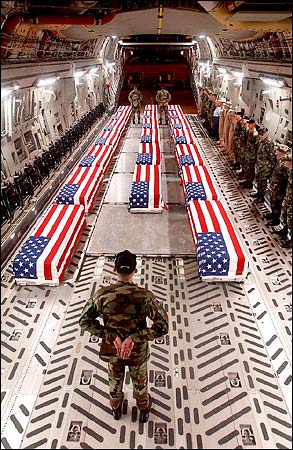
http://leftofdayton.files.wordpress.com/2007/10/soldiers-caskets-on-plane.jpg

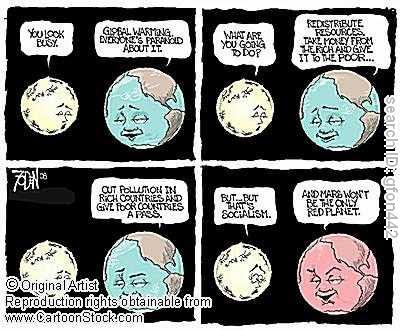
Republicans are now trying to rebrand Democrats as Socialists.
(W)hen the RNC meets in an extraordinary special session next week, it will approve a resolution rebranding Democrats as the “Democrat Socialist Party.”
Steele wrote a memo last month opposing the resolution. Steele said that while he believes Democrats “are indeed marching America toward European-style socialism,” he also said in a (rare) flash of insight that officially referring to them as the Democrat Socialist Party “will accomplish little than to give the media and our opponents the opportunity to mischaracterize Republicans.”
The RNC wants to reframe 'Democrats' or 'Liberals' as 'Socialists' to create an aura of fear. In other words, if you think like a liberal then you are really a socialist. If you are a socialist then you are opposed to a capitalist system of government.

But what happens when liberalism comes obsolete in a society?

Chris Hedges at Truthdig has a compelling article on that point. He suggests that there is a negative effect on a nation of being embattled in a 'Permanent War.' He states that when liberal democratic forces of a nation become powerless then the effect is "an age of moral nihilism....it can manifest itself in fascist salutes, communist show trials or Christian crusades."

The embrace by any society of permanent war is a parasite that devours the heart and soul of a nation. Permanent war extinguishes liberal, democratic movements. It turns culture into nationalist cant. It degrades and corrupts education and the media, and wrecks the economy. The liberal, democratic forces, tasked with maintaining an open society, become impotent. The collapse of liberalism, whether in imperial Russia, the Austro-Hungarian Empire or Weimar Germany, ushers in an age of moral nihilism. This moral nihilism comes is many colors and hues. It rants and thunders in a variety of slogans, languages and ideologies. It can manifest itself in fascist salutes, communist show trials or Christian crusades. It is, at its core, all the same. It is the crude, terrifying tirade of mediocrities who find their identities and power in the perpetuation of permanent war.

It was a decline into permanent war, not Islam, which killed the liberal, democratic movements in the Arab world, ones that held great promise in the early part of the 20th century in countries such as Egypt, Syria, Lebanon and Iran. It is a state of permanent war that is finishing off the liberal traditions in Israel and the United States. The moral and intellectual trolls—the Dick Cheneys, the Avigdor Liebermans, the Mahmoud Ahmadinejads—personify the moral nihilism of perpetual war. They manipulate fear and paranoia. They abolish civil liberties in the name of national security. They crush legitimate dissent. They bilk state treasuries. They stoke racism.

“War,” Randolph Bourne commented acidly, “is the health of the state.”

In “Pentagon Capitalism” Seymour Melman described the defense industry as viral. Defense and military industries in permanent war, he wrote, trash economies. They are able to upend priorities. They redirect government expenditures toward their huge military projects and starve domestic investment in the name of national security. We produce sophisticated fighter jets, while Boeing is unable to finish its new commercial plane on schedule. Our automotive industry goes bankrupt. We sink money into research and development of weapons systems and neglect renewable energy technologies to fight global warming. Universities are flooded with defense-related cash and grants, and struggle to find money for environmental studies. This is the disease of permanent war. [...]

Citizens in a state of permanent war are bombarded with the insidious militarized language of power, fear and strength that mask an increasingly brittle reality. The corporations behind the doctrine of permanent war—who have corrupted Leon Trotsky’s doctrine of permanent revolution—must keep us afraid. Fear stops us from objecting to government spending on a bloated military. Fear means we will not ask unpleasant questions of those in power. Fear means that we will be willing to give up our rights and liberties for security. Fear keeps us penned in like domesticated animals.

Doing away with liberalism will not make us safer. It's the RNC that seems to be off track.

Monday, May 4, 2009

What Should Be Regulated?


Republicans and the right-wing media are framing Barack Obama as being a "socialist." They complain that there is too much government regulation. They want government to get out of our lives and not control what we do. Unless of course they are refering to what we do in our bedrooms.

Daily Kos has an interesting article,
How Freedom Was Lost, about the need for government regulation because unregulated business does not self regulate.
In recent days there seems to be a trend, especially among those nodding along to Fox News, to look on every government worker as a leach on society. Is there any term said with more innate disdain than government bureaucrat? When George W. Bush first ran for congress, he campaigned for the elimination of two government agencies -- OSHA and the EPA. It's a position that would draw many cheers from those pulling for Rick Perry's rebellion today.

If there is one critical difference between the conservative and progressive view of the nation it is this: Conservatives believe that America became a vibrant, wealthy nation in spite of the government's burden on business. Progressives believe that the United States prospered because of a national effort to reign in the worst of corporate excess.

Over a century, we became a country with safety rules, with environmental regulations, with protection for the elderly. Over that same century our economy and individual wealth outstripped both our historical bests and the record of the rest of the world. Progressives see that as victory. Conservatives call it coincidence.

It's tempting to run the experiment of giving conservatives what they want. A nation without environmental rules, without workplace safety rules, without any social safety nets. Free them from the reign of bureaucrats and petty regulations. Let them live in that place where the medicine you give your baby to ease her teething pains can be made with antifreeze. Let them work in a mine where there is no regulation and thousands die each year. Let them wonder if their next bite of food will put them among the 1.8 million who die horribly each year from severe food-borne cases of diarrhea. Let them drive a car that will fall apart in the slightest collision. Let them breath free air, untainted by government interference -- air you can really sink your teeth into.

Fortunately, we don't have to run that experiment -- because we already did it. That's how we got where we are today. All those areas of our lives became regulated, because left unregulated people overreached to unsafe, and frequently hideous degrees. There would be no Clean Air Act if companies had controlled pollution on their own. There'd be no need to regulate banks, had they not demonstrate time and again that without supervisions they'll chase short term profit into a pit -- and drag the rest of us after them.


America isn't the only example of this experiment. This is an study that's been made hundreds of time in hundreds of nations, and the absolute freedom of the marketplace always runs counter to the good of ordinary citizens. Always. Those places in the world with the fewest restrictions on business are not the places anyone would really want to live. They're not even good places to do business if your task is more complex than ripping resources out of the ground and shipping them to some place that's safer. Business and government must reach a compromise if either is to be effective.