Showing posts with label Economics. Show all posts

Sunday, January 15, 2012

Bill Moyers is Back!

RJ Matson - Roll Call - PBS Goes Conservative - English - Big Bird, cookie monster,PBS,Sesame Street,Bill Moyers,closet,sweater,conservative,news,TV 

Bill Moyers and Moyers & Company is back highlighting important political, social and pressing issues that affect us all.   The following video is from the show: Bill Moyers: Occupy a Cause.
What’s the common cause behind Occupy protesters?
The Moyers & Company team visited the Occupy Wall Street site several times between October and December in 2011 — visits that reveal real faces, real people, and a true common cause. In this premiere Bill Moyers Essay, Bill talks about their anger — not at the concept of wealth itself, but at the crony capitalists who resort to tricks, loopholes, and hard, cold cash for politicians to make sure insiders prosper… and then pull up the ladder behind them.
Bill Moyers also explores how America’s vast inequality didn’t just happen, it’s been politically engineered. Watch the Bill Moyers' interview with Jacob Hacker and Paul Pierson about their book Winner-Take-All Politics: How Washington Made the Rich Richer--and Turned Its Back on the Middle Class.

Jacob Hacker & Paul Pierson on Winner Take All Politics from BillMoyers.com on Vimeo.

Tuesday, January 10, 2012

The Nit-Picking of Newt

Taylor Jones - Politicalcartoons.com - Newt - Hobsons choice - English - gingrich,newt gingrich,newt,republicans,conservatives,tea party,mitt romney

Massachusetts Senatorial Democratic candidate Elizabeth Warren has articulated quite well a progressive economic message regarding the debt crisis and fair taxation, as she speaks on the campaign trail. As a Democrat candidate, she makes a strong case for the underlying social contract that has been in effective in this country.


Here is a another statement from a political candidate that reflects the same sentiment as Warren's statements. Can you figure out who said this?

The era of Republican domination back between 1856 and 1932 was a period of tremendous government experimenting, a period of building the transcontinental railroad...a period of encouraging homesteading through the Homestead Act, a period of the agricultural college and the Morrill Act which led to the land-grant colleges and the agricultural agent system.

The test I always give conservatives is to say "How many of you wanted to save the Panama Canal?" Most of my conservative friends promptly raise their hands. But the fact of the matter is that the Panama Canal was built by government engineers, because government doctors cured yellow fevers. It was run by a government corporation and it was constructed by government Army and Navy, the largest public works project in history at the time was it was set up.*

The underlying message of the above statement fits into the progressive economic message of Elizabeth Warren. However, this quote did not come from Elizabeth Warren. It came from a young Rep. Newt Gingrich, in 1983. Gingrich has previously acknowledged the benefits of government in certain cases.

*Via
Congressional Record (daily ed.), November 3, 1983, H9200

Sunday, January 8, 2012

Sunday, December 11, 2011

The Newtster is at it Again!

Taylor Jones - Politicalcartoons.com - A gift from Newt - COLOR - English - gingrich,newt gingrich,newt,callista gingrich,child labor,child labor laws,tiffanys,republicans

In the news last week, Newt Gingrich said that he believed that kids from poor neighborhoods should work janitorial jobs at school in order to learn a work ethic. The REASON? Gingrich wants to relax our "truly stupid" child labor laws. He wants to do away with union workers, fire janitors and employ children at slave labor wages. Newt has a way of putting his thoughts into succinct statements.
“It is tragic what we do in the poorest neighborhoods, entrapping children in, first of all, child [labor] laws, which are truly stupid,”
"You say to somebody, you shouldn’t go to work before you’re what, 14, 16 years of age, fine. You’re totally poor. You’re in a school that is failing with a teacher that is failing. I’ve tried for years to have a very simple model. Most of these schools ought to get rid of the unionized janitors, have one master janitor and pay local students to take care of the school. The kids would actually do work, they would have cash, they would have pride in the schools, they’d begin the process of rising."
But not to worry, even Gingrich has his limits. When speaking to WNYM radio host Curtis Sliwa, he clarified, “Kids shouldn’t work in coal mines; kids shouldn’t work in heavy industry,” but he still supports having poor school kids scrub toilets in public schools.

Is this a new way of thinking for Gingrich? Absolutely not! In 1994, Newt proposed bringing back orphanages for children on welfare.
In 1994, during the early days of the public debate on welfare reform, Speaker of the House Newt Gingrich ignited a media firestorm by suggesting that orphanages are better for poor children than life with a mother on Aid to Families with Dependent Children (AFDC).
As part of his push for welfare reform, Gingrich proposed that states end aid to poor single mothers and their children be sent to orphanages that would be built with the saved money.
Responding to criticism of the plan by then-first lady Hillary Clinton, Gingrich cites a 1938 Hollywood film and said, “I’d ask her to go to Blockbuster and rent the Mickey Rooney movie about ‘Boys Town.’”
Newt's statements are bold, direct and false. Recently he added a proposal about the food stamp program.

In a speech in Iowa last month, for instance, Gingrich took on the federal Supplemental Nutrition Assistance Program — or food stamps, as it used to be called. The former U.S. House speaker, whom one would assume would know better, said that “people take their food stamp money and use it to go to Hawaii” on vacations. He also said “they give food stamps now to millionaires.”

PolitiFact.com, the fact-checkers at the Tamp Bay Times, looked into Gingrich’s charges and found them false, giving him the “Pants on Fire” rating of its truth meter for being so wrong.

The political pundits seem to agree that with Newt's success in the GOP primary race, Newt will continue to make outrageous, absurd and misinformed statements.


Taylor Jones - El Nuevo Dia, Puerto Rico - Newt work ethic - English -   gingrich,newt gingrich,newt,child labor,child labor laws,republicans,conservatives,tea party,unemployment

A different view has been espoused by Louis King, president and CEO of Summit Academy OIC, an educational and vocational training center focused on getting jobs for the jobless and under-employed. King believes that, “the best example for kids is to see their parents working” in order to have parents serve as role models. In other words, put their parents to work.
“You can’t have it both ways,” he adds. “You can’t demand people take care of themselves and at the same time not afford equal lending, good education and access to jobs. That is the hypocrisy of both the left and the right.”

Jobs for adults, he repeats, not putting children to work, is the path away from poverty to prosperity. “If I can put one or two people to work feeding their families, that is better than feeding 300 people one time.”

Monday, November 7, 2011

No Taxes, No Services

Steve Greenberg - Freelance, Los Angeles - Yapping creature - English - Grover Norquist,Republicans,tax,taxes,pledge,No New Taxes,GOP,GOP

Here's a great message by Stephen D. Foster Jr. about the "102 Things NOT To Do If You Hate Taxes."
So, you’re a Republican that hates taxes? Well, since you do not like taxes or government, please kindly do the following.

1. Do not use Medicare.
2. Do not use Social Security
3. Do not become a member of the US military, who are paid with tax dollars.
4. Do not ask the National Guard to help you after a disaster.
5. Do not call 911 when you get hurt.
6. Do not call the police to stop intruders in your home.
7. Do not summon the fire department to save your burning home.
8. Do not drive on any paved road, highway, and interstate or drive on any bridge.
9. Do not use public restrooms.
10. Do not send your kids to public schools.
11. Do not put your trash out for city garbage collectors.
12. Do not live in areas with clean air.
13. Do not drink clean water.
14. Do not visit National Parks.
15. Do not visit public museums, zoos, and monuments.
16. Do not eat or use FDA inspected food and medicines.
17. Do not bring your kids to public playgrounds.
18. Do not walk or run on sidewalks.
19. Do not use public recreational facilities such as basketball and tennis courts.
20. Do not seek shelter facilities or food in soup kitchens when you are homeless and hungry.
21. Do not apply for educational or job training assistance when you lose your job.
22. Do not apply for food stamps when you can’t feed your children.
23. Do not use the judiciary system for any reason.
24. Do not ask for an attorney when you are arrested and do not ask for one to be assigned to you by the court.
25. Do not apply for any Pell Grants.
26. Do not use cures that were discovered by labs using federal dollars.
27. Do not fly on federally regulated airplanes.
28. Do not use any product that can trace its development back to NASA.
29. Do not watch the weather provided by the National Weather Service.
30. Do not listen to severe weather warnings from the National Weather Service.
31. Do not listen to tsunami, hurricane, or earthquake alert systems.
32. Do not apply for federal housing.
33. Do not use the internet, which was developed by the military.
34. Do not swim in clean rivers.
35. Do not allow your child to eat school lunches or breakfasts.
36. Do not ask for FEMA assistance when everything you own gets wiped out by disaster.
37. Do not ask the military to defend your life and home in the event of a foreign invasion.
38. Do not use your cell phone or home telephone.
39. Do not buy firearms that wouldn’t have been developed without the support of the US Government and military. That includes most of them.
40. Do not eat USDA inspected produce and meat.
41. Do not apply for government grants to start your own business.
42. Do not apply to win a government contract.
43. Do not buy any vehicle that has been inspected by government safety agencies.
44. Do not buy any product that is protected from poisons, toxins, etc…by the Consumer Protection Agency.
45. Do not save your money in a bank that is FDIC insured.
46. Do not use Veterans benefits or military health care.
47. Do not use the G.I. Bill to go to college.
48. Do not apply for unemployment benefits.
49. Do not use any electricity from companies regulated by the Department of Energy.
50. Do not live in homes that are built to code.
51. Do not run for public office. Politicians are paid with taxpayer dollars.
52. Do not ask for help from the FBI, S.W.A.T, the bomb squad, Homeland Security, State troopers, etc…
53. Do not apply for any government job whatsoever as all state and federal employees are paid with tax dollars.
54. Do not use public libraries.
55. Do not use the US Postal Service.
56. Do not visit the National Archives.
57. Do not visit Presidential Libraries.
58. Do not use airports that are secured by the federal government.
59. Do not apply for loans from any bank that is FDIC insured.
60. Do not ask the government to help you clean up after a tornado.
61. Do not ask the Department of Agriculture to provide a subsidy to help you run your farm.
62. Do not take walks in National Forests.
63. Do not ask for taxpayer dollars for your oil company.
64. Do not ask the federal government to bail your company out during recessions.
65. Do not seek medical care from places that use federal dollars.
66. Do not use Medicaid.
67. Do not use WIC.
68. Do not use electricity generated by Hoover Dam.
69. Do not use electricity or any service provided by the Tennessee Valley Authority.
70. Do not ask the Army Corps of Engineers to rebuild levees when they break.
71. Do not let the Coast Guard save you from drowning when your boat capsizes at sea.
72. Do not ask the government to help evacuate you when all hell breaks loose in the country you are in.
73. Do not visit historic landmarks.
74. Do not visit fisheries.
75. Do not expect to see animals that are federally protected because of the Endangered Species List.
76. Do not expect plows to clear roads of snow and ice so your kids can go to school and so you can get to work.
77. Do not hunt or camp on federal land.
78. Do not work anywhere that has a safe workplace because of government regulations.
79. Do not use public transportation.
80. Do not drink water from public water fountains.
81. Do not whine when someone copies your work and sells it as their own. Government enforces copyright laws.
82. Do not expect to own your home, car, or boat. Government organizes and keeps all titles.
83. Do not expect convicted felons to remain off the streets.
84. Do not eat in restaurants that are regulated by food quality and safety standards.
85. Do not seek help from the US Embassy if you need assistance in a foreign nation.
86. Do not apply for a passport to travel outside of the United States.
87. Do not apply for a patent when you invent something.
88. Do not adopt a child through your local, state, or federal governments.
89.Do not use elevators that have been inspected by federal or state safety regulators.
90. Do not use any resource that was discovered by the USGS.
91. Do not ask for energy assistance from the government.
92. Do not move to any other developed nation, because the taxes are much higher.
93. Do not go to a beach that is kept clean by the state.
94. Do not use money printed by the US Treasury.
95. Do not complain when millions more illegal immigrants cross the border because there are no more border patrol agents.
96. Do not attend a state university.
97. Do not see any doctor that is licensed through the state.
98. Do not use any water from municipal water systems.
99. Do not complain when diseases and viruses, that were once fought around the globe by the US government and CDC, reach your house.
100. Do not work for any company that is required to pay its workers a livable wage, provide them sick days, vacation days, and benefits.
101. Do not expect to be able to vote on election days. Government provides voting booths, election day officials, and voting machines which are paid for with taxes.
102. Do not ride trains. The railroad was built with government financial assistance.

The fact is, we pay for the lifestyle we expect. Without taxes, our lifestyles would be totally different and much harder. America would be a third world country. The less we pay, the less we get in return. Americans pay less taxes today since 1958 and is ranked 32nd out of 34 of the top tax paying countries. Chile and Mexico are 33rd and 34th. The Republicans are lying when they say that we pay the highest taxes in the world and are only attacking taxes to reward corporations and the wealthy and to weaken our infrastructure and way of life. So next time you object to paying taxes or fight to abolish taxes for corporations and the wealthy, keep this quote in mind…

“I like to pay taxes. With them, I buy civilization.” ~Oliver Wendell Holmes
It is time to face facts. Without the rich and the large corporations paying a higher tax rate, society will suffer. The American dream will be difficult unless you are rich and pay lower taxes than the rest of us.

Sunday, October 30, 2011

Can Congress Pass Banking Reform?

Bill Schorr - Cagle Cartoons - Congress Cant Pass Banking Reform - English - Congress, Capital, Mastercard, Visa, American Express, Discover, banking reform, wall street, banks


Robert Reich says that since Wall Street is still out of control, that it would be a politically and economically smart move for President Obama to resurrect the Glass-Steagall Act and thereby break up the big banks.

Next week President Obama travels to Wall Street where he’ll demand – in light of the Street’s continuing antics since the bailout, as well as its role in watering-down the Volcker rule – that the Glass-Steagall Act be resurrected and big banks be broken up.

I’m kidding. But it would be a smart move — politically and economically.

Politically smart because Mitt Romney is almost sure to be the Republican nominee, and Romney is the poster child for the pump-and-dump mentality that’s infected the financial industry and continues to jeopardize the American economy.

Romney was CEO of Bain & Company – a private-equity fund that bought up companies, fired employees to save money and boost performance, and then resold the firms at a nice markups.

Romney also epitomizes the pump-and-dump culture of America’s super rich. To take one example, he recently purchased a $3 million mansion in La Jolla, California (in addition to his other homes) that he’s razing in order build a brand new one.

What better way for Obama to distinguish himself from Romney than to condemn Wall Street’s antics since the bailout, and call for real reform?

Economically it would be smart for Obama to go after the Street right now because the Street’s lobbying muscle has reduced the Dodd-Frank financial reform law to a pale reflection of its former self. Dodd-Frank is rife with so many loopholes and exemptions that the largest Wall Street banks – larger by far than they were before the bailout – are back to many of their old tricks.

It’s impossible to know, for example, the exposure of the Street to European banks in danger of going under. To stay afloat, Europe’s banks will be forced to sell mountains of assets – among them, derivatives originating on the Street – and may have to reneg on or delay some repayments on loans from Wall Street banks.

The Street says it’s not worried because these assets are insured. But remember AIG? The fact Morgan Stanley and other big U.S. banks are taking a beating in the market suggests investors don’t believe the Street. This itself proves financial reform hasn’t gone far enough.

If you want more evidence, consider the fancy footwork by Bank of America in recent days. Hit by a credit downgrade last month, BofA just moved its riskiest derivatives from its Merrill Lynch unit to a retail subsidiary flush with insured deposits. That unit has a higher credit rating because the Federal Deposit Insurance Corporation (that is, you and me and other taxpayers) are backing the deposits. Result: BofA improves its bottom line at the expense of American taxpayers.

Wasn’t this supposed to be illegal? Keeping risky assets away from insured deposits had been a key principle of U.S. regulation for decades before the repeal of Glass-Steagall.

The so-called “Volcker rule” was supposed to remedy that. But under pressure of Wall Street’s lobbyists, the rule – as officially proposed last week – has morphed into almost 300 pages of regulatory mumbo-jumbo, riddled with exemptions and loopholes.

It would have been far simpler simply to ban proprietary trading from the jump. Why should banks ever be permitted to use peoples’ bank deposits – insured by the federal government – to place risky bets on the banks’ own behalf? Bring back Glass-Steagall.

True, Glass-Steagall wouldn’t have prevented the fall of Lehman Brothers or the squeeze on other investment banks in 2007 and 2008. That’s why it’s also necessary to break up the big banks.

In the wake of the bailout, the biggest banks are bigger than ever. Twenty years ago the ten largest banks on the Street held 10 percent of America’s total bank assets. Now they hold over 70 percent. And the biggest four have a larger market share than ever – so large, in fact, they’ve almost surely been colluding. How else to explain their apparent coordination on charging debit card fees?

The banks aren’t even fulfilling their fiduciary duties to investors. Last summer, after Groupon selected Goldman Sachs, Morgan Stanley, and Credit Suisse to underwrite its initial public offering, the trio valued it at a generous $30 billion. Subsequent accounting and disclosure problems showed this estimate to be absurdly high. Did the banks care? Not a wit. The higher the valuation, the fatter their fees.

Just last week Citigroup settled charges (without admitting or denying guilt) that it defrauded investors by selling them a package of mortgage-backed securities rife with mortgages it knew were likely to default, but didn’t disclose the hazard. It then bet against the package for its own benefit – earning fees of $34 million and net profits of at least $126 million. So what’s Citi paying to settle this outrage? A mere $285 million. Its CEO at time (Charles Prince) doesn’t pay a dime.

I doubt the President will be condemning the Street’s antics, or calling for a resurrection of Glass-Steagall and a breakup of the biggest banks. Democrats are still too dependent on the Street’s campaign money.

That’s too bad. You don’t have to be an occupier of Wall Street to conclude the Street is still out of control. And that’s dangerous for all of us.

Congress would be smart to repeal the 1999 Gramm–Leach–Bliley Act and then resurrect the banking reforms found in the 1933 Glass-Steagall Act. Those reforms, which were in place for over sixty years, worked to control speculation. They also prohibited a bank holding company from owning other financial companies and as well separated commercial banking from investment banking. And for that, President Obama needs to demand the change!

Saturday, October 29, 2011

The Peoples Response to Police Violence


In Oakland, California on October 25th, 2011 an Occupy Wall Street protest turned into a confrontation between the protestors and the Oakland Police. As Marc Ash can tell you in Remember What They Did in Oakland that "no one really saw it coming. We should have."

Civil unrest, civil resistance, a paranoid, uneducated - and far too heavily armed - police force, governmental officials with no experience in managing para-military forces under their control. It was all there, flame lit, waiting to boil over.

Can anyone see it still? It's there, right there in the picture ... look closely. It's an Oakland police officer standing in broad daylight in the middle of an American city leveling a shotgun at American citizens and firing at them as they run for their lives. Think Kent State, think Chicago 1968. This happened. Mark the day, rue the day.

To the credit of the protesters, they provoked but did not engage or reciprocate in the violence. The Oakland Police Department, however, gave the United States an abject lesson in why compromising civil liberties for the sake of national security is a decision that will eventually blow up in your face.

Scott Olsen and Joshua Shepherd were trained - they thought - by the Marine Corps and the Navy, respectively, to defend freedom. Both served overseas until they realized that the real fight for American freedom is, and really has been, here in the land we call home. So they stood side by side facing down freedom's oldest enemies: fear, ignorance and authoritarianism. The police opened fire on them and Scott Olsen fell critically wounded. Not in Iraq or Afghanistan, but here. He is now in an Oakland hospital fighting for his life. He and all of those who were there with him that night in Oakland, and every city in America now occupied by Americans standing up to injustice, need our support.

What are they fighting for?

Like all revolutionary political movements the Occupy Movement is a spontaneous eruption. It was not scripted or planned in advance. It is rather, the stifled voice of the oppressed, silent no more. To understand what they want we must ask, what do we want? And we must listen to what they say, and to what is in our hearts.

The common theme is "justice." Economic justice, earth environmental justice and social justice. Do those goals sound familiar? They should. They have been at the forefront of every political demonstration in history. However, on a slightly more specific note, if you are looking for things to watch for you will probably be hearing more about the abolishment of the Federal Reserve System in the days, weeks and months to come. Perhaps growing demands for legal prosecution of financial industry managers, maybe some - real - healthcare reform, a little solidarity with our fellow citizens of earth who do not want an American military base in their back yard. Stuff like that.

If the goal of the Oakland police was to squash the Occupy movement, then the violence was not the message. The result is that Occupy Oakland and its supporters have called for a "GENERAL STRIKE & MASS DAY OF ACTION - NOVEMBER 2."
We as fellow occupiers of Oscar Grant Plaza propose that on Wednesday November 2, 2011, we liberate Oakland and shut down the 1%.

We propose a city wide general strike and we propose we invite all students to walk out of school. Instead of workers going to work and students going to school, the people will converge on downtown Oakland to shut down the city. All banks and corporations should close down for the day or we will march on them.

While we are calling for a general strike, we are also calling for much more. People who organize out of their neighborhoods, schools, community organizations, affinity groups, workplaces and families are encouraged to self organize in a way that allows them to participate in shutting down the city in whatever manner they are comfortable with and capable of.

The whole world is watching Oakland. Let’s show them what is possible.


Change may have been a campaign slogan. Now is is a reality!

Thursday, October 13, 2011

Sen. Bernie Sanders has a Six Point Plan to Reform Wall Street


Sen. Bernie Sanders (I-VT) commenting on Occupy Wall Street says focusing pressure on Wall Street is now the right thing to do for sweeping Wall Street reform. "We have six financial institutions , the largest six banks in the country, who control 60% of the assests of the United Sates of America. After we bailed them out, because they were too big to fail, then three out of the four financial institutions actually became bigger."
WATCH:


Sen. Sanders says there are Six Demands to Make of Wall Street:
The Occupy Wall Street protests are shining a national spotlight on the most powerful, dangerous, and secretive economic and political force in America.

If this country is to break out of the horrendous recession and create the millions of jobs we desperately need, if we are going to create a modicum of financial stability for the future, there is no question but that the American people are going to have to take a very hard look at Wall Street and demand fundamental reforms. I hope these protests are the beginning of that process.

Let us never forget that as a result of the greed, recklessness, and illegal behavior on Wall Street, this country was plunged into the worst economic downturn since the Great Depression. Millions of Americans lost their jobs, homes, and life savings as the middle class underwent an unprecedented collapse. Sadly, despite all the suffering caused by Wall Street, there is no reason to believe that the major financial institutions have changed their ways, or that future financial disasters and bailouts will not happen again.

More than three years ago, Congress rewarded Wall Street with the biggest taxpayer bailout in the history of the world. Simultaneously but unknown to the American people at the time, the Federal Reserve provided an even larger bailout. The details of what the Fed did were kept secret until a provision in the Dodd-Frank Act that I sponsored required the Government Accountability Office to audit the Fed's lending programs during the financial crisis.

As a result of this audit, the American people have learned that the Federal Reserve provided more than $16 trillion in low-interest loans to every major financial institution in this country, huge foreign banks, multi-national corporations, and some of the wealthiest people in the world.

In other words, when Wall Street was on the verge of collapse, the federal government acted boldly, aggressively, and with a fierce sense of urgency to save our financial system from collapse with no strings attached.

Now that the middle class is collapsing and a record-breaking 46 million Americans are living in poverty, the Federal Reserve has failed to act with the same sense of urgency to make sure that small businesses receive the affordable loans needed to put millions of Americans back to work and prevent millions of Americans from losing their homes.

As a result, Wall Street is back to making record-breaking profits, handing out record-breaking compensation packages, and taking the same risks that caused the financial crisis in the first place. Meanwhile, 25 million Americans are unemployed or under-employed; middle class families are making $3,600 less than they did ten years ago; the foreclosure rate is still breaking new records; and the American people are still paying over $3.40 for a gallon of gas.

The financial crisis and the jobs crisis have demonstrated to the American people that we now have a government that is of the 1 percent, by the 1 percent and for the 1 percent, as Nobel Prize winning economist Joseph Stiglitz eloquently articulated. The rest of the 99 percent are, more or less, on their own. We now have the most unequal distribution of wealth and income of any major, advanced country on earth. The top one percent earn more income than the bottom 50 percent and the richest 400 Americans own more wealth than the bottom 150 million Americans.

Now that Occupy Wall Street is shining a spotlight against Wall Street greed and the enormous inequalities that exist in America, the question then becomes, how do we change the political, economic and financial system to work for all Americans, not just the top 1 percent?

Here are several proposals that I am working on:

  1. If a financial institution is too big to fail, it is too big to exist. Today, the six largest financial institutions have assets equal to more than 60 percent of GDP. The four largest banks in this country issue two-thirds of all credit cards, half of all mortgages, and hold nearly 40 percent of all bank deposits. Incredibly, after we bailed out these big banks because they were "too big to fail," three out of the four largest are now even bigger than they were before the financial crisis began. It is time to take a page from Teddy Roosevelt and break up these behemoths so that their failure will no longer lead to economic catastrophe and to create competition in our financial system.

  2. Put a cap on credit card interest rates to end usury. Today, more than a quarter of all credit card holders in this country are paying interest rates above 20 percent and as high as 59 percent. When credit card companies charge 25 or 30 percent interest rates they are not engaged in the business of "making credit available" to their customers. They are involved in extortion and loan-sharking. Citigroup, Bank of America, and JP Morgan Chase should not be permitted to charge consumers 25-30 percent interest on their credit cards, especially while these banks received over $4 trillion in loans from the Federal Reserve.

  3. The Federal Reserve needs to provide small businesses in America with the same low-interest loans it gave to foreign banks. During the financial crisis, the Federal Reserve provided hundreds of billions of dollars to foreign banks and corporations including the Arab Banking Corporation, Toyota, Mitsubishi, the Korea Development Bank, and the state-owned Bank of Bavaria. At a time when small businesses can't get the lending they need, it is time for the Fed to create millions of American jobs by providing low-interest loans directly to small businesses.

  4. Stop Wall Street oil speculators from artificially increasing gasoline and heating oil prices. Right now, the American people are being gouged at the gas pump by speculators on Wall Street who are buying and selling billions of barrels of oil in the energy futures market with no intention of using a drop for any purpose other than to make a quick buck. Delta Airlines, Exxon Mobil, the American Trucking Association, and other energy experts have estimated that excessive oil speculation is driving up oil prices by as much as 40 percent. We have got to end excessive oil speculation and bring needed relief to American consumers.

  5. Demand that Wall Street invest in the job-creating productive economy, instead of gambling on worthless derivatives. The American people have got to make it crystal clear to Wall Street that the era of excessive speculation is over. The "heads, bankers win; tails, everyone else loses" financial system must end. Most important, we need to create a new Wall Street that exists not to reward CEOs and investors for the bets they make on exotic financial instruments nobody understands. Rather, we need a Wall Street that provides financial services to small businesses and manufacturers to create decent-paying jobs and grow the economy by productive means. Think of all of the productive short- and long-term investments that could be made in our country right now if Wall Street used the money it has received from the federal government wisely. Instead of casino-style speculation, Wall Street could invest in high-speed trains; fuel-efficient cars; wind turbines and other alternative energy sources; affordable housing; affordable prescription drugs that save people's lives; and other things that America desperately needs. That is what we have got to demand from Wall Street.

  6. Establish a Wall Street speculation fee on credit default swaps, derivatives, stock options and futures. Both the economic crisis and the deficit crisis are a direct result of the greed and recklessness on Wall Street. Establishing a speculation fee would reduce gambling on Wall Street, encourage the financial sector to invest in the productive economy, and significantly reduce the deficit without harming average Americans. There are a number of precedents for this. The U.S had a similar Wall Street speculation fee from 1914 to 1966. The Revenue Act of 1914 levied a 0.2 percent tax on all sales or transfers of stock. In 1932, Congress more than doubled that tax to help finance the government during the Great Depression. And today, England has a financial transaction tax of 0.25 percent, a penny on every $4 invested.

Making these reforms will not be easy. After all, Wall Street is clearly the most powerful lobbying force on Capitol Hill. From 1998 through 2008, the financial sector spent over $5 billion in lobbying and campaign contributions to deregulate Wall Street. More recently, they spent hundreds of millions more to make the Dodd-Frank bill as weak as possible, and after its passage, hundreds of millions more to roll back or diluter the stronger provisions in that legislation.

Reform of Wall Street will benefit all of the 99% of the U.S. citizens and therefore we should all be in unison on this message.

Thursday, October 6, 2011

We are the 99%

Bob Englehart - The Hartford Courant - Occupy Wall Street - English - wealthy,dow jones,stock market, demonstrations, occupy wall street, protesters

The mainstream media has given the Occupy Wall Street protest limited exposure. But the information coming from MSM would have you believe that the occupation is made solely of kids and hippies. Think again. WATCH:


Although many in the Occupy Wall Street movement do not want political support for their protest, many Democratic politicians have shown some solidarity with the protestors.

Which Democratic lawmakers have begun to embrace the Occupy Wall Street protestors?

Reps. Raul Grijalva (D-Ariz.) and Keith Ellison (D-Minn.) stated in a joint statement:

"We share the anger and frustration of so many Americans who have seen the enormous toll that an unchecked Wall Street has taken on the overwhelming majority of Americans while benefiting the super-wealthy. We join the calls for corporate accountability and expanded middle-class opportunity."

House Democrat, Caucus Chairman John Larson (Conn.), released a statement:

"The silent masses aren't so silent anymore. They are fighting to give voice to the struggles that everyday Americans are going through."

Sen. Bernie Sanders (I-Vt.), stated:

"I applaud those protesters who are out there, who are focusing attention on Wall Street, but what we've got to do is put meat on that bone. We've got to make demands on Wall Street [and] break those institutions up."

Reps. Dennis Kucinich (D-Ohio) and Louise Slaughter (D-N.Y.) have also applauded the movement.


Rep. Barbara Lee (D-Calif.), a leader in both the Congressional Progressive Caucus and the Congressional Back Caucus, said:

"All of us should join that movement."

The chairman of the Federal Reserve, Ben Bernanke, was asked about the protests during his appearance before the Joint Economic Committee on Tuesday.

"I would just say very generally, I think people are quite unhappy with the state of the economy and what's happening," Bernanke said. "They blame, with some justification, the problems in the financial sector for getting us into this mess, and they're dissatisfied with the policy response here in Washington. And at some level, I can't blame them."
And a sole Republican has come out indicating that he sympathized with the protesters. Rep. Ron Paul (Texas), an outspoken Republican critic of the Federal Reserve, stated
“If they were demonstrating peacefully, and making a point, and arguing our case, and drawing attention to the Fed — I would say, good!
Occupy Wall Street is about ending corporate greed, getting jobs, building back the middle class and keeping the American dream alive. This is a national message that should not be limited to political divisiveness or ideology. We are the 99% and we are gaining strength!

Wednesday, October 5, 2011

The Truth about Who Increased the Debt

The graph above represents this chronology of events that led to the increase of the U.S. debt.

1980: Ronald Reagan runs for president, promising a balanced budget

1981 - 1989: With support from congressional Republicans, Reagan runs enormous deficits, adds $2 trillion to the debt.

1993: Bill Clinton passes economic plan that lowers deficit, gets zero votes from congressional Republicans.

1998: U.S. deficit disappears for the first time in three decades. Debt clock is unplugged.

2000: George W. Bush runs for president, promising to maintain a balanced budget.

2001: CBO shows the United States is on track to pay off the entirety of its national debt within a decade.

2001 - 2009: With support from congressional Republicans, Bush runs enormous deficits, adds nearly $5 trillion to the debt.

2002: Dick Cheney declares, "Deficits don't matter."

2009: Barack Obama inherits $1.3 trillion deficit from Bush; Republicans immediately condemn Obama's fiscal irresponsibility.

2009: Congressional Democrats unveil several domestic policy initiatives -- including health care reform, cap and trade, DREAM Act -- which would lower the deficit. GOP opposes all of them, while continuing to push for deficit reduction.

September 2010: In Obama's first fiscal year, the deficit shrinks by $122 billion. Republicans again condemn Obama's fiscal irresponsibility.

October 2010: S&P endorses the nation's AAA rating with a stable outlook, saying the United States looks to be in solid fiscal shape for the foreseeable future.

November 2010: Republicans win a U.S. House majority, citing the need for fiscal responsibility.

December 2010: Congressional Republicans demand extension of Bush tax cuts, relying entirely on deficit financing. GOP continues to accuse Obama of fiscal irresponsibility.

March 2011: Congressional Republicans declare intention to hold full faith and credit of the United States hostage -- a move without precedent in American history -- until massive debt-reduction plan is approved.

July 2011: Obama offers Republicans a $4 trillion debt-reduction deal. GOP refuses, pushes debt-ceiling standoff until the last possible day, rattling international markets.

August 2011: S&P downgrades U.S. debt, citing GOP refusal to consider new revenues. Republicans rejoice and blame Obama for fiscal irresponsibility.
Any questions?

Saturday, September 10, 2011

It's Just a Tale, Not a Miracle!

Jim Hightower is a Texan who is bringing truth into the spotlight that Rick Perry is now latching onto. Hightower, a Texan, is America’s #1 populist who has been following the antics of Rick Perry for years. Perry is not who he says he is says Hightower in his commentary, Perry Tales: jobs creation.

The "Texas Miracle"

Presidential wannabe Rick Perry is flitting hither, thither and yon, spreading little "Perry Tales" about the economic miracles he has produced in Texas.

Fantasy number one is a creationist story about jobs. As he recently flitted across Iowa, he gushed that he has built "a job-creating machine in the state of Texas," and a Perry aide flatly said, "The governor's job-creation record speaks for itself."

Just a Tale

Actually it doesn't. Probe even an inch into the million-job number that Perry tosses around like fairy dust, and you'll learn that these are mostly "jobettes" that can't sustain a family. Most come with very low pay and no health care or pension, and many are only part-time or temporary positions. Indeed, more than a half a million Texans now work for minimum wage or less – a number that has doubled since 2008, leaving Texas tied with Mississippi for the nation's highest percentage of its workforce reduced to poverty pay.

Public vs Private Sector

Spreading even more fairy dust, Perry claims that his Texas Miracle is the result of him keeping the government out of the private sector's way. But peek behind that ideological curtain and you'll find this startling fact: during Perry's decade, the growth in private sector jobs has been a relatively paltry nine percent, while the public sector has more than doubled that, increasing the number of local, state, and federal workers in Texas by 19 percent. One out of six employed Texans are now teachers, police officers, highway engineers, military personnel, and other government workers – and many of these jobs were created with federal money, including cash from Barack Obama's stimulus program that Perry-the candidate now loudly denounces. There's his "miracle."

Meanwhile, joblessness is on the rise in Texas, and the whole Perry Tale is about to go poof – thanks to his recent multibillion-dollar budget cuts that will destroy more than 100,000 good jobs throughout the state.

No Government Mantra but Yes Government Monetary Personal Support

Interestingly, even his tea-partyish hatred — nay, loathing! — of big government's intrusion into the lives of ordinary citizens turns out to be just another Perry Tale. In fact, there would be no Rick Perry without the steady "intrusion" of government into his life.

Local taxpayers in Haskell County put him through their public school system — for free. He and his family were dry-land cotton farmers, and federal taxpayers helped support them with thousands of dollars in crop subsidies — Perry personally took $80,000 in farm payments.

State and federal taxpayers financed his college education his at Texas A&M, even giving him the extracurricular opportunity to be a cheerleader. Upon graduation, he spent four years on the federal payroll as an Air Force transport pilot who never did any combat duty.

Then, in 1984, Perry hit the mother lode of government pay by moving into elected office — squatting there for 27 years and counting. In addition to getting regular paychecks from taxpayers for nearly three decades as a state representative, agriculture commissioner, lieutenant governor and governor, he also receives platinum-level health care coverage and a generous pension from the state, plus $10,000 a month for renting a luxury suburban home, a covey of political and personal aides and even a publicly paid subscription to Food & Wine magazine.

So when this taxpayer-supported lifer flits into your town to declare that he will slash public benefits and make government "as inconsequential as possible," he means in your life, not his.

Hightower fights on behalf of "consumers, working families, environmentalists, small businesses, and just-plain-folks." He knows Texas, and knows the real story behind the self-absorbed, fantasy driven, hypocritical Rick Perry.

Sunday, August 28, 2011

GOP-Tea Party Attaches Strings to Hurricane Irene Assistance

Taylor Jones - Politicalcartoons.com - Cantor points the way Color - English - cantor,eric cantor,congress,republicans,tea party,debt crisis,debt ceiling, caricature

The GOP-Tea Party Republicans have developed a new procedure, a new approach, a new policy for responding to disasters. When money is needed as a remedy for a potential disaster, the GOP-Tea Party Republicans will not lend support for the needed money or assistance unless the agenda that they want is also attached. This tactic was used during the debt-ceiling crisis. Eric Cantor has now says that "the GOP approach would break from how U.S. policymakers have operated." AlterNet has the story of GOP's Callous, Money-Oriented Response to Storm Damage: "It is Sinful"
Hurricane Irene made landfall this morning, hitting North Carolina with sustained winds of 90 miles per hour. Irene was downgraded overnight to a Category 1 hurricane, but it remains a powerful storm capable of doing serious harm.

Obviously, we can all hope the severity of the damage is limited. Regrettably, though, the line on federal disaster aid from congressional Republicans has not changed.

This week, House Majority Leader Eric Cantor (R-Va.) said the GOP approach would break from how U.S. policymakers have operated. Whereas Congress used to provide emergency funds after a disaster, without regard for budget caps or offsets, Republicans have said they will no longer accept such an approach -- if Democrats want emergency assistance in the wake of a natural disaster, Republicans will insist on attaching some strings to the relief funds.

In this case, the strings are cuts elsewhere in the budget. Or as Cantor's spokesperson put it, GOP leaders expect "additional funds for federal disaster relief" to be "offset with spending cuts."

The Republican position is already drawing fire.

"It is sinful to require us to cut somewhere ... in order to provide emergency disaster assistance for American citizens," Rep. Cedric Richmond (D-La.) told The Huffington Post on Friday.

The Louisiana Democrat pointed out that this weekend is the sixth anniversary of Hurricane Katrina, which devastated his district and cost the federal government more than $100 billion. That recovery effort would have been delayed "by years" if Congress had required the same kind of spending cuts to offset aid, he said.

"I have been one who has been preparing for the hurricane, trying to give people some comfort. One thing they need to know is the federal government can come to their aid," Richmond said. "I don't think we're in a position, given the rules set up by the majority, that we're going to be able to come to their aid quickly."

Perhaps realizing the potential for a political nightmare -- Republicans are already unpopular; just wait until they hold hostage relief funds for communities hit by a hurricane -- GOP leaders weren't eager to talk about their position yesterday.

But they didn't disavow it, either. Cantor's office rejected questions about "hypothetical federal aid caused by hypothetical damage," despite the fact that the Majority Leader and his spokesperson were more than willing to discuss the position 24 hours earlier.

House Speaker John Boehner's (R-Ohio) office was also cagey, saying policymakers will "discuss costs when and if they occur."

Neither Republican leader offered the correct response, which is, "Of course we'll do whatever it takes to help the affected communities."

With any luck, this will be a moot point. If the damage isn't severe, Congress won't have to approve emergency relief. At this point, we just don't know.

But in the event of extensive damage, there's a real possibility that the first question from congressional Republicans won't be, "How can we help?" but rather, "What will Democrats give us in exchange for disaster aid?
Paul Krugman has astutely observed that this behavior is analogous to a hostage situation.
Six months ago President Obama faced a hostage situation. Republicans threatened to block an extension of middle-class tax cuts unless Mr. Obama gave in and extended tax cuts for the rich too. And the president essentially folded, giving the G.O.P. everything it wanted.

Now, predictably, the hostage-takers are back: blackmail worked well last December, so why not try it again? This time House Republicans say they will refuse to raise the debt ceiling — a step that could inflict major economic damage — unless Mr. Obama agrees to large spending cuts, even as they rule out any tax increase whatsoever.
Legislators have historically been willing to compromise. Krugman notes what has changed?
The answer is the radicalization of the Republican Party. Normally, a party controlling neither the White House nor the Senate would acknowledge that it isn’t in a position to impose its agenda on the nation. But the modern G.O.P. doesn’t believe in following normal rules. [...] At some point — and sooner rather than later — the president has to draw a line. Otherwise, he might as well move out of the White House, and hand the keys over to the Tea Party.
The President did give in to the GOP-Tea Party agenda with tax cuts and the debt-ceiling. Now, there are catastrophic costs for disaster relief. The response of the GOP-Tea Party is to have another hissy fit, hold their breath till they turn blue and claim there will be no money unless their strings are attached.

I hear conservatives continually criticism liberals for a negative attitude toward them. But sometimes, truth is merely truth. And if negativity stems from the truth, then one should look at the behavior emanating from the actor or participant of the action rather than the observer of the facts.
It is time to put the children to bed without their supper and just say NO to being held hostage. Yell as loud as you can, "Right back at you Cantor!!!!"

Wednesday, August 3, 2011

Jobs and Free Trade

J.D. Crowe - Mobile Register - Fre Trade shoveler - English - Free trade NAFTA CAFTA rural south jobs business economy

The North American Free Trade Agreement, NAFTA,, was signed into law by President Bill Clinton in 1994. It was touted as a way to strengthen the economy while creating U.S. middle-class jobs. The theory of a free trade agreement is that it will allow faster and more business between the two countries which will benefit both.

President Clinton used the method of triangulation to work with Republicans in creating free trade legislation that would pass Congress. When NAFTA was first signed in 1994, proponents said it would eventually create jobs for the U.S. economy. In signing a NAFTA side agreement in 1993, several months before signing the agreement into law, President Clinton explained way he thought trade agreements were important.

I believe that NAFTA will create a million jobs in the first five years of its impact. And I believe that that is many more than will be lost...

However, on March 19, 2010, former President Clinton admitted that the policy underlying the free trade agreement with Haiti was a mistake and a failure. As the UN Special Envoy to Haiti, he apologized for having imposed free trade on Haiti during his first term in office.

This policy "may have been good for some of my farmers in Arkansas, but it has not worked. It was a mistake," Clinton told the Senate Foreign Relations Committee. "I had to live every day with the consequences of the loss of capacity to produce a rice crop in Haiti to feed those people because of what I did; nobody else."

Seventeen years after NAFTA was signed into law, there are new estimates that trade agreements have the cost the American worker hundreds of thousands of job losses.

According to a report by Economic Policy Institute economist Robert Scott, entitled "Heading South: U.S.-Mexico trade and job displacement after NAFTA," an estimated 682,900 U.S. jobs have been "lost or displaced" because of the agreement and the resulting trade deficit.

In light of the concrete evidence that NAFTA has created, not jobs, but job losses for the American worker, there are presently three trade agreements with Panama, South Korea and Colombia pending before Congress.

Yet, in light of this evidence and along with President Bill Clinton's revelation regarding the effect of a trade agreement with Haiti, here’s how President Obama describes the three NAFTA-style free trade agreements that Congress is attempting to ratify later this month, one with Panama.

There are a few things that we can and should do right now to redouble our efforts on behalf of the American people. Today, Congress can advance trade agreements that will help businesses sell more American-m­ade goods and services to Asia and South America, supporting thousands of jobs here at home.

The evidence is substantiated that NAFTA continues to lose jobs for U.S. workers.

Jobs continue to be lost to NAFTA today. In the years 2007-2010, the U.S. economy has lost 116,400 as a result of the trade deficit created by NAFTA. And last year, the growth of Mexican auto exports to the United States alone created more Mexican jobs -- 30,400 -- than the entire U.S. auto industry.

It's the U.S. manufacturing sector that has suffered most mightily from NAFTA, alone accounting for 60.8 percent -- 415,000 total -- of the jobs lost to the agreement. Specifically, those making computer of electronic parts have accounted for 22 percent of all job losses, and motor vehicle and parts workers accounted for 15 percent of job losses.

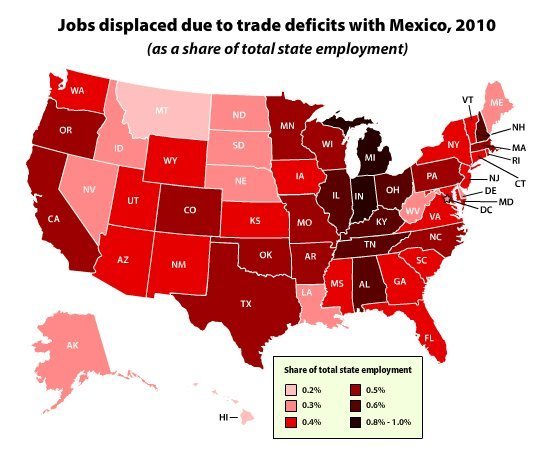
Job losses haven't been limited to certain geographic regions, either, as all fifty states have lost jobs as a result. And while the states with the largest total number of job losses, California and Texas, do hug the southern border, it's actually manufacturing-heavy states to the north, such as Michigan, Indiana and Kentucky, that have lost the largest share of jobs to Mexico.

The below chart tracks jobs displaced as share of total state employment:


Why would President Obama support this trade agreement legislation? Dylan Ratigan proffers a suggestion about politicians and trade agreements on his blog:

If you want to know why politicians are so eager to pass a free trade agreement with Panama this month, type “Panama offshore banks” into Google and look at the paid ads. What you’ll see is advertising by law firms and banks that will offer you help to set up a secret corporate structure in Panama immune from taxes.

Panama is too small as an economy to really impact jobs in the United States, the real value of the FTA is strategic and has to do with American geopolitical aims. For the business community, Panama is a great place to hide their money.

Is there any method to this madness? Banks, corporations and big business all want trade agreements and they always have more influence on politicians than the American worker does.