Showing posts with label GOP Agenda. Show all posts

Wednesday, January 18, 2012

On the Road to Pottersville

John Darkow - Columbia Daily Tribune, Missouri - Its A Wonderful Life-For Wall Street - English - Wall Street, Wall Street CEO bonuses, rich, money 
According to Robert Parry, the goal of the right-wing Republican Tea Bag Party is set on "Turning America into Pottersville."
The Republican presidential race has taken a detour into the "class warfare" that the party supposedly despises, with Newt Gingrich and Rick Perry tagging Mitt Romney as an elitist who got rich by laying off workers. But this spat misses the larger point of what the Right is doing to America, writes Robert Parry.
For many years, it appeared that the Right wanted to take the United States back to the 1950s - when blacks "knew their place," women were "in the kitchen" and gays stayed "in the closet" - but it turns out that the intended back-in-time-travel was to the 1920s, to an era of a few haves and many have-nots, not only before the Civil Rights Movement but before the Great American Middle-Class.

The Right's goal has been less to recreate the world of "Father Knows Best" than to establish a national "Pottersville," like in the movie, "It's a Wonderful Life," where the existence of the average man and woman was brutish and unfulfilling, while the 1 percent of that age lived in gilded comfort and held sweeping power.

That is the message ironically coming from the expensive ad wars of the Republican presidential battle, where frontrunner Mitt Romney has emerged as the personification of the 1 percent and has been attacked by rivals who - while supporting similar policies favoring the ultra-rich - have savaged his career as a venture capitalist, or as Texas Gov. Rick Perry puts it, a "vulture capitalist."

Romney's response has been telling. The former chief executive of the corporate takeover firm Bain Capital went beyond the Right's usual lament about "class warfare," terming the criticism of high-flying financiers who use layoffs to fatten their bottom lines "the bitter politics of envy."

And, if there remained any doubt about Romney's status as the nation's "elitist-in-chief," he added that it was wrong to have a noisy and open debate about the dangers of growing income inequality. He told Matt Lauer on NBC's "Today" that "I think it's fine to talk about those things in quiet rooms, and discussions about tax policy and the like."

In other words, keep the rabble from protesting their lot; leave these matters to the well-bred and the well-off, in their think tanks and their board rooms.

For decades, the Right has largely concealed this elitist agenda behind appeals to social conservatism and flag-waving patriotism. Many working- and middle-class Americans, especially white males, have sided with the economic free-marketers because the hated "lib-rhuls" supported civil rights for blacks, women and gays - and also questioned America's military might.

Plus, many Americans have forgotten a basic truth: that the Great American Middle-Class was largely a creation of the federal government and its policies dating back to Franklin Roosevelt's New Deal. For many Americans in the middle-class, it was more satisfying to think that they or their parents had climbed the social ladder on their own. They didn't need "guv-mint" help.

But the truth is that it was government policies arising out of the Great Depression and carried forward through the post-World War II years by both Republican and Democratic presidents that created the opportunities for tens of millions of Americans to achieve relative comfort and security.

Those policies ranged from Social Security and labor rights in the 1930s to the GI Bill after World War II to government investments in infrastructure and technological research in the decades that followed. Even in recent years, despite right-wing efforts to choke off this flow of progress, government programs - such as the Internet - brought greater efficiency to markets and wealth to many entrepreneurs.

So, not only is Massachusetts Senate candidate Elizabeth Warren right when she notes that "there is nobody in this country who got rich on his own," it's also true that government policies enabled large numbers of Americans to climb out of poverty and into the middle-class.

The Dick Cheney example
Oddly, one of the best examples of this reality is the life of right-wing icon Dick Cheney, as he revealed in his recent memoir, In My Time. In the book, Cheney recognizes that his personal success was made possible by Franklin Roosevelt's New Deal and the fact that Cheney's father managed to land a steady job with the federal government.

"I've often reflected on how different was the utterly stable environment he provided for his family and wondered if because of that I have been able to take risks, to change directions, and to leave one career path for another with hardly a second thought," Cheney wrote.

By contrast, in sketching his family's history, Cheney depicted the hard-scrabble life of farmers and small businessmen scratching out a living in the American Midwest and suffering financial reversals whenever the titans of Wall Street stumbled into a financial crisis and the bankers cut off credit.

After his forebears would make some modest headway from their hard work, they would find themselves back at square one, again and again, because of some "market" crisis or a negative weather pattern. Whether a financial panic or a sudden drought, everything was lost.

"In 1883, as the country struggled through a long economic depression, the sash and door factory that [Civil War veteran Samuel Fletcher Cheney] co-owned [in Defiance, Ohio] had to be sold to pay its debts," Cheney wrote. "At the age of fifty-four, Samuel Cheney had to start over," moving to Nebraska.

There, Samuel Cheney built a sod house and began a farm, enjoying some success until a drought hit, again forcing him to the edge. Despite a solid credit record, he noted that "the banks will not loan to anyone at present" and, in 1896, he had to watch all his possessions auctioned off at the Kearney County Courthouse. Samuel Cheney started another homestead in 1904 and kept working until he died in 1911 at the age of 82.

His third son, Thomas, who was nicknamed Bert (and who would become Dick Cheney's grandfather), tried to build a different life as a cashier and part owner of a Sumner, Kansas, bank, named Farmers and Merchants Bank. But he still suffered when the economy crashed.

"Despite all his plans and success, Bert Cheney found that, like his father, he couldn't escape the terrible power of nature," Dick Cheney wrote. "When drought struck in the early 1930s, farmers couldn't pay their debts, storekeepers had to close their doors, and Farmers and Merchants Bank went under. … My grandparents lost everything except for the house in which they lived."

Finding security
Bert Cheney's son, Richard, ventured off in a different direction, working his way through Kearney State Teachers College and taking the civil service exam. He landed a job as a typist with the Veterans Administration in Lincoln, Nebraska.

"After scraping by for so long, he found the prospect of a $120 monthly salary and the security of a government job too good to turn down," his son, Dick Cheney, wrote. "Before long he was offered a job with another federal agency, the Soil Conservation Service.

"The SCS taught farmers about crop rotation, terraced planting, contour plowing, and using ‘shelter belts' of trees as windbreaks - techniques that would prevent the soil from blowing away, as it had in the dust storms of the Great Depression. My dad stayed with the SCS for more than thirty years, doing work of which he was immensely proud.

"He was also proud of the pension that came with federal employment - a pride that I didn't understand until as an adult I learned about the economic catastrophes that his parents and grandparents had experienced and that had shadowed his own youth."

Like many Americans, the Cheney family was pulled from the depths of the Great Depression by the New Deal of Franklin Roosevelt, cementing the family's support for the Democratic president and his party. The family celebrated when little Dick was born on FDR's birthday.

"When I was born [on Jan. 30, 1941] my granddad wanted to send a telegram to the president," Cheney wrote in his memoir. "Both sides of my family were staunch New Deal Democrats, and Granddad was sure that FDR would want to know about the ‘little stranger' with whom he now had a birthday in common."

However, Dick Cheney took a different path. Freed from the insecurity that had afflicted his father and earlier Cheneys - caused by the cruel vicissitudes of laissez-faire capitalism - Dick Cheney enjoyed the relative comfort of middle-class life in post-World War II America. He took advantage of the many opportunities that presented themselves.

Most notably, Cheney attached himself to an ambitious Republican congressman from Illinois named Donald Rumsfeld. When Rumsfeld left Congress for posts in the Nixon administration, he brought Cheney along. Eventually Rumsfeld became White House chief of staff to President Gerald Ford and - when Rumsfeld was tapped to become Defense Secretary in 1975 - he recommended his young aide, Dick Cheney, to succeed him.

Cheney's career path through the ranks of Republican national politics, with occasional trips through the revolving door into lucrative private-sector jobs, was set. He became a major player within the GOP Establishment, building a reputation as an ardent conservative, a foreign policy hawk - and a fierce opponent of the New Deal.

Demonizing guv-mint
The Right's ongoing campaign to dismantle the New Deal also has hinged on the demonization of "guv-mint," a darkening of attitudes that became more possible when many middle-class Americans lost their memory of how their families had moved into the middle-class.

In the 1960s and 1970s, middle-class white men in particular came to view the government as a force for helping the poor, women and minorities, while putting pressure on white males to change long-established attitudes. Plus, they were told that the government was taking their hard-earned dollars to give to the undeserving.

When these messages - along with a mix of patriotic hoopla and coded appeals to bigotry - were delivered by the personable Ronald Reagan in 1980, middle- and working-class whites rallied to the Right's banner. It was time, they felt, to dismantle many government programs for the poor and to get tough on foreign adversaries.

But Reagan's most important policy was slashing taxes, especially those on the rich. Under Reagan's "supply-side economics," the top marginal tax rate - that is what the richest Americans pay on their highest tranche of income - was more than halved, from 70 percent to 28 percent.

Yet, since the promised surge in "supply-side" growth didn't materialize, one result was a dramatic rise in the national debt. Another less obvious change was the incentivizing of greed. Under presidents from Dwight Eisenhower (when the top marginal tax rate was 90 percent) through Jimmy Carter (with a 70 percent top rate), taxes had been a disincentive against greed.

After all, if 70 to 90 percent of your highest tranche of income went to the government to help pay for building the nation, you had little personal incentive to press for that extra $1 million or $2 million. So corporate CEOs - while well-compensated - were happy earning about 25 times as much as their average worker in the 1960s. A few decades later, that ratio on CEO pay was about 200 times what the average worker was making.

As the Washington Post's Peter Whoriskey framed this historic development in a June 19, 2011, article, U.S. business underwent a cultural transformation from the 1970s when chief executives believed more in sharing the wealth than they do today.

Whoriskey described the findings of researchers with access to economic data from the Internal Revenue Service. The numbers revealed that the big bucks were not flowing primarily to athletes or actors or even stock market speculators; America's new super-rich were mostly corporate chieftains.

The article cited a U.S. dairy company CEO from the 1970s, Kenneth J. Douglas, who earned the equivalent of about $1 million a year. He lived comfortably but not ostentatiously. Douglas had an office on the second floor of a milk distribution center, and he turned down raises because he felt it would hurt morale at the plant, Whoriskey reported.

However, just a few decades later, Gregg L. Engles, the CEO of the same company, Dean Foods, averaged about 10 times what Douglas made; worked in a glittering high-rise office building in Dallas; owned a vacation estate in Vail, Colorado; belonged to four golf clubs; and traveled in a $10 million corporate jet. He apparently had little concern about what his workers thought.

"The evolution of executive grandeur - from very comfortable to jet-setting - reflects one of the primary reasons that the gap between those with the highest incomes and everyone else is widening," Whoriskey reported.

"For years, statistics have depicted growing income disparity in the United States, and it has reached levels not seen since the Great Depression. In 2008, the last year for which data are available, for example, the top 0.1 percent of earners took in more than 10 percent of the personal income in the United States, including capital gains, and the top 1 percent took in more than 20 percent."

The old New-Deal-to-post-World-War-II notion had been that a healthy middle-class contributed to profitable businesses because average people could afford to buy consumer goods, own their own homes and take an annual vacation with the kids. That "middle-class system," however, had required intervention by the government as the representative of the everyman.

The consequences of several decades of Reaganism and its related ideas (such as shipping many middle-class jobs overseas) are now apparent. Wealth has been concentrated at the top with billionaires living extravagant lives while the middle-class shrinks and struggles. One everyman after another gets shoved down the social ladder into the lower classes and into poverty.

Those real-life consequences are painful. Millions of Americans forego needed medical care because they can't afford health insurance; young people, burdened by college loans, crowd back in with their parents; trained workers settle for low-paying jobs or are unemployed; families skip vacations and other simple pleasures of life.

Beyond the unfairness, there is the macro-economic problem which comes from massive income disparity. A strong economy is one in which the vast majority people can buy products, which can then be manufactured more cheaply, creating a positive cycle of profits and prosperity.

Instead, Mitt Romney - and even his Republican rivals who criticize his personal business methods - are intent to press ahead down the dark road of Reaganism toward some nightmarish Pottersville. Instead of a vibrant debate about whether this is the right way to go, Romney instructs the masses to keep their mouths shut with the only permitted conversations about the nation's future restricted to "quiet rooms."
John Darkow - Columbia Daily Tribune, Missouri - Ten Thousand Bucks - English - Mitt Romney, Presidential Election 2012, betting Perry, debate, GOP

Wednesday, October 5, 2011

The Truth about Who Increased the Debt

The graph above represents this chronology of events that led to the increase of the U.S. debt.

1980: Ronald Reagan runs for president, promising a balanced budget

1981 - 1989: With support from congressional Republicans, Reagan runs enormous deficits, adds $2 trillion to the debt.

1993: Bill Clinton passes economic plan that lowers deficit, gets zero votes from congressional Republicans.

1998: U.S. deficit disappears for the first time in three decades. Debt clock is unplugged.

2000: George W. Bush runs for president, promising to maintain a balanced budget.

2001: CBO shows the United States is on track to pay off the entirety of its national debt within a decade.

2001 - 2009: With support from congressional Republicans, Bush runs enormous deficits, adds nearly $5 trillion to the debt.

2002: Dick Cheney declares, "Deficits don't matter."

2009: Barack Obama inherits $1.3 trillion deficit from Bush; Republicans immediately condemn Obama's fiscal irresponsibility.

2009: Congressional Democrats unveil several domestic policy initiatives -- including health care reform, cap and trade, DREAM Act -- which would lower the deficit. GOP opposes all of them, while continuing to push for deficit reduction.

September 2010: In Obama's first fiscal year, the deficit shrinks by $122 billion. Republicans again condemn Obama's fiscal irresponsibility.

October 2010: S&P endorses the nation's AAA rating with a stable outlook, saying the United States looks to be in solid fiscal shape for the foreseeable future.

November 2010: Republicans win a U.S. House majority, citing the need for fiscal responsibility.

December 2010: Congressional Republicans demand extension of Bush tax cuts, relying entirely on deficit financing. GOP continues to accuse Obama of fiscal irresponsibility.

March 2011: Congressional Republicans declare intention to hold full faith and credit of the United States hostage -- a move without precedent in American history -- until massive debt-reduction plan is approved.

July 2011: Obama offers Republicans a $4 trillion debt-reduction deal. GOP refuses, pushes debt-ceiling standoff until the last possible day, rattling international markets.

August 2011: S&P downgrades U.S. debt, citing GOP refusal to consider new revenues. Republicans rejoice and blame Obama for fiscal irresponsibility.
Any questions?

Saturday, August 13, 2011

The Man Behind Fear, Hate and Greed

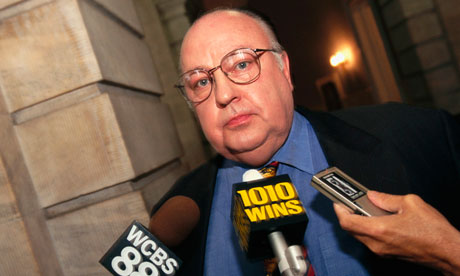
Fox News chairman Roger Ailes.
Fox News chairman Roger Ailes. Photograph: James Leynse/ James Leynse/CORBIS SABA

A very interesting and frightening perspective of Roger Ailes, "The Chairman" of Fox News exposes Ailes as a fear based, paranoid media mogul. Below is an excerpt from Roger Ailes and the rise of Fox News.

Even Rupert Murdoch is afraid of Roger Ailes, the paranoid boss of Fox News. But 'the Chairman' is using his power to make Americans more right wing, more ignorant and ever more terrified.

To watch even a day of Fox News – the anger, the bombast, the virulent paranoid streak, the unending appeals to white resentment, the reporting that is held to the same standard of evidence as a political campaign attack ad – is to see a refraction of its founder, one of the most skilled and fearsome operatives in the history of the Republican party. As a political consultant, Ailes repackaged Richard Nixon for television in 1968, papered over Ronald Reagan's budding Alzheimer's in 1984, shamelessly stoked racial fears to elect George Bush in 1988, and waged a secret campaign on behalf of Big Tobacco to derail healthcare reform in 1993. "He was the premier guy in the business," says former Reagan campaign manager Ed Rollins. "He was our Michelangelo."

In the fable Ailes tells about his own life, he made a clean break with his dirty political past long before 1996, when he joined forces with Murdoch to launch Fox News. "I quit politics," he has claimed, "because I hated it." But an examination of his career reveals that Ailes has used Fox News to pioneer a new form of political campaign – one that enables the Republican party to bypass skeptical reporters and wage an around-the-clock, partisan assault on public opinion. The network, at its core, is a giant sound stage created to mimic the look and feel of a news operation, cleverly camouflaging political propaganda as independent journalism.

The result is one of the most powerful political machines in American history. One that plays a leading role in defining Republican talking points and advancing the agenda of the far right. Fox News tilted the electoral balance to George W Bush in 2000, prematurely declaring him president in a move that prompted every other network to follow suit. It helped create the Tea Party, transforming it from the butt of late-night jokes into a nationwide insurgency capable of electing US senators. Fox News turbocharged the Republican takeover of the House last autumn, and even helped elect former Fox News host John Kasich as the union-busting governor of Ohio – with the help of $1.26m in campaign contributions from News Corp. And by incubating a host of potential Republican contenders on the Fox News payroll – including Sarah Palin, Mike Huckabee, Newt Gingrich and Rick Santorum – Ailes seems determined to add a fifth presidential notch to his belt in 2012. "Everything Roger wanted to do when he started out in politics, he's now doing 24/7 with his network," says a former News Corp executive. "It's come full circle."

The 71-year-old Ailes presents the classic figure of a cinematic villain: bald and obese, with dainty hands, Hitchcockian jowls and a lumbering gait. Friends describe him as loyal, generous and funny. But Ailes is also, by turns, a tyrant: "I only understand friendship or scorched earth," he has said. One former deputy pegs him as a cross between Don Rickles, the venomous comic, and Don Corleone. "What's fun for Roger is the destruction," says Dan Cooper, a key member of the team that founded Fox News. "When the light bulb goes on and he's got the trick to outmaneuver the enemy – that's his passion." Ailes is also deeply paranoid. Convinced that he has personally been targeted by al-Qaida for assassination, he surrounds himself with an aggressive security detail and is licensed to carry a concealed handgun.

The complete article can be found here.

Paranoia, fear, hate and greed make dangerous bedfellows.

Monday, May 30, 2011

Democrats: Do not negotiate with hostage-takers!!

RJ Matson - The St. Louis Post Dispatch - Ransom Notes From The Republican Revolution-COLOR - English - Ransom Notes From The Republican Revolution, Federal Budget, Budget Deficits, Budget Cuts, National Debt, Debt Ceiling, Tax Cuts, Medicare, ObamaCare, Health Care Reform, Republican Party, Congress, President Obama

The decision for Democrats is stark but unequivocal. The Republicans are not negotiating. The GOP has boxed its party into a position of, "Do it my way or no way." The path for the Republicans is that they will not support raising the debt ceiling unless big Medicare cuts are part of the deal. That means gutting Medicare.

That also means that the Democrats needs to have guts and say "NO!"

Public polling, the NY-26 outcome, and other objective indicators make it clear Republicans have boxed themselves into a political corner with their plan to end Medicare. It's a big problem for them politically, and there's no easy way out, especially since virtually every Republican in Congress is now on the record, with a vote, that they favor gutting Medicare.

So how are they gonna get out of this jam? Senate Minority Leader Mitch McConnell (R-KY) just made it clear in a briefing with reporters on the Hill: They're going to hold the government's debt limit as hostage in order to back their way out of this political tight spot.

How? McConnell just announced he will not support raising the debt ceiling unless big Medicare cuts are part of the deal. Translation: Unless Democrats get us off the hook by agreeing to deep Medicare cuts (meaning Democrats can no longer attack Republicans for wanting to eliminate Medicare), then we're going to force the federal government into default on its debt.

What if McConnell extracted substantial other cuts from the White House to achieve the GOP's spending cuts goal? No matter, McConnell says. If Medicare cuts aren't part of the deal, then no dice on the debt ceiling -- U.S. economy and world financial system be damned.

It's as stark as that. And the decision for Democrats is equally stark: Do you negotiate with hostage-takers?

McConnell went so far to say that all negotiation is off the table. Medicare cuts must be part of that deal to get his support.

Senate Minority Leader Mitch McConnell (R-KY) says substantial Medicare cuts must be part of a spending and deficit cut package to get his support to raise the debt limit.

In a Capitol briefing with reporters Friday, McConnell declared affirmatively that unspecified Medicare cuts are on the table in bipartisan debt limit negotiations, led by Vice President Joe Biden, and he expects they'll be part of the final deal. But in response to a question from TPM, he went further than he has in the past in laying down a marker on that issue. Medicare cuts must be part of that deal to get his support, he says -- even if negotiators manage to find trillions of dollars in savings elsewhere, even if his other priorities are met.

"To get my vote, for me, it's going to take short term [cuts, via spending caps]... Both medium and long-term, entitlements.," McConnell said. "Medicare will be part of the solution."

To clarify, I asked "[I]f [the Biden group] comes up with big cuts, trillions of dollars worth of cuts, but without substantially addressing Medicare, it won't get your vote?"

"Correct," McConnell said.

The question now is whether Democrats will be on board with this, or whether they'll try to call the GOP's bluff.

In response to TPM's report on Mitch McConnell's uncompromising position, Jon Summers, spokesman for Senate Majority Leader Harry Reid (D-NV) issued the following statement.
"Republicans are holding the United States' credit hostage to ram through their plan to end Medicare. They are now saying they won't accept any plan to reduce the deficit unless it also cuts Medicare. Voters have resoundingly rejected this ideological agenda. Republicans should drop it and move on."
Good response.! Let all Democrat politicians know to stand strong in their response to this Republican nonsense. The GOP
debt reduction plan is nothing more than "a smoke screen obscuring a dangerous far-right agenda."

Rep. Paul Ryan, R-Wisconsin, is waging radical class warfare and ideological privatization schemes and selling it as a debt reduction plan. His newly released FY12 budget proposal, The Path to Prosperity, ought to have the subtitle: "A Windfall For the Already Prosperous."

As Dean Baker of the Center for Economic and Policy Research reminds us, the economic policies of the last three decades, by favoring corporations and the wealthy over average Americans, have achieved the world's most breathtaking upward redistribution of wealth. America's richest 1 percent are getting about $1.5 trillion richer each year. Studies also show that the richest 5 percent hold almost 64 percent of our wealth while and the bottom 80 percent of scrape by on just 12.8 percent of the pie.

Yet under the guise of debt reduction, the chairman of the House Budget Committee's budget proposal would take from the already poor, give to the already rich and attempt to achieve debt reduction not by cutting real costs, but by privatizing entitlement programs and shifting costs from the wealthy and corporations to struggling states, seniors, disabled, sick and low-income Americans. And the additional revenues necessary for serious debt reduction is glaringly absent, with proposals that would actually decrease tax-revenue from those most able to pay.

From start to finish, this budget is a smoke screen.
Will Republicans stop at Medicare and Medicaid?

This reverse-Robin Hood scheme cynically claims to "Strengthen the Social Safety Net," yet it eviscerates an already tattered net by privatizing Medicare and converting Medicaid and SNAP (food stamps) from successful, guaranteed benefits programs to limited block grant programs.

It would devastate lives of the at least 44 million Americans living in poverty by slashing spending on critical human needs to below 2008 funding levels and freezing it there for 5 years. At the same time, it would boost the luxurious lifestyles of the tiny percentage of Americans who are genuinely rich by repealing estate and corporate taxes, slashing the income taxes the wealthiest among us pay and instituting a regressive national sales tax that would most likely increase tax obligations for poor, working-class, and middle-class Americans.

Even though this GOP FY12 Budget Resolution doesn't specify details of a plan to privatize Social Security, stay tuned. Privatizing Social Security is another essential piece of Ryan's (and the GOP's) dangerous agenda.
The GOP 's new mantra is that they have a plan to reduce the budget and the Democrats don't. But there are alternatives to the extreme measures the Republicans are all supporting. One answer is a single-payer Medicare system nation-wide.
Under Ryan's health care schemes, beneficiaries would increasingly bear the burden of soaring costs with no guarantee of receiving the remedies prescribed by their doctors. A better and fairer approach would expand the single-payer Medicare system nation-wide, achieving cost-savings, implementing real cost control and retaining guaranteed healthcare for all Americans.

The GOP is right about one thing: We should be serious about long-term debt reduction. Ryan's dangerous and seriously flawed scheme, however, is nothing more than an ideological ploy to shrink government programs that help poor and middle-class Americans while rewarding the already wealthy.
The moral of the story is: Do not negotiate with hostage-takers!!

Thursday, May 26, 2011

The GOP Today: No Credibility, Mucho Money & A Vast Propoganda Network

David Fitzsimmons - The Arizona Star - dumb and dumber - English - republicans, oil, tax breaks, subsidies, medicare

The GOP is ignoring the political analysis of David Frum. Frum is the editor of FrumForum.com which is "dedicated to the modernization and renewal of the Republican party and the conservative movement."

The MinistryOfTruth | Via Daily Kos thinks that:

David Frum sees the writing on the wall.

I used to worry that Sarah Palin would be the Barry Goldwater of 2012. My bad. Paul Ryan is the Barry Goldwater of 2012.

~snip~

. . . The big issues of 2012 will be jobs and incomes in a nation still unrecovered from the catastrophe of 2008-2009. What does the GOP have to say to hard-pressed voters? Thus far the answer is: we offer Medicare cuts, Medicaid cuts, and tighter money aimed at raising the external value of the dollar.

No candidate, not even if he or she is born in a log cabin, would be able to sell that message to America’s working class. [Bold text added]

Reagan's 11th Commandment is a hard sell

Now, we all know that Reagan's 11th Commandment was "No Republican shall ever attack another Republican", so it makes sense to see the GOP and RW media trying to double down on the disastrously unpopular Paul Ryan plan. They are just going to pretend that this isn't happening. But in reality world, outside of their controlled media environment, people aren't buying the GOP's bullshit on this. Rush can say whatever he wants, Fox can reframe it and Paul Ryan can call his plan "premium care" or "voucher system" or whatever the hell he likes, the voters aren't buying it, and why should they? As Frum admits himself, the real problems are jobs and declining and stagnant wages and incomes, and so far the GOP plan is to cut everything, including our noses off to spite our faces. I think Frum is 100% right. No candidate, not even if they host a reality show or have adonis dna, would be able to sell that message to America's working class.

I think David Frum is one of the very few voices on the right who is smart enough not to believe everything Rush Limbaugh says. Frum can see the tide shifting against the GOP with one of their core constituencies, older voters. Between seniors turning against the GOP, an energized Dem base that is fired up to protect Medicare and recall several already massively unpopular GOP Governor's, and a GOP Presidential field of uninspiring crumudgeons and gaffe prone half wits, what I see is a perfect storm of an electoral ass kicking heading the GOP's way. The best part? The perfect storm of bad things heading the GOP's way is entirely of their own making.

Giving the rich bigger tax breaks while cutting middle-class entitlements

In dissecting the "NY-26 debacle" as Frum puts it, he quotes Henry Olsen of AEI, who Frum calls "as smart a political numbers guy as can be found on the political right." Olsen says of the Ryan Plan to end Medicare so we can give the rich bigger tax breaks . . .

. . . blue-collar voters react differently to issues than the GOP base does. They are more supportive of safety-net programs at the same time as they are strongly opposed to large government programs in general. These voters crave stability and are uncertain of their ability to compete in a globalized economy that values higher education more each year. They are also susceptible to the age-old Democratic argument that the secret Republican agenda is to eviscerate middle-class entitlements to fund tax cuts for the wealthy.
Myth? When your budget call for huge tax cuts for the rich and deep budget cuts to everything that the middle class depends on it isn't a myth. It's pretty damn obvious that the "the secret Republican agenda is to eviscerate middle-class entitlements to fund tax cuts for the wealthy" is hardly a myth, and it isn't even a secret anymore. The ONLY thing you need to know about the Ryan Plan is that it will eviscerate middle-class entitlements to fund tax cuts for the wealthy.

A policy askew

My favorite part of this story? Frum will be totally ignored for breaking Reagan's 11th Commandment and daring to challenge another Conservative. Just as Newt was torched for calling the Ryan plan "right wing social engineering that goes a step too far.", I think Frum will get torched by Rush and the Foxaganda Network and the GOP will continue their self imposed death march towards the fountain of true conservatism. They can't help themselves. They can't appeal to moderates without looking like they are compromising to the fire breathing knuckledraggers in teabaggerstan, and the more they pander to the cruel and heartless far right and the rich special interests who rule their world the harder it will be to win votes outside of the farthest right wing of the political spectrum. Of course, I love the schadenfreude of all of this, because I think the GOP should have zero credibility on jobs after the Bush years, they should have zero credibility on balancing budgets, managing the economy or keeping our country safe as well. The GOP has no credibility, just lots of money and an outstanding propaganda network. If they played moderate and then governed to the far right they can get power and run amok, as they did in 2010 in states like Wisconsin, Ohio and Michigan, but that will not last too long before the middle class figures out that the only thing the GOP of today care about is the not so secret Republican agenda to eviscerate middle-class entitlements in order to fund tax cuts for the wealthy. Good luck running on that message, boys. You see, it's not just GOP Presidential Candidates who suck and are uninspiring, it's their whole message, their every policy screws the little guy and pats the billionaires on their backs. And now the American public is waking up to that fact again.

As David Neiwert at CrooksAndLiars points out . . .

And even after this disaster, their tune will not change one iota. Because they cannot budge from the ideological corner into which they've painted themselves. Ryan's Path to the Poorhouse is not just an economic and social disaster in the making for Americans, it's one that ordinary, common-sense voters can see coming a mile away. Democrats don't have to "demagogue" to make a clear case that it would be disastrous.

So count me in with others who are watching this unfold and cheering on the GOP to double down on being stupid. When David Frum shouts out DO. NOT. SEEK. THE TREASURE. in the movie theater, I am rooting for the GOP to go for it and see how far this "Trade you your Medicare for Tax Cuts for the Rich" plan can take them. If my hopes are correct, Obama will blow these guys out at every level of government in such a way that will make Barry Goldwater's disaster look less threatening than a current GOP presidential nominee.

The GOP agenda is exceptionally generous to rich, powerful and corporate interests but totally devoid of comprehending issues relevant to the middle class and poor. A definite issue for the GOP candidates in the 2012 election.

DO NOT seek the treasure!

Friday, April 15, 2011

SILENCE Please!

On April 14th, Rep. Joe Crowley (D-NY) delivered a one-minute presentation on the House floor. It was a unique speech. This is more of a visual than audio video. WATCH:


Using tear sheets to illustrate his rebuttal to the Republican budget plans that would slash hundreds of thousands of public jobs and effectively eliminate Medicare, Crowley concluded that he was simply “speechless.”
Here is his speech!


LAST FALL THE AMERICAN PEOPLE

GAVE US OUR MARCHING ORDERS

JOBS JOBS JOBS

100 DAYS OF GOP RULE

0 JOBS BILLS

SO, IF NOT JOBS...

WHAT HAS THE GOP BEEN UP TO?

GOP'S PRIORITY #1:

Cut more than 700,00 American Jobs

GOP PRIORITY #2:

Take away healthcare for the people...

but keep it for themselves

Surely, a jobs bill must be priority #3

GOP'S PRIORITY #3:

Manipulate tax code to pursue ideological agenda...

at the expense of women $ small businesses

REALLY GOP? REALLY?

100 DAYS IN AND GOP STILL DOESN'T GET IT

I'M

SURPRISED
STUNNED
SHOCKED


SPEECHLESS

Tuesday, March 29, 2011

Redistributing Wealth from the Poor to the Wealthy

RJ Matson - The St. Louis Post Dispatch - New Reality-COLOR - English - New Reality, Unemployment, Jobs, Safety Net, Republican Agenda

Jay Michaelson has written a very interesting article about the robber-baron agenda of the Republicans. Not for the Sake of Heaven, The Polymath: Debased Discourse in a New Gilded Age, was originally published in the The Jewish Daily Forward. Michaelson begins and ends his article with a discussion of the jewish holiday of Passover and the questions that we should be asking.

Passover is coming, and with it, the season of questions. We Jews have long prided ourselves on asking good questions — even more than on providing adequate answers. We prize debates that go on forever. And, of course, we answer questions with still more questions. Inquiry, discourse, communication: These are some of the core values of the Jewish intellectual heritage.

And yet, while it has temporarily been pushed off the front page by the news from Japan and Libya, our current domestic political moment is one so devoid of truthful discourse as to render our Passover symposia almost absurd, verbally fiddling while the planet burns, deluding us into thinking that conversations like the Passover Seder still matter in our public life.

This is not a matter of ideology. I am not so young as to suppose that a momentary rightward drift in America’s political trajectory represents the end of the world as we know it. (After the events in Wisconsin and Michigan, and the Islamophobic McCarthyism in Washington, a young friend of mine on Facebook asked me how to stay politically engaged but “avoid the despair and paranoia.” He said he was really in a “dark world at the moment, trying to get out.” I remember feeling that way in 1994.) This, too, shall pass.

Substance is not my concern here, process is. “We’re sort of in a truth-free period right now,” former president Clinton said recently. I think that this assessment is spot-on, and should worry all of us who value the very notion of reasoned intellectual discourse.

A return to pre-New Deal, Gilded Age America

Contrast, for example, Rep. Peter King’s odious accusations of collective guilt against the Muslim American community with the current efforts around the country to return to pre-New Deal, Gilded Age America. The former, I think, are unconscionable. But at least they’re honest. However misinformed King and his allies may be, they are at least acting sincerely against what they perceive to be a threat, and they are stating their case clearly. In theory, my dispute with King is l’shem shamayim — for the sake of heaven. We both want people to be free from terrorist attacks, and I think we both want Americans be free from religious persecution. We just have a strong difference of opinion as to how best to pursue those goals.

Such is not the case, however, with Republican efforts to “rein in spending” or “reform public unions” or whatever other spin-doctored phrase the Fox/Koch axis has concocted to mask its radical, reactionary, robber-baron agenda. These aren’t goals, they’re pretexts, and the refusal to speak honestly about them makes real public debate impossible.

For example, we now know, thanks to off-the-cuff (but recorded) remarks, that Wisconsin’s governor, Scott Walker, busted the public sector union in Wisconsin not to balance the state budget, but to bust the union, which tends to contribute to the Democratic Party. “Balancing the budget” had about as much to do with Walker’s action as “weapons of mass destruction” did with the invasion of Iraq.

Republican stated goals are really pretexts

Or consider the congressional budget negotiations. As the infographic by the Center for American Progress (reproduced here) makes clear, balancing the budget is a mere pretext for axing programs that Republicans have hated for decades. I’m not even talking about NPR and the Public Broadcasting Service; the culture war is just another distraction. The entire savings from cutting early childhood programs, low-income housing programs, legal services for the poor, food stamps — all $44 billion of it — is only slightly more than the $42 billion cost of the Bush tax cuts for the richest 1% of Americans. This isn’t about the budget; it’s about redistributing wealth from the poorest to the wealthiest.

The CAP infographic really is a gem. Did you know that the $8.9 billion that the Republicans want to cut from low-income housing programs is exactly equivalent to the $8.9 billion it costs to let rich people deduct the mortgage interest on vacation homes? If Congress wanted to save $8.9 billion in the area of housing, why not put the burden on the 32% of Americans fortunate enough to own vacation homes? Or how about ensuring equal access to justice by preserving Legal Aid ($420 million in proposed cuts) and stopping companies from writing off punitive damages (at a cost of $312 million)? You don’t get to write off your parking tickets, so why should huge corporations write off fines for their willful and harmful misconduct?

Source : Donna Cooper, center for American ProgressCuts, But Where?: These figures show which programs pay what prices.
Cuts, But Where?: These figures show which programs pay what prices.

Republicans favor the rich over the poor

It’s nothing new for Republicans to favor the rich over the poor; that preference is as old as the Grand Old Party itself. And there’s nothing new about the rich buying off politicians in order to get richer. It’s the world’s second-oldest profession, and it has much in common with the first. Today’s GOP agenda aims to overturn the Great Society, and the New Deal, and to return America to the laissez-faire policies of Herbert Hoover — only this time, with multinational corporations, globalization and an information-technology-enabled financial bubble machine.

And actually, there’s nothing wrong with that. There are plenty of sincere conservatives who sincerely believe in total laissez-faire economics. If the rich get richer, they think that the poor will likely be better off, too — and certainly better off than if the government tries to game the system. From Friedrich Hayek to Milton Friedman, this view is time-honored and is clearly an ideology animating the Republicans’ agenda.

Brainwashed by media spin

But you won’t hear any of this real conservatism on Fox News. Instead, we’re told that the estate tax (I’m sorry, the “death tax”) hurts families and family farms, even though it actually affects only “families” who inherit more than $3 million. Instead of principled defenses of conservative positions, our public discourse is filled with cynical lies, and phrases like “relief for the American family” pasted over policies that hurt 95% of American families.

Our popular political culture is like the child she’eno yodeah lishol, who doesn’t know that there’s a question to ask. It’s an infantilized adolescent, brainwashed by media spin. We’re not having the discussion we ought to have, because one side refuses to engage, instead offering one half-truth after another in order to shred the social-safety net.

We’re not even clear on how we got here in the first place. To some, the Tea Party movement represents a populist upwelling against a Democratic administration that grew government too big. But this, too, is a mirage. Actually, the Tea Party is a pseudo-populist movement bankrolled by big business — not just the Koch brothers, but a legion of phony “think tanks” and “grassroots organizations” that somehow have the money to make big media buys. Yes, there’s genuine anger out there. But it’s been whipped into a specifically Republican frenzy, thanks to very deliberate, calculated work by some very rich people and corporations.

And why the anger? Obviously, it relates to the deep pain created by the financial crisis of 2008. And here’s where it gets really fun. The financial crisis was brought on by deregulation, which allowed huge (“too big to fail”) financial institutions to merge with one another and make unregulated, high-risk bets. But the triumph of the Tea Party meant a victory for the deregulators, who now want even less regulation than there was before. Because of the sleight-of-hand perpetrated on sincere, hurting Tea Party voters — perhaps the greatest con in our nation’s history — the kid who crashed the old car was given the keys to the new one.

Too much wealth in so few hands.

The crisis was also brought on by the increase in the wealth gap, which concentrated so much wealth in so few hands. Today, a mere 400 people hold more cash, stock and property than 255 million Americans. In 2009, America’s wealthiest households had a net worth that was 225 times greater than that of the median family’s, the most lopsided ratio in American history. The injustice of that distribution of wealth is so massive that our eyes glaze over.

Yet even setting aside justice concerns, this is exactly the sort of imbalance that brings on big crashes. Why? Because those few very rich folks tend to invest in those same “too big to fail” banks that, without regulation, are incentivized to overspeculate. When wealth is this concentrated, risk is exacerbated, and when big bets are lost (as they inevitably sometimes are), the costs are far more severe. We fall farther, harder and faster.

Yet once again, the anger brought on by the financial crisis has handed over power to the people who created the crisis to begin with. Bernard Madoff went to jail for running a Ponzi scheme. The Republicans went to Congress.

The financial crisis is also the reason we have the budget deficit that suddenly, after decades of deficit spending, so alarms the Republican Party. The first stimulus plan, the second stimulus plan (what the Obama administration got in exchange for extending the Bush tax cuts last December) and the massive drop in tax revenue are the main reasons the government is in such a financial hole. Deregulation and wealth concentration caused this deficit. The response? More deregulation and wealth concentration! All the while repeating disingenuously that this is about reducing the deficit or helping America’s small businesses, or whatever. It isn’t. From public television to collective bargaining, from the tax code to the lack of real financial regulation, Republican policies are about radical social engineering.

We need an honest debate

Here’s what I think Passover, and the Jewish value of discourse it represents, is meant to teach us. If you’re going to cut programs for the poor because you think it’s not government’s business to help the poor, or cut NPR because you think it’s too liberal, have the courage to argue your case directly. If you think unions are bad for America, then say so. Don’t hide behind the financial crisis, or the budget deficit, or phony rhetoric about American families.

As we sit down to our Seders, disagreement is part of the point. On important questions of justice, freedom and morality, reasonable people disagree, and that’s fine. But the very foundation of our religious life is that honest, principled debate is possible, that it is a sacred act to argue. And yet for all the bluster and histrionics on the airwaves today, there is little true debate, no real conversation. On the contrary, the level of dissembling has grown so high that the news looks less like Passover and more like Purim: a grotesque carnival in which no one can tell truth from falsehood.

The Republican agenda is solely based on the goal of making the rich richer. Therefore, trickle down economy is just a myth.

Tuesday, March 22, 2011

Going "Medieval on America!"

Pat Bagley - Salt Lake Tribune - Tea Party Barbarian Color - English - Barbarian, Tea Party, Science, Education, Tax Cuts, GOP, Republicans, Dont Tread on Me, PBS, EPA, Food, Conan, Cuts, Budget, Teachers

David Sirota brings to our attention the "6 Sadistic State Laws Conservatives Are Trying to Ram Through."
We’re talking about true legislative sadists looking to go medieval on America.

Supreme Court Justice Louis Brandeis once said that states are the “laboratories of democracy.” Oft repeated over time, the aphorism has helped impart legitimacy to the rough and tumble of state lawmaking. We’ve heard “laboratory” and we’ve imagined staid scientists in white coats rigorously testing forward-thinking theories of societal advancement.

It’s certainly a reassuring picture—but there is a darker side of the metaphor. States are indeed laboratories. The problem is that today, those laboratories are increasingly run by mad scientists.

We’re not talking about the usual Dr. Frankensteins trying to bring alive new corporate giveaways through harebrained cuts to social services (though there are those, too). We’re talking about true legislative sadists looking to go medieval on America. Behold just six of the most telling examples:

1. The Anti-Life Pro-Life Act: After anti-abortion Republicans in Congress tried to narrow the legal definition of rape, Nebraska Republican state Sen. Mark Christensen took the assault on women’s rights one step further with a bill to legitimize the murder of abortion providers by classifying such homicides as “justified.”

2. The Let Them Eat Corporate Tax Cuts Act: As poverty rates and hunger have risen, so, too, have corporate profits. The Georgia Legislature’s response? Intensify the inequity with a bill to create a regressive sales tax on food that would then finance a brand new corporate tax cut.

3. The Demoralize the Workforce Act: Wisconsin Gov. Scott Walker didn’t just threaten to deploy the National Guard against state workers unless they accept big pay and pension cuts. Apparently, that was too Kent State and not enough Ludlow Massacre for him. So he pressed to statutorily bar those workers from ever again collectively bargaining.

4. The Child Labor Act: Missouri state Sen. Jane Cunningham’s proposal to eliminate child labor laws would allow corporations to employ any kid under 14 and would terminate restrictions on the number of hours that kid can be forced to work. The legislation is proof that when tea party ideologues refer to “the ’50s,” some of them aren’t referring to the 1950s—they are referring to the 1850s.

5. The Obesity and Deficit Encouragement Act: Colorado exemplifies America’s childhood obesity epidemic and its budget crisis. The state’s childhood obesity rate grew at the second-fastest rate in the country, and its $1.2 billion budget gap is threatening the state’s already underfinanced schools. Yet, despite the U.S. Department of Agriculture showing that higher soda taxes would drive down obesity, and despite such a levy raising much-needed public revenues, Colorado’s newly Republican House is pushing legislation to create a special budget-busting sales tax exemption exclusively for soda.

6. The Endorsing Your Own Demise Act: Between trying to legalize hunting with hand-thrown spears and pressing to eliminate education requirements for those seeking the office of state superintendent of schools, Montana’s Republican lawmakers are also considering legislation to officially endorse catastrophic global climate change. That’s right, in the face of a Harvard study showing that climate change could destroy Montana’s water supplies, agriculture industries and forests, state Rep. Joe Read’s bill would declare that “global warming is beneficial to the welfare and business climate of Montana.”

If you don’t live in one of these states, it’s easy to tell yourself that these bills don’t affect you. But history suggests that what happens in one “laboratory” is quite often replicated in others—and ultimately, in the nation’s capital. That’s why we should all hope saner minds cut short these experiments before they get even more out of control.

Rachel Maddow puts this Republican strategy in context. WATCH:

Visit msnbc.com for breaking news, world news, and news about the economy


“If you aren't completely appalled then you haven't been paying attention!”


Dave Granlund - Politicalcartoons.com - Turning back the clocks - English - Clocks,clock,time change,standard time,fall back,time zones,GOP,republicans,2010,elections,comngress,elephant,GOP elephant,GOP mascot,turn back clock,change your clock,2008,2004,2000,campaign,candidates,conservatives

Friday, March 18, 2011

Fascism Comes to America Dressed as a Fiscal Crisis

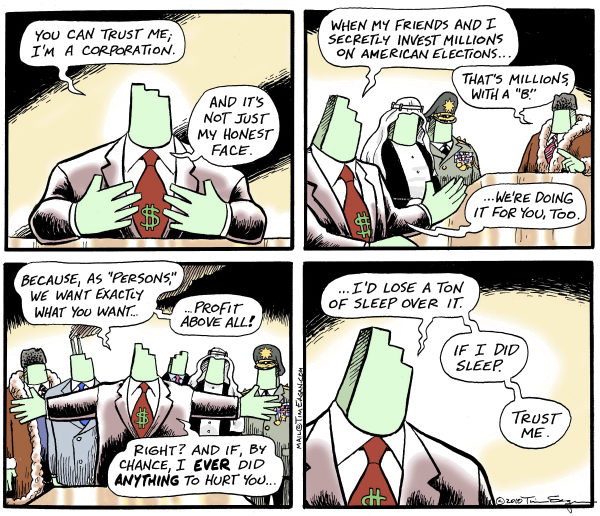
Tim Eagan - Deep Cover - Im a corporation - English - corporations, supreme court, citizens united, elections, persons

The Michigan Legislature gave its final approval to a measure that strengthens the powers of state-appointed emergency financial managers. This measure has been sent to Governor Rick Snyder’s desk for signing. You might be wondering, what is a "financial manager?" According to this bill, it is just another name for Fascism.

“This is a takeover by the right wing and it’s an assault on democracy like I’ve never seen.”

~ Mark Gaffney, Michigan State President of the AFL-CIO.

Perhaps lost in the Wisconsin shuffle is the story of what exactly is happening in Michigan. Newly elected Republican governor, Rick Snyder, is set to pass one of the most sweeping, anti-democratic pieces of legislation in the country – and almost no one is talking about it.

Snyder’s law gives the state government the power not only to break up unions, but to dissolve entire local governments and place appointed “Emergency Managers” in their stead. But that’s not all – whole cities could be eliminated if Emergency Managers and the governor choose to do so. And Snyder can fire elected officials unilaterally, without any input from voters. It doesn’t get much more anti-Democratic than that.

Except it does. The governor simply has to declare a financial emergency to invoke these powers – or he can hire a private company to declare financial emergency and take over oversight of the city. That’s right, a private corporation can declare your city in a state of financial emergency and send in its Emergency Manager, fire your elected officials, and reap the benefits of the ensuing state contracts.

These Republican governors have risen to power in what will eventually be seen as one of the great political farces of our time. The Tea Party movement talks a good game about democracy and limited government, but in practice its elected leaders are crony-capitalists and union-busters. There is nothing limited about a state government that can erase entire cities or take control of school districts and local governments with the swipe of a pen. Manufactured crisis and a litany of politicians and power-brokers talking about how broke we are is all it takes to rob us of our democracy.

Public services are on the auction block, and unions, teachers, and anyone else standing in the way are all going to have to fight for their continued existence – or at least their continued membership in the ranks of the middle class.

If “Emergency Manager” is not dystopian enough a term for you, perhaps the fact that such radical legislation could go almost unnoticed in the national press is. Fortunately, Rachel Maddow proves an exception to the rule. WATCH:


Here's a breakdown of what the Republicans are doing, according to Naomi Klein, author of the Shock Doctrine:
Gov Scott Walker said to the faux David Koch that this is our moment to change the course of history.

The Governor cuts the state budget which then creates a financial emergency and allows the Governor to take over the town.

The plan is to consolidate power and then to auction off the state.

The Republicans are using the fiscal crisis as a pretext to privatize the government.

The Republicans see money in the deals to privatize government.

By using and fabricating a crisis [Shock Doctrine] they create a Corporate Monopoly State.

GOP politicians run on the notion of having less government but they actually don't believe in the government they run.

The real issue is who needs to pay for the crisis...regular working people or the rich corporations who created the crisis?

The Republicans want to tie the hands of unions because unions are a political force.

Unions are the last line of defense against the privatization of the state and by private corporate sector.
Good-by Democracy....Say hello to Corporate America!

“If you aren't completely appalled then you haven't been paying attention!”

Adam Zyglis - The Buffalo News - Money Talks - English - collective bargaining, america, unions, organized labor, labor, corporations, business, big biz, companies, political donations, donations, campaigns, politics, state, government, koch, contributions