Showing posts with label Democracy. Show all posts

Monday, November 7, 2011

The Conservative Misconception of Socialism

Today, for the Tea Party Republicans the new 'red scare' in society is the concept of Socialism. Conservatives have created a negative niche by equating 'Liberalism' with 'Socialism.' In order to educate the conservative side of the political scale, Nurse Pam does an excellent job "Explaining Socialism to a Republican."

I was talking recently with a new friend who I’m just getting to know. She tends to be somewhat conservative, while I lean more toward the progressive side.

When our conversation drifted to politics, somehow the dreaded word “socialism” came up. My friend seemed totally shocked when I said “All socialism isn’t bad”. She became very serious and replied “So you want to take money away from the rich and give to the poor?” I smiled and said “No, not at all. Why do you think socialism mean taking money from the rich and giving to the poor?

“Well it is, isn’t it?” was her reply.

I explained to her that I rather liked something called Democratic Socialism, just as Senator Bernie Sanders, talk show host Thom Hartman, and many other people do. Democratic Socialism consists of a democratic form of government with a mix of socialism and capitalism. I proceeded to explain to her the actual meaning terms “democracy” and “socialism”.

Democracy is a form of government in which all citizens take part. It is government of the people, by the people, and for the people.

Socialism is where we all put our resources together and work for the common good of us all and not just for our own benefit. In this sense, we are sharing the wealth within society.

Of course when people hear that term, “Share the wealth” they start screaming, “OMG you want to rob from the rich and give it all to the poor!” But that is NOT what Democratic Socialism means.

To a Democratic Socialist, sharing the wealth means pooling tax money together to design social programs that benefit ALL citizens of that country, city, state, etc.

The fire and police departments are both excellent examples of Democratic Socialism in America. Rather than leaving each individual responsible for protecting their own home from fire, everyone pools their money together, through taxes, to maintain a fire and police department. It’s operated under a non-profit status, and yes, your tax dollars pay for putting out other people’s fires. It would almost seem absurd to think of some corporation profiting from putting out fires. But it’s more efficient and far less expensive to have government run fire departments funded by tax dollars.

Similarly, public education is another social program in the USA. It benefits all of us to have a taxpayer supported, publicly run education system. Unfortunately, in America, the public education system ends with high school. Most of Europe now provides low cost or free college education for their citizens. This is because their citizens understand that an educated society is a safer, more productive and more prosperous society. Living in such a society, everyone benefits from public education.

When an American graduates from college, they usually hold burdensome debt in the form of student loans that may take 10 to even 30 years to pay off. Instead of being able to start a business or invest in their career, the college graduate has to send off monthly payments for years on end.

On the other hand, a new college graduate from a European country begins without the burdensome debt that an American is forced to take on. The young man or woman is freer to start up businesses, take an economic risk on a new venture, or invest more money in the economy, instead of spending their money paying off student loans to for-profit financial institutions. Of course this does not benefit wealthy corporations, but it does greatly benefit everyone in that society.

EXAMPLE American style capitalistic program for college: If you pay (average) $20,000 annually for four years of college, that will total $80,000 + interest for student loans. The interest you would owe could easily total or exceed the $80,000 you originally borrowed, which means your degree could cost in excess of $100,000.

EXAMPLE European style social program for college: Your college classes are paid for through government taxes. When you graduate from that college and begin your career, you also start paying an extra tax for fellow citizens to attend college.

Question - You might be thinking how is that fair? If you’re no longer attending college, why would you want to help everyone else pay for their college degree?

Answer - Every working citizen pays a tax that is equivalent to say, $20 monthly. If you work for 40 years and then retire, you will have paid $9,600 into the Social college program. So you could say that your degree ends up costing only $9,600. When everyone pools their money together and the program is non-profit, the price goes down tremendously. This allows you to keep more of your hard earned cash!

Health care is another example: If your employer does not provide health insurance, you must purchase a policy independently. The cost will be thousands of dollars annually, in addition to deductible and co-pays.

In Holland, an individual will pay around $35 monthly, period. Everyone pays into the system and this helps reduce the price for everyone, so they get to keep more of their hard earned cash.

In the United States we are told and frequently reminded that anything run by the government is bad and that everything should be operated by for-profit companies. Of course, with for-profit entities the cost to the consumer is much higher because they have corporate executives who expect compensation packages of tens of millions of dollars and shareholders who expect to be paid dividends, and so on.

This (and more) pushes up the price of everything, with much more money going to the already rich and powerful, which in turn, leaves the middle class with less spending money and creates greater class separation.

This economic framework makes it much more difficult for average Joes to ”lift themselves up by their bootstraps” and raise themselves to a higher economic standing.

So next time you hear the word “socialism” and “spreading the wealth” in the same breath, understand that this is a serious misconception.

Social programs require tax money and your taxes may be higher. But as you can see everyone benefits because other costs go down and, in the long run, you get to keep more of your hard earned cash!

Democratic Socialism does NOT mean taking from the rich and giving to the poor. It works to benefit everyone so the rich can no longer take advantage of the poor and middle class.

There is a misconception spread by conservatives that lower taxes will lower individual costs. By spreading this misconception, the rich pay less tax, the middle class pay more while social services, that benefit everyone, get cut. The rich get richer while the poor and middle class have less money and less services. What is that called? It is called 'trickle down economy' and time and time again it has been proven not to work.

Monday, June 6, 2011

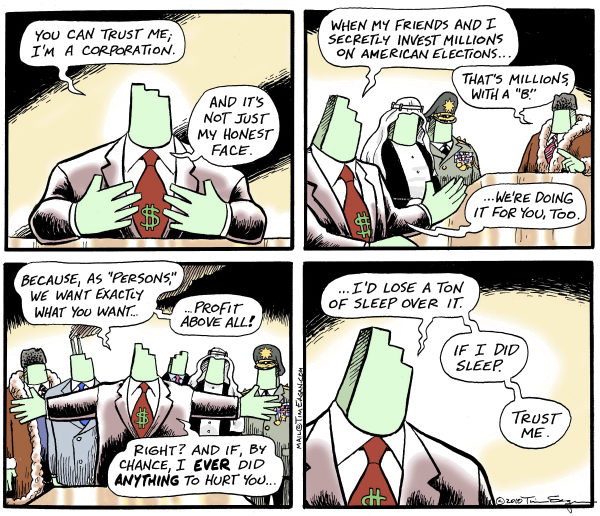
Secret Money Scandal

Tim Eagan - Deep Cover - Im a corporation - English - corporations, supreme court, citizens united, elections, persons

Michael Winship at Salon War Room has an interesting article, Secret Cash, The worst political scandal of all.

Sometimes I feel like Gus, the father in "My Big Fat Greek Wedding" -- you know, the guy who thinks you can cure all maladies with a spritz of Windex and declares, "Give me a word, any word, and I show you that the root of that word is Greek."

Only in my case, it’s give me a scandal, any scandal, and I’ll show you how the corrosive influence of money on politics is at its root and makes what’s bad even worse (okay, maybe not in the case of Anthony Weiner -- yet). It’s not an especially effective party trick, I know, unless you’re at a really dreary policy wonk picnic, but you work with what you’ve got.

John Edwards’ illegitimate child? The legal case being built against the freshly indicted former presidential candidate isn’t about paternity or custody or any of that kind of stuff, but revolves around felony campaign finance charges; whether or not two wealthy backers -- his now deceased fundraising chair Frederick Baron and 100-year-old heiress Rachel "Bunny" Mellon -- provided hundreds of thousands in contributions that in reality paid for the hiding of Edwards' mistress, Rielle Hunter, and their baby.

Gingrich and Tiffany

Newt Gingrich and his wife Callista’s big fat, revolving, no interest credit account at Tiffany's? It might be tin-eared and wrong for someone who purports to be a fiscal conservative and a man of the people to throw around big bucks for expensive bling, but that ain’t necessarily the scandal. Look a little deeper. On May 24, Jeff Stein of The Washington Post blog "Spy Talk" reported:

"At the same time Tiffany & Co. was extending Callista (Bisek) Gingrich a virtual interest-free loan of tens of thousands of dollars, the diamond and silverware firm was spending big bucks to influence mining policy in Congress and in agencies over which the House Agriculture Committee -- where she worked -- had jurisdiction, official records show."

Until 2006, Ms. Gingrich was chief clerk at the committee. During the years between 2005 and 2009, Tiffany's annual lobbying costs shot up from around $100,000 to $360,000, according to the nonpartisan Center for Responsive Politics.

The jewelry giant strongly denies any connection: "We had no reason to lobby the Agriculture Committee and we did not… Our focus has been on the Natural Resources Committee." The company also said it had never spoken with Newt or Callista Gingrich about federal mining policy.

But hang on, there’s more.

Tim Carney of The Washington Examiner reports:

"Christy Evans, formerly a top staffer to then-whip Newt Gingrich, is a registered lobbyist for Tiffany’s, the high-end jeweler where Gingrich and his wife enjoy an extraordinary line of credit. Evans, former floor assistant to Gingrich and now a lobbyist at the legendary K Street firm Cassidy & Associates, has represented Tiffany's on mining issues since 2000, according to lobbying filings."

The revolving door between government and corporate interests, revolving credit… the saga of Newt "Holly Golightly" Gingrich spins on. The whole affair is reminiscent of the preferential loan treatment now-collapsed subprime mortgage giant Countrywide Financial Corporation reportedly gave a few years ago to Fannie Mae CEO Jim Johnson (he resigned as a result), North Dakota Senator Kent Conrad (chair of the Senate Budget Committee), former Connecticut Senator Chris Dodd (who served as chair of the Senate Banking Committee), and former cabinet secretaries Alphonso Jackson and Donna Shalala.

The Supreme Court decision in Citizens United

Yet all this greed and venality pales against the dark heart of the worst political scandal of all, the continuing nightmare caused by Citizens United and other court decisions that have unleashed a monster of unlimited and frequently anonymous private and corporate campaign cash against a nearly defenseless citizenry.

The recent disclosure that the conservative, "grass roots" advocacy organization American Action Network received first year revenues of $2.75 million from fewer than a dozen unnamed, wealthy donors (and 82% of the money from only three of them) led Melanie Sloan, executive director of Citizens for Responsibility and Ethic in Washington, to cite AAN as just one example of how "very few people are having a disproportionate impact on our country’s elections." (The group, affiliated with Karl Rove’s American Crossroads political action committee, raised another $24 million in the four months before the 2010 midterms, funding attack ads against Democratic Senate candidates in Wisconsin, Florida, Washington State and Florida described by progressive watchdog Media Matters as "bogus," "deceptive" and "stripped of the facts.")

Secret Donors and Corporate Money

This revelation follows superb investigative reporting by a Bloomberg News team last month headlined "Secret Donors Multiply in U.S. Election Spending." They found that outside, or non-party organizations, including "trade groups, unions and non-profits started by political operatives that raise and spend money for advertising" spent $305 million on the 2010 elections, four times more than similar groups spent four years ago. They plan to raise even more money for the 2012 campaign. Contrary to law, five of those groups have failed to report to the Federal Election Commission (FEC) more than $4 million spent on attack ads in last year’s races.

"The organizations face little scrutiny from the FEC, where split votes between Republican and Democratic commissioners have stymied enforcement in case after case for almost three years," Bloomberg reported. "As a result, voters may find themselves choosing the next U.S. president knowing less about those trying to shape their views of the candidates than they have since secret money helped finance the Watergate burglary and re-elect President Richard Nixon in 1972."

The journalists quoted Donald Simon, a director of pro-disclosure organization Democracy 21: "The amounts of corporate money involved in Watergate will look quaint by the standards of secret corporate funding that will take place in 2012."

Republicans and many Democrats oppose all new attempts at campaign finance reform, including a proposed White House executive order requiring corporations seeking government contracts to reveal their political contributions. On May 26, a federal district court in Alexandria, Virginia, ruled that a long-standing ban on corporate contributions to federal candidates is unconstitutional. Unless the composition of the Supreme Court shifts in a new direction, a constitutional amendment that reverses Citizens United and other federal rulings may be our only prayer, the solitary hope we have to prevent the total usurpation of representative government by big businesses with bottomless pockets.

Economic dominance, it’s the biggest scandal of all

The Greeks had a word for it -- "oligarchy" -- political clout based on economic dominance. It is, in the words of economist Simon Johnson, "an antithesis to democracy… a small group with a lot of wealth and a lot of power. They pull the strings. They have the influence. They call the shots."

No accountability, no scruples, no shame. It’s the biggest scandal of all; a republic struck down by a possibly fatal malady that even Gus the Greek’s magic bottle of Windex can't cure.

It is always the wealthy who are continually complaining that the poor are getting things they haven't worked for and therefore don't deserve. But it is only the rich who work hard to buy the votes they want because they truly don't trust our system of democracy.

Friday, March 18, 2011

Fascism Comes to America Dressed as a Fiscal Crisis

Tim Eagan - Deep Cover - Im a corporation - English - corporations, supreme court, citizens united, elections, persons

The Michigan Legislature gave its final approval to a measure that strengthens the powers of state-appointed emergency financial managers. This measure has been sent to Governor Rick Snyder’s desk for signing. You might be wondering, what is a "financial manager?" According to this bill, it is just another name for Fascism.

“This is a takeover by the right wing and it’s an assault on democracy like I’ve never seen.”

~ Mark Gaffney, Michigan State President of the AFL-CIO.

Perhaps lost in the Wisconsin shuffle is the story of what exactly is happening in Michigan. Newly elected Republican governor, Rick Snyder, is set to pass one of the most sweeping, anti-democratic pieces of legislation in the country – and almost no one is talking about it.

Snyder’s law gives the state government the power not only to break up unions, but to dissolve entire local governments and place appointed “Emergency Managers” in their stead. But that’s not all – whole cities could be eliminated if Emergency Managers and the governor choose to do so. And Snyder can fire elected officials unilaterally, without any input from voters. It doesn’t get much more anti-Democratic than that.

Except it does. The governor simply has to declare a financial emergency to invoke these powers – or he can hire a private company to declare financial emergency and take over oversight of the city. That’s right, a private corporation can declare your city in a state of financial emergency and send in its Emergency Manager, fire your elected officials, and reap the benefits of the ensuing state contracts.

These Republican governors have risen to power in what will eventually be seen as one of the great political farces of our time. The Tea Party movement talks a good game about democracy and limited government, but in practice its elected leaders are crony-capitalists and union-busters. There is nothing limited about a state government that can erase entire cities or take control of school districts and local governments with the swipe of a pen. Manufactured crisis and a litany of politicians and power-brokers talking about how broke we are is all it takes to rob us of our democracy.

Public services are on the auction block, and unions, teachers, and anyone else standing in the way are all going to have to fight for their continued existence – or at least their continued membership in the ranks of the middle class.

If “Emergency Manager” is not dystopian enough a term for you, perhaps the fact that such radical legislation could go almost unnoticed in the national press is. Fortunately, Rachel Maddow proves an exception to the rule. WATCH:


Here's a breakdown of what the Republicans are doing, according to Naomi Klein, author of the Shock Doctrine:
Gov Scott Walker said to the faux David Koch that this is our moment to change the course of history.

The Governor cuts the state budget which then creates a financial emergency and allows the Governor to take over the town.

The plan is to consolidate power and then to auction off the state.

The Republicans are using the fiscal crisis as a pretext to privatize the government.

The Republicans see money in the deals to privatize government.

By using and fabricating a crisis [Shock Doctrine] they create a Corporate Monopoly State.

GOP politicians run on the notion of having less government but they actually don't believe in the government they run.

The real issue is who needs to pay for the crisis...regular working people or the rich corporations who created the crisis?

The Republicans want to tie the hands of unions because unions are a political force.

Unions are the last line of defense against the privatization of the state and by private corporate sector.
Good-by Democracy....Say hello to Corporate America!

“If you aren't completely appalled then you haven't been paying attention!”

Adam Zyglis - The Buffalo News - Money Talks - English - collective bargaining, america, unions, organized labor, labor, corporations, business, big biz, companies, political donations, donations, campaigns, politics, state, government, koch, contributions


Friday, November 5, 2010

Selling Politics and Politicians

You Call This News?


Dave Granlund - Politicalcartoons.com - Media hype - English - Media, news, 24/7 news, news focus, news coverage, news frenzy,soft news, news reporting, news attention, baseless news, lame news, balanced news, page one, front page, news priority

Amy Goodman, host of
“Democracy Now!,” has it right in her article, Rich Media, Poor Democracy. She finds that in this last election the biggest winner was the broadcast media at the expense of our democracy.

As the 2010 elections come to a close, the biggest winner of all remains undeclared: the broadcasters. The biggest loser: democracy. These were the most expensive midterm elections in U.S. history, costing close to $4 billion, $3 billion of which went to advertising. What if ad time were free? We hear no debate about this, because the media corporations are making such a killing by selling campaign ads. Yet the broadcasters are using public airwaves.

I am reminded of the 1999 book by media scholar Robert McChesney, “Rich Media, Poor Democracy.” In it, he writes, “Broadcasters have little incentive to cover candidates, because it is in their interest to force them to publicize their campaigns.”

The Wesleyan Media Project, at Wesleyan University, tracks political advertising. Following the recent Supreme Court ruling, Citizens United v. FEC, the project notes, “The airwaves are being saturated with more House and Senate advertising, up 20 percent and 79 percent respectively in total airings.” Evan Tracey, the founder and president of Campaign Media Analysis Group, predicted in USA Today in July, “There is going to be more money than there is airtime to buy.” John Nichols of The Nation commented that in the genteel, earlier days of television political advertising, the broadcasters would never juxtapose an ad for a candidate with an ad opposed to that candidate. But they are running out of broadcast real estate. Welcome to the brave, new world of the multibillion dollar campaigns.

There have been efforts in the past to regulate the airwaves to better serve the public during elections. The most ambitious in recent years was what became known as McCain-Feingold campaign-finance reform. During the debate on that landmark legislation, the problem of exorbitant television advertising rates was brought up, by Democrats and Republicans alike. Nevada Sen. John Ensign, a Republican, lamented: “The broadcasters used to dread campaigns because that was the time of year they made the least amount of money because of this lowest unit rate. Now it is one of their favorite times of the year because it is actually one of their highest profit-margin times of the year.” Ultimately, to get the bill passed, the public airtime provisions were dropped.

The Citizens United ruling effectively neutralizes McCain-Feingold campaign-finance reform. One can only imagine what the cost of the 2012 presidential election will be. Sen. Russ Feingold, D-Wis., lost his re-election bid to the largely self-financed multimillionaire Ron Johnson. The Wall Street Journal editorial page celebrated Feingold’s expected loss. The Journal is owned by Rupert Murdoch’s News Corp., which also owns the Fox television network and which gave close to $2 million to Republican campaign efforts.

“The elections have become a commodity, a profit center for these radio and TV stations,” Ralph Nader, consumer advocate and former presidential candidate, told me on Election Day. He went on: “The public airwaves, as we know, belong to the people, and they’re the landlords, and the radio and TV stations are the licensees. They’re the tenants, so to speak. They pay no money to the FCC for their annual license. And therefore, it’s really quite persuasive, were we to have a public policy to condition modestly the license to this enormously lucrative control of the public airwaves 24 hours a day by these TV and radio stations and say, as part of the reciprocity for controlling this commons, so to speak, you have to allow a certain amount of time, free time, on radio and TV for ballot-qualified candidates.”

The place where we should debate this is in the major media, where most Americans get their news. But the television and radio broadcasters have a profound conflict of interest. Their profits take precedence over our democratic process. You very likely won’t hear this discussed on the Sunday-morning talk shows.

This is the unfortunate result of President Bill Clinton believing that working with the Republicans and triangulation would be the answer. He signed the 1996 Telecommunication Act which set up the way for the concentration of media ownership.

Today in the U.S. there are about 6 major media conglomerates that the public is now beholden to for our skewed and unjournalistic news. They are Disney, News Corporation, Sony Corporation, Time Warner, Viacom and Vivendi.

Here's is the breakdown of what they own.

DISNEY:

  • ABC Radio Networks
  • A&E – (37.5% Disney-owned)
  • E! Entertainment Television – (34.4% Disney-owned)
  • ESPN Radio
  • ESPN Sportszone
  • History Channel, The – (37.5% Disney-owned)
  • Lifetime – (50% Disney-owned)
  • Radio Disney

NEWS CORP:

  • 20th Century Fox
  • BSkyB
  • Fox Movie Channel
  • FOXNews.com
  • FoxTel

Newspapers:

  • The Courier-Mail
  • Herald Sun
  • New York Post
  • Post-Courier Online
  • The Sun
  • The Times
  • The Weekly Times

SONY CORP:

  • Metro-Goldwyn-Mayer
  • Sony Pictures
  • Columbia Records
  • Epic Records
  • RCA Records
  • RCA Victor
  • Sony BMG Masterworks
  • Sony BMG Music Entertainment
  • Sony Music USA

TIME WARNER

  • AOL Time Warner
    • AOL Instant Messenger
    • ICQ
    • Netscape
    • Winamp
  • Warner Bros.
  • Atlantic Records
  • Rhino Records
  • Warner Brothers Records
  • Bay News 9
  • NY1 News
  • Turner Classic Movies

VIACOM

  • CBS
  • UPN
  • Dreamworks
  • Paramount Pictures
  • Comedy Central
  • Country Music Television (CMT)
  • Noggin
  • Showtime
  • Spike TV
  • Sundance Channel
  • TV Land
  • VH1
  • Paramount theme parks

VIVENDI:

  • Universal Studios
  • Def Jam.com
  • Motown Records

It is time for change.

Sunday, November 8, 2009

Democracy Isn't Always Pretty

An interesting article, The Matrix, 2009, presents an analogy of The Matrix with the concept of democracy.
The Matrix as metaphor: what if the world we know and live in is actually not a world but a simulacrum, created by omnipotent machines in order to numb and distract us while draining us of our labor (in the 1999 film, the machines use our body heat as an energy source). With corporations as the machines, we are numbed and distracted by the purported opposition of free market democracy to socialism, terrorism, and (at least among secular liberals) theocracy, as if the separation of church and state which shifts power—i.e. the power to enslave—from the cloak to the white collared suit is an improvement.

The US government is run not as a democracy—do a majority of us want troops in Iraq or Afghanistan, or bailouts of AIG and Bank of America?—but as a corporation. [...]

The opposition to a public option in the healthcare reform debates, as much as the denunciation of a single payer system as dangerously socialistic (even by Medicare recipients), underscores the corporatization of both government and discourse. At the mercy of private insurance companies, health care becomes completely arbitrary: practitioners are forced to deny coverage or bill for care they never actually provided, dates and descriptions are altered, unnecessary treatment is prescribed and the health care consumer is penalized while the perpetrators avoid accountability. Where else can such large sums of money be exchanged for a product that doesn’t actually exist, only to benefit those further removed from the point of care? [...]

As a culture we’re taught to blame the people victimized by greed rather than the victimizers, whether those with balloon mortgages and subprime loans they can’t afford and didn’t understand or those who max out their credit cards on groceries and emergency room visits. We’re never taught to blame marketing. [...]

Our world runs on exploitation of what does exist (resources, labor) in support of what doesn’t (the power of the simulacrum). [...]

As Morpheus warns Neo in The Matrix: “You have to understand, most of these people are not ready to be unplugged. And many of them are so inured, so hopelessly dependent on the system, that they will fight to protect it.”
Today, we need to fight for a society that truly has compassion. We also need to fight to keep reality in the forefront of the news especially when there is faux news such as Fox.

It is most important to understand that
nonsense, fear and an imitation of the truth spews forth from talking heads such as Glenn Beck and Rush Limbaugh and politicians such as Sarah Palin and Michelle Bachman.

The 'compassionate conservatives' have been taken over by the SSRWNJ's (sanctimonious, shrilly, screaming, right wing nut jobs)!!!!


It is time to take back compassion and call it Democracy.

WATCH: Mark Fiore's cartoon as he muses: Democracy isn't always pretty. But shouldn't it at least be kind of attractive?