Showing posts with label Corporations. Show all posts

Friday, August 12, 2011

Straight from the Horses Mouth, or is that the Elephants Rear?

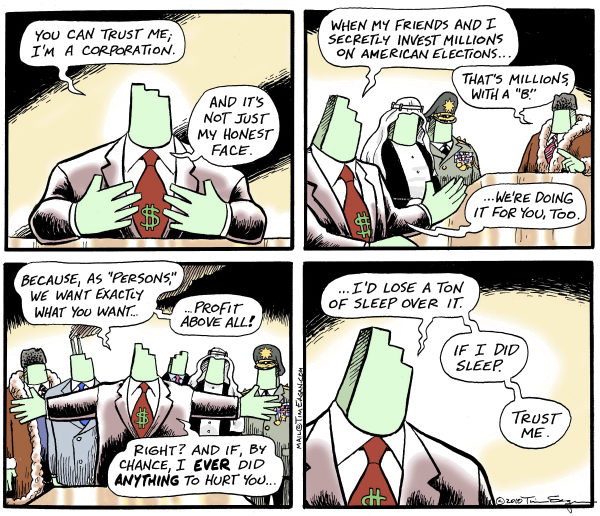
Tim Eagan - Deep Cover - Im a corporation - English - corporations, supreme court, citizens united, elections, persons

When former Massachusetts Gov. Mitt Romney (R) , the GOP frontrunner, was recently asked at the Iowa State Fair why he was focusing on entitlement reforms as a means of deficit reduction over asking corporations to share part of the burden, he said:
"Corporations are people, my friend... of course they are. Everything corporations earn ultimately goes to the people. Where do you think it goes? Whose pockets? Whose pockets? People's pockets. Human beings my friend."
WATCH Romney:


Now, former Alaska Gov. Sarah Palin (R) who kicked off her bus tour of Iowa at the state fairgrounds where Romney spoke also sided with corporations, declaring, “Mitt Romney was right.”

KEYES: Governor, are corporations people?

PALIN: The people pay the taxes. It’s not an entity — the corporation itself — that pays the taxes. It’s the people who pay the taxes. So Mitt Romney was right.

WATCH Palin:


Then, Sen. Rand Paul (R-KY) went further than Romney and Palin by saying, “all of us are corporations.”

KEYES: What did you make of Mitt Romney’s statement today that “corporations are people”?

PAUL: Corporations are collections of people. I think we’re all corporations. To say we’re going to punish corporations like they’re someone else. All of us are corporations.

KEYES: Do you think that was basically in line with what he was saying?

PAUL: You think about, if you own a retirement fund, you have a 401k, everybody who has a 401k has parts of corporations, so in a sense we are.

KEYES: I think people might argue that corporations can’t be sent to jail.

PAUL: I think those arguments can be made, but I think the fact that a lot of times people want to vilify corporations, saying they’re someone else, that they’re these other rich people. They’re us. They’re the middle class. We all own parts of corporations.

WATCH Paul:


You heard it straight from the horses mouth, or is that the elephants rear? These GOP Tea Party politicians want to protect the 'PEOPLE'S MONEY.' That means the Corporate Money with the Corporate Loopholes and the Corporate Tax Cuts. Because, you my friend... the little people.. don't have any money anymore to protect.

Sunday, August 1, 2010

New Robes for the Supreme Court

Given the recent Supreme Court decision removing restrictions on corporate and union campaign contributions, the Supreme Court justices in the majority on this decision have unveiled new robes.

picture-21

Sunday, April 25, 2010

Corporate Food: The Ugly Truth


No to Socialsm, Yes to Corporatocracy! tells the story of six banks controlling 60% of the Gross National Product (GNP)in this country. A few big corporations controlling our economic and banking system. This means that they "can distort the system. They can change the rules of the game to favor themselves. And unfortunately, the way it works in modern finance is when the rules favor you, you go out and you take a lot of risk. And you blow up from time to time, because it's not your problem. When it blows up, it's the taxpayer and it's the government that has to sort it out."

Therefore, power is being used against the people.

Another example of corporate power is found in the food industry. The movie
Food, Inc., shows how four large mega-corporations own and control the meat packing industry. In the seed industry, Monsanto is the leading producer of genetically engineered (GE) seed.


One of the repercussions of this concentrated ownership is that the bottom line profit becomes the motivating factor over the safety and quality of the product.

WATCH to see the ugly truth about our food industry.

Tuesday, April 6, 2010

Who's Not Paying Taxes


The Tea Party, the Libertarians, and the Conservatives are angry at government. They don't want government telling them what to do and they don't want taxes. Perhaps they should redirect their anger to the corporations who milk the system and pay no taxes. Or they should be angry at the government officials who write the laws that allow the loopholes that these corporations use to their advantage.

How do profitable corporations have a lower tax rate than you? The answer is surprising. Here are examples of large corporations that pay NO taxes or low taxes and reap in huge profits.

Exxon mobile Paid No Federal Income Tax in 2009

Last week, Forbes magazine published what the top U.S. corporations paid in taxes last year. “Most egregious,” Forbes notes, is General Electric, which “generated $10.3 billion in pretax income, but ended up owing nothing to Uncle Sam. In fact, it recorded a tax benefit of $1.1 billion.” Big Oil giant Exxon Mobil, which last year reported a record $45.2 billion profit, paid the most taxes of any corporation, but none of it went to the IRS:

Exxon tries to limit the tax pain with the help of 20 wholly owned subsidiaries domiciled in the Bahamas, Bermuda and the Cayman Islands that (legally) shelter the cash flow from operations in the likes of Angola, Azerbaijan and Abu Dhabi. No wonder that of $15 billion in income taxes last year, Exxon paid none of it to Uncle Sam, and has tens of billions in earnings permanently reinvested overseas.

Mother Jones’ Adam Weinstein notes that, despite benefiting from corporate welfare in the U.S., Exxon complains about paying high taxes, claiming that it threatens energy innovation research. Pat Garofalo at the Wonk Room notes that big corporations’ tax shelter practices similar to Exxon’s shift a $100 billion annual tax burden onto U.S. taxpayers. In fact, in 2008, the Government Accountability Office found that “two out of every three United States corporations paid no federal income taxes from 1998 through 2005.”

How can it be that you pay more to the IRS than General Electric?

As you work on your taxes this month, here's something to raise your hackles: Some of the world's biggest, most profitable corporations enjoy a far lower tax rate than you do--that is, if they pay taxes at all.

The most egregious example is General Electric ( GE - news - people ). Last year the conglomerate generated $10.3 billion in pretax income, but ended up owing nothing to Uncle Sam. In fact, it recorded a tax benefit of $1.1 billion.

Avoiding taxes is nothing new for General Electric. In 2008 its effective tax rate was 5.3%; in 2007 it was 15%. The marginal U.S. corporate rate is 35%.

It's GE Capital that keeps the overall tax bill so low. Over the last two years, GE Capital has displayed an uncanny ability to lose lots of money in the U.S. (posting a $6.5 billion loss in 2009), and make lots of money overseas (a $4.3 billion gain). Not only do the U.S. losses balance out the overseas gains, but GE can defer taxes on that overseas income indefinitely. The timing of big deductions for depreciation in GE Capital's equipment leasing business also provides a tax benefit, as will loan losses left over from the credit crunch.

But it's the tax benefit of overseas operations that is the biggest reason why multinationals end up with lower tax rates than the rest of us.
What the Top U.S. Companies Pay in Taxes, In Pictures
Eliminating Deferrals
Naturally the Obama administration wants to put an end to this. It has proposed doing away with tax deferrals on overseas income. If the plan passes, a U.S. company that pays a 25% tax on profits in China would have to pay an additional 10% income tax to Uncle Sam to bring it up to the 35% corporate rate.
Of course, large corporations are against Obama's plan.

Sunday, March 14, 2010

Democracy for Sale!

The Supreme Court recently ruled that corporations can contribute to federal campaigns.

Pursuant this this ruling the progressive PR firm Murray Hill Inc. has announced that it "plans to satirically run for Congress in the Republican primary in Maryland’s 8th congressional district to protest the Supreme Court’s disastrous decision."

Gil Ross says that "since the $upremes took a $tupid pill, and decided that a corporation is a 'person' entitled to 1st Amendment rights, let's just eliminate the middle-man, and really get the best government money can buy."

Think Progress has more of the story.
A press release on its website says that the company wants to “eliminate the middle man” and run for Congress directly, rather than influencing it with corporate dollars:

“Until now,” Murray Hill Inc. said in a statement, “corporate interests had to rely on campaign contributions and influence peddling to achieve their goals in Washington. But thanks to an enlightened Supreme Court, now we can eliminate the middle-man and run for office ourselves.”

“The strength of America,” Murray Hill Inc. says, “is in the boardrooms, country clubs and Lear jets of America’s great corporations. We’re saying to Wal-Mart, AIG and Pfizer, if not you, who? If not now, when?” [...]

Campaign Manager William Klein promises an aggressive, historic campaign that “puts people second” or even third. “The business of America is business, as we all know,” Klein says. “But now, it’s the business of democracy too.” Klein plans to use automated robo-calls, “Astroturf” lobbying and computer-generated avatars to get out the vote.

Murray Hill Inc. plans on spending “top dollar” to protect its investment. “It’s our democracy,” Murray Hill Inc. says, “We bought it, we paid for it, and we’re going to keep it.”

Murray Hill Inc. released its first campaign video Monday. A narrator in the video explains, “The way we see it, corporate America has been the driving force behind Congress for years. But now it’s time we got behind the wheel ourselves.”

Murray Hill Inc's spokesman Eric Hansel was recently interviewed by Thom Hartman non his radio show. Hansel explained to Hartmann that his company chose to run in the Republican primary because the GOP is more sympathetic to corporations.
Murray Hill Inc. is launching the campaign with a website, Facebook page and YouTube video.