Showing posts with label GOP Conservatives. Show all posts

Friday, March 16, 2012

Doonesbury Hitting the Issues

Today I became a mature adult. It has been a grat birthday so far!


This past week, Garry Trudeau's cartoon strip Doonesbury, has been tackling the issue of the conservative view on abortion. The newly emerging abortion laws has led to Trudeau's posting a cartoon series on the Texas ultrasound law. Garry Trudeau told Comic Riffs that to ignore the vaginal-ultrasound debate would have been “comedy malpractice.”

The website Addicting Info has carried the Doonesbury abortion comic strip all week long. "Why?"
Because many newspapers have decided that censoring this topic is a good way to keep people ignorant of what Republicans are doing to women’s rights. These so-called “news” organizations have failed to keep their readers informed because they would rather bow down to conservative demands. We here at AI reject such censorship and will continue to bring you the Doonesbury comic strip as long as this abortion segment continues. Republicans have declared war on women and everyone has the right to know exactly how the GOP is waging that war. To that end, Garry Trudeau decided to include the war in Doonesbury.

Republicans don’t want anyone to see this strip because they know it will draw the ire of much of the country. Women represent just over half of the national population, yet they are having virtually no say in what middle aged white male conservatives decide about their sex lives and medical privacy. It’s wrong and shouldn’t be tolerated. The only people who should be able to decide what is best for women’s bodies is women. Republicans have completely obliterated their claim of being the party that stands for small government the stays out of our lives. They’ve decided that small government should violate our privacy, force us to get medical procedures against our will and dictate what we do in our private lives with others. If that is their new definition of small government, I want no part of it. To combat this war on women and Republican censorship, please be sure to spread the word and share this with everyone you know. Women are counting on us to stand with them and their rights.
Monday’s Doonesbury:

Tuesday’s Doonesbury:

Wednesday’s Doonesbury:

Thursday’s Doonesbury:

Friday’s Doonesbury: 
Doonesbury


Saturday’s Doonesbury:
Doonesbury

According to Garry Trudeau:
I chose the topic of compulsory sonograms because it was in the news and because of its relevance to the broader battle over women's health currently being waged in several states. For some reason, the GOP has chosen 2012 to re-litigate reproductive freedom, an issue that was resolved decades ago. Why [Rick] Santorum, [Rush] Limbaugh et al. thought this would be a good time to declare war on half the electorate, I cannot say. But to ignore it would have been comedy malpractice.

Texas's HB-15 isn't hard to explain: The bill says that in order for a woman to obtain a perfectly legal medical procedure, she is first compelled by law to endure a vaginal probe with a hard, plastic 10-inch wand. The World Health Organization defines rape as “physically forced or otherwise coerced penetration — even if slight — of the vulva or anus, using a penis, other body parts or an object.” You tell me the difference.

Saturday, February 25, 2012

The Idiocy of the Culture Wars

Adam Zyglis - The Buffalo News - War on Women - English - politics, womens rights, contraception, gop, republican, party, santorum, obama, virginia, abortion, choice, freedom, government, women, health, symbol, target, komen, foundation


As the song goes, "War...what is it good for...absolutely nothing!"  Of course, those words sung by Edwin Star in 1969, represented a blatant anti-Vietnam War protest song.  In 2012, we are still fighting wars in other countries while the U.S. continues its wars against crime, drugs, and terrorists. And now the new escalated war on the scene is the 'culture war.'  

 
While economic problems are a reality for the middle class and poor, the politics of the conservative movement has been focused on social issues. The conservative swing to the far-right has its basis in the religious fervor of those who find moral objection to anything that they believe is not granted in the Constitution or by God in the bible.  This broad spectrum of negatives that are morally objectionable to the conservatives will have devastating effects on public education, science based teachings, women's health care and equal rights for all.

This is apparent in the backlash that has erupted over the legislation that the Tea Party Republican's have recently purposed.  As Lauren Kelley writes, "Ordinary citizens aren't the only ones protesting the GOP's anti-gay, anti-woman measures -- several lawmakers and a judge recently did too."
Political history has repeated itself recently, in a terrible way, with the return of the culture wars. Rather than focus on much-needed steps to improve the economy, Republican lawmakers have been focusing in recent months on efforts to roll back women's rights, including access to abortion and contraception, while homophobia runs rampant among the 2012 GOP candidates.

Activists have responded to these attacks by attempting to dispel hateful myths and draw attention to the harm that could be done with Republicans' social agenda. For instance, about 1,000 activists gathered at the Virginia statehouse earlier this month to silently protest the invasive transvaginal ultrasound bill the state legislature was considering (and has since withdrawn).

But ordinary citizens aren't the only ones protesting these anti-gay, anti-woman measures; several lawmakers and a judge recently made headlines for their creative and inspiring efforts to highlight the absurdities of the new culture wars.

1. Gay judge in Texas refuses to marry straight couples.
Texas judge Tonya Parker takes a very straightforward stance on officiating marriage ceremonies: she won't do it. Why? Because under Texas law, Parker, who is gay, does not have the right to get married herself.
Parker recently told a members of the Stonewall Democrats of Dallas (via the Dallas Voice):
"I use it as my opportunity to give them a lesson about marriage inequality in this state because I feel like I have to tell them why I'm turning them away. So I usually will offer them something along the lines of 'I'm sorry. I don't perform marriage ceremonies because we are in a state that does not have marriage equality, and until it does, I am not going to partially apply the law to one group of people that doesn't apply to another group of people.' And it's kind of oxymoronic for me to perform ceremonies that can't be performed for me, so I'm not going to do it."
Parker has a point -- why should she have to perform marriage ceremonies when she would not be able to waltz into a courthouse and get married to her own partner?

Just last week a second federal judge deemed the Defense of Marriage Act (DOMA) unconstitutional, paving the way for the law to head to the Supreme Court, and both Washington and Maryland moved to legalize same-sex marriage in the past month. So here's hoping Parker will be able to start performing both gay and straight marriages sooner rather than later.

Watch Parker's speech to the Stonewall Democrats of Dallas:
 

2. Oklahoma lawmaker sneaks "life begins at ejaculation" amendment into "personhood" bill.
"Personhood" measures that would give legal rights to fetuses are all the rage among anti-choice Republican lawmakers these days, with bills popping up in Mississippi, Colorado, and most recently, Virginia and Oklahoma. The legislation proved to be highly unpopular in Mississippi and Colorado, and was roundly defeated. But personhood could become law in Oklahoma very soon, as it has already passed both state legislative chambers.

Women's rights advocates are obviously enraged at this development, which, as Sarah Seltzer wrote recently:
threaten[s] the legal standing of everything from in vitro fertilization to the morning-after pill to miscarriages to many kinds of birth control -- and this particular bill has no rape or incest exceptions.
In a less legal sense, it pathologizes women who struggle with fertility (are their bodies murderers?), and contrary to its name, makes them into less than full persons. If this bill gets signed into law, it will be the first genuine personhood law that goes into effect.
Democrats in the state are also upset about the measure, and one Dem lawmaker, Constance Johnson, decided to do something about it by inserting the following language into the personhood bill:
However, any action in which a man ejaculates or otherwise deposits semen anywhere but in a woman's vagina shall be interpreted and construed as an action against an unborn child.
Johnson just took the Republicans' logic to its logical extreme: if they want to say life begins at conception, then why not go ahead and say that life begins at ejaculation? It was a wiseass move that wasn't meant to be taken seriously, but what it did do is pretty great. The move garnered headlines and drew attention to the absurdity of anti-choice legislation. Brava, state Sen. Johnson.

3. Virginia lawmaker: if women must undergo an ultrasound to get an abortion, men should have to get a rectal exam before receiving Viagra. 

Another troubling anti-choice legislative trend is the transvaginal ultrasound requirement. Under such measures, many women seeking abortions would be required to undergo an invasive vaginal procedure that is not medically necessary -- in other words, to endure state-sanctioned rape. (At least a few Republicans have poo-poohed the outrage over such measures by arguing, absurdly, that women consented to vaginal penetration when they had sex, so that consent should carry over when seeking an abortion.)

Texas already has a transvaginal ultrasound law on the books, and such measures have also been considered in Pennsylvania and Virginia, where, as mentioned above, more than 1,000 women's rights supporters gathered recently to protest the bill.

Another person who protested Virginia's ultrasound bill was Democratic state Sen. Janet Howell, who introduced an amendment into the legislature that would have required men to obtain a rectal exam and cardiac stress test before they could receive a prescription for Viagra. As Howell told the Huffington Post, "We need some gender equity here. The Virginia Senate is about to pass a bill that will require a woman to have totally unnecessary medical procedure at their cost and inconvenience. If we're going to do that to women, why not do that to men?"

Amid all the outrage, Virginia Gov. Bob McDonnell revised the legislation to do away with the transvaginal ultrasound requirement. However, women seeking abortions in the state still would have to undergo a medically unnecessary external ultrasound.

4. Congresswomen boycott all-male hearing on contraception.
By now virtually everyone has heard about Rep. Darrell Issa's recent hearing on whether employees at religiously affiliated institutions should be required to receive insurance that covers birth control without a co-payment. People were up in arms because the panel debating the issue looked like this:

hearing

Not a woman in sight. In fact, when a woman tried to testify, Issa refused to let her participate, arguing that "As the hearing is not about reproductive rights and contraception but instead about the Administration's actions as they relate to freedom of religion and conscience, he believes that Ms. Fluke is not an appropriate witness."

Enraged by the all-male panel, Democratic women present at the Issa hearing staged a walk-out. As Think Progress reported :
Reps. Carolyn Maloney (D-NY) and Eleanor Holmes Norton (D-DC) walked out of the hearing in protest of his decision, citing frustration over the fact that the first panel of witnesses consisted only of male religious leaders against the rule. Holmes Norton said she will not return, calling Issa's chairmanship an "autocratic regime."
The good news is that Sandra Fluke got a chance to speak a week later, at an alterna-hearing organized by Nancy Pelosi.

Rather than roll over and admit defeat, these lawmakers, and the judge from Texas, channeled their outrage over the GOP culture wars into creative, meaningful activism. Might we all learn something from them.
This conservative narrative is also apparent regarding other social issues. There is now a movement among conservative think tanks to create confusion and controversy regarding whether or not humans are changing the weather and the issue of public education.
Leaked documents reveal a right-wing think-tank's plans to undermine the teaching of climate science -- and defund public education in the process.

Though the various “reform” proposals these groups support typically involve rhetoric about “choice” and “markets” and “accountability,” when you boil off the vapors what you are left with is nothing more than a plan to take money away from public schools and hand it over to religious academies in the form of vouchers.
A conservative Republican Tea Party platform will continue to fight the rights of women, fight the rights of marriage and equality for all individuals, promote tax cuts to the rich, promote teaching creationism and abstinence in schools as well as defunding welfare, healthcare, medicare, social security and the public schools.  It is a misogynistic, homophobic, fear-based, religious platform.

Wednesday, February 15, 2012

GOP Name Calling


Republicans are good at name calling while claiming that is what Democrats do best. Cenk Uygur from The Young Turks doesn't want to disappoint the Republicans. He says that 99% of the GOP are "corporate whores."

The Conservative Political Action Conference, or CPAC, was chock full of speakers using hateful speech to describe liberals — all while decrying “name-calling” by Democrats. Cenk says, “Two can play at that game. We let them call us all of these names and we don’t fight back. Ninety-nine percent of the Republican party are corporate whores. They service the rich so they can give them more tax cuts. That’s all their objective is. The only thing they care about is how they can pleasure corporations and the very rich. You know what that makes them? It makes them corporate whores. You like name-calling? There it is.” 
WATCH:


b

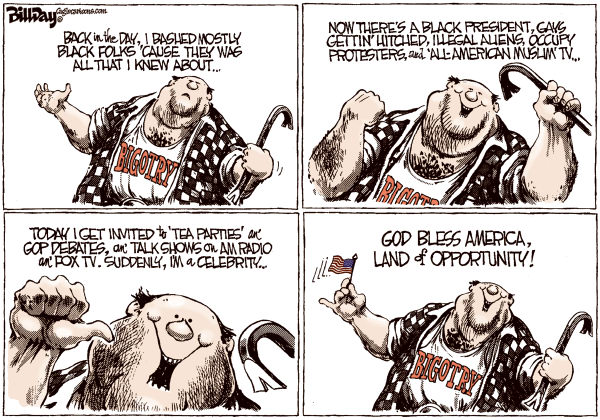
The Conservative Acceptance of Racism


Bill Day - Cagle Cartoons - Land of Opportunity - English - bigotry, illegal aliens, gays, occupy movement, debates

Stephen Eric Bronner believes that the Republicans, the Tea Party, Libertarians and other conservative factions are "At Home With the Bigot." 

The rise of reactionary activists.
Republicans and their conservative allies insist that racism is a thing of the past. But their party still serves as the bastion of anti-gay, anti-immigrant, anti-black, and anti-feminist activism. Not since the Great Depression has its lower-middle class base experienced such disorientation and disruption. President George W. Bush left them with two failed wars in Iraq and Afghanistan, the bursting of the sub-prime housing bubble and the crashing of the derivates market in 2007. And then, on top of it, came the electoral defeat in 2008 that produced the first black president of the United States. Military miscalculation abroad, economic collapse at home, and burning political humiliation fueled the stubborn radicalism and small-minded resentment of what would become the Tea Party. Coming from non-urban areas mostly in the South and the Mid-West, but also from white immigrant enclaves in some big cities, its members have their own forms of moral cognition. They have little use for globalization, the welfare state, new social movements or the "adversary culture" inherited from the 1960s. Wearing revolutionary garb and tricorn hats, disrupting town meetings devoted to healthcare and other social issues, bullying progressive congressional representatives and holding rallies of their own, they constitute a new generation of reactionary activists calling for "revolution" - though, naturally, only one that will protect their privileges and interests.

The coming together of Libertarians, bigots and religious fanatics in to the Tea Party.
The Tea Party meshes libertarian capitalists preaching the gospel of the free market and reactionary populists intent upon rehabilitating "family values," rehabilitating religion, and a parochial vision of community. Over the last century, for the most part, these trends were diametrically at odds with one another: Libertarians had little use for rabble-rousing bigots, religious fanatics or the like, while populists hated big business, open markets, and the scientific culture of modernity. Ronald Reagan initially brought these contradictory trends together. He blended the anti-union and de-regulating interests of elites committed to the classical principles of the free market with the cultural conservatism and hyper-nationalism of the old "moral" majority and burgeoning religious movements. George W. Bush built on that coalition. But there was new urgency for an organizational alliance between liberations and populists following the economic collapse of 2008 and subsequent presidential victory of Barack Obama. Fears of dramatic state intervention into the economy blended with horror over the symbolic implications of having a black president for the image of community associated with old television shows like Father Knows Best, Leave It to Beaver, and Happy Days. Out of this alliance and these anxieties, indeed, the Tea Party was born in 2009.

The GOP embraces and then succumbs to the Tea Party.
The GOP was quick to recognize its importance. Seasoned operatives of the Republican Party were soon offering their advice and leadership. They originally thought the Tea Party might be manipulated. But the opposite took place: the tail wound up wagging the dog. There is an old saying: styles make fights. The new rhetoric was supplied by Fox News and a score of feral media demagogues, among whom Glenn Beck and Michael Savage were merely the most venal. Evangelicals and far-right groups associated with them and others like them, and the Tea Party routinely began referring to President Obama as the Anti-Christ and as an Imam. The bigot applauded. Advertisements compared him and his family to chimpanzees, portrayed the White House with rows of watermelons on the lawn, and implied that the president is a crack addict. But the problem apparently was not the bigot's friends who supposedly hate blacks: it was rather Obama who clearly hates whites. The new president was seen as the advocate of the (black) welfare cheat, the (Latino) immigrant, the anti-Christian (Arab) terrorist, the supposedly overpaid (lazy and shiftless) union worker, and anti-family (feminist and gay) forces. The Tea Party channeled the bigot's prejudices. It would become easy for him to identify with the (white) business elite whose (seemingly color-blind) policies attacking the bureaucratic welfare state appeared intent upon recreating a patriarchal world of white privilege.

Capitalist fundamentalism.
Lingering economic recession, fear of radical social and economic reform, and fanatical mobilization (coupled with disillusionment of those expecting yet more radical changes by the new regime) brought about the sweeping victory of the far right in the Congressional elections of 2010. Now it was the Republicans' turn to applaud. The Tea Party was not simply nuts. Challenging the seemingly sacrosanct image of FDR and the New Deal, whatever its racist and intolerant elements, the Tea Party had become the agent of what might be termed capitalist fundamentalism. This meant highlighting the "invisible hand" of the market and the individual (not the accumulation process and class) as the units of social analysis. The state budget could now be equated with a household budget and everyone would now echo the mantra of Margaret Thatcher: "There is no society, there are only individuals." The welfare state would now be condemned (once again) not merely as wasteful - but immoral. Hard work brings rewards. Individuals are responsible for themselves, not others. Lack of ambition and foresight by individuals are the causes of unemployment and poverty. No free rides! Evangelicals know the "truth": no abortions, no condoms, and no gay marriage - women back to the kitchen and gays to the closet.

White is Right!
With the increasing influence of the Tea Party upon the Republican Party, indeed, the once modest home afforded the bigot turned into a mansion. Rooms would prove available especially for someone who is neither white nor male and who seemingly represents the less privileged. Women like former Republican vice-presidential candidate Sarah Palin or Congresswoman Michelle Bachmann (R-Minnesota) reaffirm the house-wife or the "soccer mom" in the face of an economy in which the single breadwinner has become an anachronism. A gay couple (two male earners) is trotted out occasionally to congratulate the Tea Party for its libertarian values. There is the Latino Senator Marco Rubio (R-Fla), who is apparently terrified by the immigrant mob threatening to invade from South of the border. The bigot has also made friends with an African-American or two. Hermann Cain received his applause for insisting that Blacks were "brain-washed" into supporting the Democratic Party, thereby confirming the bigot's old belief that they are too stupid to favor egalitarian and redistributive policies on their own. Supreme Court Justice Clarence Thomas champions tough love while his (white) wife champions the Tea Party. Then there is Congressman Allen West (R-Fla), whose idea of tolerance is to tell liberals "to get the hell out of the United States" and then identify the Democratic Party with the Nazi propaganda machine. This cast of characters, it should be noted, is not simply useful for propagandizing the undecided: it also reinforces the bigot's idea of what makes a real person of color or a real woman. These political figures validate the benevolent image of a bygone America in which taxes were low, government was small, women were in the kitchen, and the only important color was white.

US low among nations for Social Justice.
The clock has already been turned back. A study released on October 29, 2011, by the Bertelsmann Stiftung showed that the United States has plummeted into the bottom five among the thirty nations comprising the industrial world in "Overall Social Justice Rating," "Overall Poverty Prevention Rating," Overall Poverty Rate," "Child Poverty," and "Income Inequality." Libertarian economic policies championed by the Tea Party endanger democratic deliberation, diversity, and cosmopolitan ideals. New socio-economic burdens and constraints also threaten disadvantaged groups. People of color will disproportionately suffer from a flat tax as well as other regressive attempts to shrink the tax base and, subsequently, bankrupt the welfare state. African-Americans and Latinos will be disproportionately impacted by attempts to demand photo-ID, literacy tests, and the like in order to vote. Redistricting and racist zoning regulations are recreating segregation while the uncurbed use of private money in election campaigns is disenfranchising the working people and the poor. Privatizing the prison system has sharply increased incarceration, especially among minority groups: people of color constitute 70% of inmates, nationally, and one in three African-American males is currently either awaiting trial, in jail, or on parole. Since convicts cannot vote, hundred of thousands of primarily African-Americans and people of color are currently being disenfranchised by what has been called the "new Jim Crow."

Bigotry is accepted by the Tea Party GOP.
There is hardly a policy proposal forwarded by the GOP that does not disadvantage people of color, women, and working people - and, worse, there is hardly a single major Republican politician willing to publicly challenge the rhetoric or the proposals of the far right and the Tea Party. The mainstream has justified the extreme. All candidates for the Republican presidential nomination of 2012 seem to worry about a "disappearing white majority" as they take turns in attacking the Civil Rights Act of 1964, "food stamp presidents," and critics of religious dogmatism (as well as the Crusades). White supremacists of varying shades try to recruit and mix with luminaries of the Republican Party at conferences like that hosted by the American Conservative Union. Fragments of half-baked conspiracy theories float around in the minds of many grassroots activists in the Tea Party. Obama may look like he is in charge but (especially since he is black) the more paranoid insist that he is being controlled by more powerful interests and organizations like the Bilderberg banking group, the Trilateral Commission, Freemasons, Islamic terrorists, or Jews - or all of them working in concert. Conspiracy theory is common currency in the Tea Party and, again, there is hardly a single Republican willing to condemn it. Such talk makes no sense and thus frustration grows, resentment increases, and rage intensifies. It is taken out not merely on African-Americans but on other outsiders as well: gays, immigrants, Arabs, and Jews. Bigotry has become a commonplace of political life in the United States. The jargon of prejudice, sometimes veiled and sometimes not, is now so prevalent that most people simply shrug their shoulders. And the Tea Party has been in the vanguard. The influence of their words on action may be indirect: but it is, nonetheless, palpable.

"Racism is alive and well in the United States."
Everyday violence (that mostly goes unreported) against homosexuals, immigrants, and minorities is simply a routine fact of American life. Doctors performing abortions outside the larger cities do so at their own risk. The virtual obsession of the Tea Party with the right to own firearms (including AK-47s) does not merely express a desire to hunt ducks. Mainstream politicians of the Republican Party again fall into line. Sure: explicit calls for the use of violence come only from the margins. Just as the conservative mainstream has helped legitimate the Tea Party, however, the Tea Party is giving new hope to fanatics who stand even further on the right. The Republican Party has lacked the courage to take on the bigots in its own ranks - and its toleration of the Tea Party validates precisely what its ideologues wish to deny: racism is alive and well in the United States. And, all the while, the bigot is smiling. The approving winks that he gets are evident everywhere. What one reaps is what one sows. The prejudices of times past have not disappeared. One just needs to know where to look. Talk about the "end of racism" has become a bad joke. Conservative politics attests to its continuation. The Tea Party will probably find itself in the trashcan of history once Republicans suffer some serious electoral defeats. But its mass base will undoubtedly survive and take new organizational forms as it always has in the past - from the "Know-Nothings" to the KKK to McCarthy to the "Silent Majority" and the "Moral Majority" and God knows what other fringe groups. For the foreseeable future, however, the bigot has no need to worry. With the Republican Party, indeed, he has once again found himself a happy home.
The lesson that needs to be acted upon is that voices of protest against bigotry, racism, hate and disenfranchisement need to be loud, strong and now!

Jimmy Margulies - The Record of Hackensack, NJ - Holocaust Memorial hate crime - English - Holocaust Memorial, Hate crimes, White supremacists, Anti-semitism, Bigotry

Wednesday, July 13, 2011

Cause and Effect

John Cole - The Scranton Times-Tribune - GOP booze-energy drink COLOR - English - GOP, budget, loko four, deficit, debt, tax cuts, rich, bubble economy, boehner, mcconnell, deregulation, recovery, recession

In 1996, President Bill Clinton developed his triangulation style of governing. He would position himself, not to the 'left' or to the 'right' of an issue but smack dab in the middle. Of course, this Clintonian strategy was really the brain-child of the famously issue shifting pundit, Dick Morris. This approach allowed Clinton to work with mainstream Republicans while separating himself from traditional Democratic ideas. They saw it as a political win-win situation.

Truth be told, it was a huge win for the Republicans, big business, mega-corporation, bankers and Wall St. Of course, it was also a big win for Clinton who won over Republican voters by adopting Republican positions and theories. The down side was for the American people, the worker, the middle class, the poor, the environment and the principles of the Democratic Party.

In the end, triangulation led to the ratification in whole of the Bretton Woods Agreement in 1994 which opened the door for NAFTA in 1994. Clinton also signed into law the 1996 Telecommunication Act and the 1999 Gramm–Leach–Bliley Act which repealed the provisions of the Glass–Steagall Act of 1933.

So why is this important today? Thom Hartmann, radio show host and author has published a book titled, Unequal Protection: How Corporations became 'People' -and How You Can Fight Back. In an excerpt from his book, Hartmann shows the historical aspects of today's politics and the importance of these events.
It was the last week of June 1944, and the war wasn’t going well for Adolf Hitler. [...]

This same weekend that opened July 1944, a three-week meeting was convened in an isolated hotel in New Hampshire’s White Mountains near the town of Bretton Woods. Bankers, economists, and representatives of the governments of forty-four nations arrived for the meeting, which was convened as the International Monetary and Financial Conference of the United and Associated Nations.

The official history of the meeting suggests it was a group of nations getting together to work out a new international economic world order that would prevent a repeat of the Great Depressions and the European inflations that had occurred in the 1930s and driven Hitler to prominence and power with his promises to “restore Germany to greatness.”

Four years earlier, in November 1940, the German minister of finance, Walther Funk, had suggested a “New Order” for the world’s finances and banking that would be dominated by Germany. Partly in response to this, in 1942 John Maynard Keynes had begun to create a plan for an International Clearing Union, which formed part of the eventual basis of the Bretton Woods discussions.

According to Raymond F. Mikesell, who was present at the meetings, on the night of December 13, 1941, the U.S. secretary of the treasury, Henry Morganthau, “dreamed about an international currency” and the next morning called his undersecretary, Harry Dexter White, to ask him to write up a paper on how it could be brought to pass.

“Two weeks later,” Mikesell wrote, “White responded with a general out- line of an International Stabilization Fund (ISF) and a (World) Bank.”

During these three weeks and in subsequent meetings, the attendees hammered out the Bretton Woods Agreement, which created the International Monetary Fund (IMF) and the World Bank and laid early foundations for the General Agreement on Tariffs and Trade (GATT), which gave birth to the World Trade Organization (WTO). The group selected as the first U.S. executive director of the IMF the lead U.S. representative to the meeting and then–U.S. undersecretary of the treasury, Harry Dexter White.

The Bretton Woods Agreement wasn’t ratified in whole by the United States until Bill Clinton’s administration roughly fifty years later. And the near- immediate result of that would be hundreds of thousands of dead dolphins— along with the loss of as many as 20 million American manufacturing jobs. [...]

The U.S. Constitution specifically states that the president “shall have Power, by and with the Advice and Consent of the Senate, to make Treaties, provided two thirds of the Senators present concur.” That two-thirds-of-the-senators requirement, however, made for a slow and contentious process, particularly when it came to issues that could affect American jobs.[...]

Each president from Richard Nixon to Bush Sr. pushed to get this “fast- track authority” for himself. Bush Sr. pushed for ratification of the GATT agreement but was unsuccessful.

But Bill Clinton, in the final days of his first four-year term, joined with Senate leader Bob Dole to use political pressure, fast-track procedures, and careful timing (just before the Christmas recess) to bring the GATT agreement to pass.

Thus, after much lobbying and giving out of substantial campaign contributions by multinational business interests and a Senate vote to invoke cloture—a procedure that allowed only thirty hours of congressional debate and forbade amendments—the final parts of the Bretton Woods Agreement and its offspring were ratified in November 1994, just as Congress was hurrying to head home for the holidays. Most of the members of Congress didn’t read the document they voted on, but it became the law of the land in any case. One month later the now-fully-empowered GATT gave birth to the World Trade Organization. [...]

The Role of NAFTA and GATT/WTO

The biggest hit on the average family in the developed world has been the result of changes in how international trade is regulated. While Ross Perot stepped up to the podium during the presidential campaign and warned about “giant sucking sounds” from the south, both Bill Clinton and George Bush Sr. supported the U.S. ratification of the North American Free Trade Agreement (NAFTA), both saying that it would produce at least 170,000 new jobs.

NAFTA did, in fact, create that many new jobs and more—in Mexico. But in the United States, more than 420,000 jobs vanished by 1996 as a result of NAFTA, and over $28 billion in business was lost to U.S.-based workers. When job losses because of other international trade deals and the resultant U.S. trade deficit are factored in, more than 20 million U.S. manufacturing jobs have disappeared since the 1970s, most of them year-round and full-time, although many have been replaced by part-time or low-pay service-sector jobs, thus the “net loss” of “only” 420,000 jobs.

Let's not forget that it was the Bretton Woods Agreement, which created the International Monetary Fund (IMF) and the World Bank and laid early foundations for the General Agreement on Tariffs and Trade (GATT), which gave birth to the World Trade Organization (WTO).

WATCH Hartmann explain the impact today of the WTO on the American society.


Hartmann discusses the devastating effects of the Bretton Woods Agreement and NAFTA on the U.S. economy and politics. Remember that most of this legislation was based on the Republican, conservative theory that deregulation is good for competition. However, a review of the legislation that was passed under President Bill Clinton shows just the opposite.

1996 Telecommunication Act

The stated intent of the 1996 Telecommunication Act was to promote competition and the public interest by opening up markets to competition by removing regulatory barriers. In reality, the effect has been just the opposite.

In 2005, Common Cause issue a report on an analysis of the Act.

This study tells the story of the Telecommunications Act of 1996 and its aftermath. In many ways, the Telecom Act failed to serve the public and did not deliver on its promise of more competition, more diversity, lower prices, more jobs and a booming economy.

Instead, the public got more media concentration, less diversity, and higher prices.

Over 10 years, the legislation was supposed to save consumers $550 billion, including $333 billion in lower long-distance rates, $32 billion in lower local phone rates, and $78 billion in lower cable bills. But cable rates have surged by about 50 percent, and local phone rates went up more than 20 percent.

Industries supporting the new legislation predicted it would add 1.5 million jobs and boost the economy by $2 trillion. By 2003, however, telecommunications’ companies’ market value had fallen by about $2 trillion, and they had shed half a million jobs.

And study after study has documented that profit-driven media conglomerates are investing less in news and information, and that local news in particular is failing to provide viewers with the information they need to participate in their democracy.

Why did this happen? In some cases, industries agreed to the terms of the Act and then went to court to block them. By leaving regulatory discretion to the Federal Communications Commission, the Act gave the FCC the power to issue rules that often sabotaged the intent of Congress. Control of the House passed from Democrats to Republicans, more sympathetic to corporate arguments for deregulation. And while corporate special interests all had a seat at the table when this bill was being negotiated, the public did not. Nor were average citizens even aware of this legislation’s great impact on how they got their entertainment and information, and whether it would foster or discourage diversity of viewpoints and a marketplace of ideas, crucial to democratic discourse.

The 1999 Gramm–Leach–Bliley Act (GLB) which repealed the provisions of the Glass–Steagall Act (GSA) of 1933

The Glass-Steagall Act distinguished types of banks and separated them by the type of business, such as, commercial and investment banking. Another aspect of the Act was that it founded the Federal Deposit Insurance Corporation (FDIC) for insuring bank deposits. By repealing the GSA, restrictions against merging commercial and investment banking were lifted. Furthermore, the Gramm-Leach-Bliley Act allowed banking institutions to provide a broader range of services, including underwriting and other dealing activities.

In 1933, in the wake of the 1929 stock market crash and during a nationwide commercial bank failure and the Great Depression, two members of Congress put their names on what is known today as the Glass-Steagall Act (GSA). This act separated investment and commercial banking activities. At the time, "improper banking activity", or what was considered overzealous commercial bank involvement in stock market investment, was deemed the main culprit of the financial crash. According to that reasoning, commercial banks took on too much risk with depositors' money. Additional and sometimes non-related explanations for the Great Depression evolved over the years, and many questioned whether the GSA hindered the establishment of financial services firms that can equally compete against each other.
There are many who blame the repeal of GSA for the monetary problems today. Of course legislation which was passed after GLB also played a part in the financial crisis. The 2000 Commodity Futures and Modernization Act also exempted credit default swaps from regulation and was signed by President Clinton.
WATCH a video on the cause and effect of repealing the Glass-Steagall Act.


Here's a video of former President Bill Clinton responding to a question about his role in deregulation. WATCH:


Is deregulation the culprit? If so, then the conservative approach to governing will be more of the same laissez-faire attitude toward corporate and banking behavior. That approach has very negative effects for Americans.

Tuesday, May 19, 2009

GOP: Getting Back to Their Conservative Base

A new Gallup survey shows that moderates and liberals are leaving the Republican party at a higher rate than conservatives. As matter of fact, only 1% of Republicans who considered themselves conservatives have left the Republican Party over the last eight years. The most loyal Republicans were weekly church goers.

Comparatively, 9% of moderates and 8% of liberals have left the party.

Some Republicans might find these results reassuring. According to Rush Limbaugh, Sean Hannity or Dick Cheney this exodus is not a problem. They have been saying that the GOP shouldn't moderate but rather the GOP should focus its rebuilding efforts on the party's conservative base.

Give Limbaugh, Hannity and Cheney medals for a 'mission accomplished.'

tsv7ekhtmkmkzrt5kcyt_g