Wednesday, June 23, 2010

The Important Story about Afghanistan


Joshua Holland's compelling article, "Don't Let the McChrystal Frenzy Obscure the Dirty Truth About Afghanistan," brings out the most important point of the Rolling Stone article which the media is ignoring. The story by Rolling Stone reporter Matt Hastings reveals that the Afghanistan war is an "exercise in futility."

It should come as no surprise that General Stanley McChrystal’s return to Washington to explain a series of derogatory comments he and his staff made about the White House has ignited a media frenzy.

The story has everything a reporter could want -- tension within the administration, a very public clash between civilian and military leaders over just what we might hope to accomplish in Afghanistan, and even some echoes of Truman's historic clash with General George MacArthur during the Korean conflict.

But the story by Rolling Stone reporter Matt Hastings also reveals just how narrow the discourse about our Afghanistan adventure really is. Because while we’ll be treated to tens of thousands of column inches and hours of cable news blather about McChrystal’s “insubordination,” or whether Obama looks “tough enough” in handling the situation, the most important part of Hastings’ article is largely being ignored by the corporate media.

Hastings told a tale of a project with no hope for success. His story shows us that the U.S. presence in Afghanistan is all about tactics dressed up as a strategy. It’s a profile of a military establishment running on inertia -- unable to withdraw because withdrawing is an admission of defeat, but also unable to accomplish the wholly unrealistic tasks put before it.

This is perhaps the most revealing passage from Hastings’ report:

"[Team Obama] are trying to manipulate perceptions because there is no definition of victory – because victory is not even defined or recognizable," says Celeste Ward, a senior defense analyst at the RAND Corporation who served as a political adviser to U.S. commanders in Iraq in 2006. "That's the game we're in right now. What we need, for strategic purposes, is to create the perception that we didn't get run off. The facts on the ground are not great, and are not going to become great in the near future."

But facts on the ground, as history has proven, offer little deterrent to a military determined to stay the course. Even those closest to McChrystal know that the rising anti-war sentiment at home doesn't begin to reflect how deeply fucked up things are in Afghanistan. "If Americans pulled back and started paying attention to this war, it would become even less popular," a senior adviser to McChrystal says. Such realism, however, doesn't prevent advocates of counterinsurgency from dreaming big: Instead of beginning to withdraw troops next year, as Obama promised, the military hopes to ramp up its counterinsurgency campaign even further. "There's a possibility we could ask for another surge of U.S. forces next summer if we see success here," a senior military official in Kabul tells me.

Again, counterinsurgency is a matter of tactics. The strategy, we have been told for almost a decade, is to defeat the remnants of the Taliban and create a functional, legitimate state in a country where one has never before existed. It was a “state-building” project that was supposed to enhance our security by fostering the kind of stability and economic progress that would supposedly make Islamic extremism unappealing to the masses.

But as the New York Times reported earlier this month, the leader of that government, Hamid Karzai, has “lost faith in the Americans and NATO to prevail in Afghanistan.” An adviser told the Times that Karzai has no “confidence in the capability of either the coalition or his own government to protect this country,” and for that reason he has been “pressing to strike his own deal with the Taliban and the country’s archrival, Pakistan, the Taliban’s longtime supporter.”

Anan Gobal noted that in 2008, after seven years of fighting, less than a third of the country was under the control of the central government in Kabul, and added: “Many say even that is now an optimistic assessment.” Earlier this month, Bloomberg reported that the Pentagon was making cash payments to Afghan warlords. According to Bloomberg, “Contractors told congressional investigators they believe that, in turn, the ‘warlords make protection payments to insurgents’ who are fighting the U.S.”

Our tax dollars are actually financing those trying to kill U.S. troops.

According to a report released in January, the U.S.-backed government is also awash in corruption, which Afghans now view “as a bigger concern than security and unemployment.” The government we’re backing may be extracting as much as one quarter of Afghanistan’s gross national product in bribes. And Karzai’s own brother has been implicated in Afghanistan’s rich drug trade.

Hastings’ report also paints a picture of a White House that despite its grand promises of change continues to fight George W. Bush’s war much the same way as he waged it for seven years. He noted how similarly divorced from reality the rhetoric coming from this White House has been to that of the Bushies:

"There is no denying the progress that the Afghan people have made in recent years – in education, in health care and economic development," the president says. "As I saw in the lights across Kabul when I landed – lights that would not have been visible just a few years earlier."

It is a disconcerting observation for Obama to make. During the worst years in Iraq, when the Bush administration had no real progress to point to, officials used to offer up the exact same evidence of success. "It was one of our first impressions," one GOP official said in 2006, after landing in Baghdad at the height of the sectarian violence. "So many lights shining brightly." So it is to the language of the Iraq War that the Obama administration has turned – talk of progress, of city lights, of metrics like health care and education. Rhetoric that just a few years ago they would have mocked.

The conflict in Afghanistan is now the longest one the United States has ever fought. Tens of thousands of people have been killed, at a cost of hundreds of billions of U.S. tax dollars. That there are electric lights in Kabul is as pathetic a “milestone for success” as one could imagine, and Obama’s focus on how sparkly the approach to Kabul’s airport is offers evidence of the same obstinate dismissal of reality that was so maddeningly common in the Bush White House.

Ultimately, what the Rolling Stone story tells us is that even those tasked with carrying out Obama’s Afghanistan policy know it’s an exercise in futility. McChrystal and his aides are protecting his legacy against history’s harsh judgment of what will prove an incoherent policy from its inception.

Max Bergmann of the Center for American Progress didn’t miss what lies at the heart of the Rolling Stone report. “The significance of this food fight is not in what was said,” he wrote, “but in what it says about where the United States is in Afghanistan":

What has become apparent is that … the mythic status now given to the surge in Iraq led to a significant degree of over-confidence on the part of McChrystal and others about their ability to turn the Afghan war around after it had utterly deteriorated year after year under the neglectful watch of the Bush administration.

The McChrystal incident provides some titillating political news for the pundits to chew on for a few days. But it also tells us a lot about the state of affairs in Afghanistan, and the picture is not pretty. That, rather than some quotes from McChrystal’s anonymous staffers, should be the Big Story this week.

Is anyone surprised to find out that winning in Afghanistan is the mission, but the reality of the situation indicates otherwise? There is "no hope for success."

Tuesday, June 22, 2010

Republicans Want Power Back


Republicans have been hinting of a GOP turn-around in Congress in 2011. One of the issues that they see on the table is the impeachment of President Obama.
Should the Republicans retake Congress, not only will they derail any chance at even incremental policy improvements, they will try to destroy the Obama presidency. All the president's efforts at making nice and crossing the aisle to form bipartisan consensus always were but the pursuit of a myth. Unilateral kneecapping. Unipartisanship. Call it what you will.
Michele Bachmann has raised the issue of impeachment.
And the thing is, here we are, people can’t wait until November. They’re practically lining up for polls now, they can’t wait to go out and vote. The only thing is people wish Barack Obama was up for re-election right now, because they’d honestly love to have a chance to throw him out of office. Everywhere I go, people ask me, “Michele, can we impeach the president?”
The issue of Republican control is important to Rep. Darrel Issa, who will chair the Oversight and Government Reform Committee, should the Republicans retake the House, this November. Issa wants subpoena power.
Rep. Darrell Issa, the conservative firebrand whose specialty is lobbing corruption allegations at the Obama White House, is making plans to hire dozens of subpoena-wielding investigators if Republicans win the House this fall.

At a recent speech to Pennsylvania Republicans here, he boasted about what would happen if the GOP wins 39 seats, and he gets the power to subpoena.

“That will make all the difference in the world,” he told 400 applauding party members during a dinner at the chocolate-themed Hershey Lodge. “I won’t use it to have corporate America live in fear that we’re going to subpoena everything. I will use it to get the very information that today the White House is either shredding or not producing.”

In other words, Issa wants to be to the Obama administration what Rep. Dan Burton (R-Ind.) was to the Clinton administration — a subpoena machine in search of White House scandals.

Fox News as well as Matt Drudge and other right-wing pundits have also raised allegations of "an impeachable offense," against President Obama.

Right-wing media are comparing false allegations that the White House "bribed" Rep. Joe Sestak (D-PA) with an administration job to the Watergate scandal. In fact, legal experts have rejected the claims that such offers are a bribe or are illegal.

The Republican strategy is very different than the Democrats.

Democrats took impeachment off the table despite Bush having lied us into war, authorized torture and imposed police state surveillance. Some Republicans keep talking impeachment of President Obama, despite there being absolutely no grounds whatsoever. Let there be no doubt that should the Republicans retake either House of Congress, they will spend the rest of Obama's first term investigating absolutely any delusion they can hallucinate. The TV talk shows should be asking about it. Voters should be aware of it.

What is the agenda of the Republicans?

That’s the Republican agenda: Protect the corporate nobility, waste time and money on purely partisan witch hunts against Democrats, and ignore the needs of people.

Meet the Wandering Minstrels in Nepal

From That Good Ol’ Himalayan Mountain Music comes the story of the search for musical roots in two divergent areas.
Every time I think I’ve grown tired of gimmicky global music pairings—klezmer meets calypso! chanting monks go techno!—I run into another combination that suggests there’s some deep universal taproot of musical expression. The latest strange bedfellows I’ve come across: Appalachian and Nepalese music. The musicians behind the documentary The Mountain Music Project—A Musical Odyssey from Appalachia to Himalaya set out in search of threads between the two traditions, and from the looks (and sounds) of this trailer they found plenty:


The Bluegrass Blog reports that the film has been nominated for best music feature in the World Music and Independent Film Festival.

Source: The Mountain Music Project, The Bluegrass Blog


A Brain in God's Neck?

'The  Separation of Light From Darkness' was among Michelangelo's last Sistine  Chapel frescoes.
Copyright 2010, Congress of Neurological Surgeons

Via NPR: Michelangelo's The Separation of Light From Darkness was one of the last Sistine Chapel frescoes painted by Michelangelo. Two neurosurgery researchers at Johns Hopkins University say they've found something unique in the lines of the character's neck.

Two neurosurgery researchers at Johns Hopkins University say Michelangelo hid something within one of his Sistine Chapel frescoes: an anatomically accurate painting of the human brain.

And they found it in God's neck in the fresco, The Separation of Light from Darkness. That's the painting immediately above the chapel's altar, says Dr. Rafael Tamargo, a neurosurgery professor and co-author of an article in the journal Neurosurgery.

"As we studied the lines that Michelangelo had included in the neck, we were surprised to find that if you follow these lines, you can actually draw an anatomically correct view of the brainstem," Tamargo tells NPR's Robert Siegel.

He says Michelangelo started dissecting cadavers when he was 17 years old.

"So he probably had the ability and the material to carry on multiple dissections and eventually sort out the gross anatomy of the brain," he says.

But what was Michelangelo's motive for drawing a brain in God's neck?

The comparison of God's neck  in Michelangelo's painting with a picture of the brain.
Copyright 2010, Congress of Neurological Surgeons

The researchers matched the the neck of God in Michelangelo's fresco (left) with a similar area in the brainstem of a cadaver (right).

"I think that Michelangelo might have been somewhat reluctant to advertise his anatomical dissections. At the time, cadaver dissections were viewed with ambivalence by the population and the Vatican. I think he had a lot of anatomical knowledge that he wanted to express, but didn't have a venue in which to do so. And by incorporating this image of the brain first, he was able to display his knowledge of anatomy and also sign the fresco, so to speak, in a unique way," Tamargo says.

Tamargo says he's convinced that this was Michelangelo's intention.

"Prior to the article, my colleague and I, Ian Suk, showed it to other neurosurgeons, neuroanatomists," he says. "And without saying much, they spontaneously recognized the brainstem. So I think it's real."

Images from "Concealed Neuroanatomy in Michelangelo's Separation of Light From Darkness in the Sistine Chapel" by Ian Suk and Rafael J. Tamargo (Neurosurgery 66(5):851-861, May 2010). Copyright 2010, Congress of Neurological Surgeons

Sunday, June 20, 2010

This represents all of our frustration! The Krog Street Tunnel in Atlanta, Georgia gets painted.

Wednesday, June 16, 2010

Sharron Angle's Angle


Sharron Angle, Republican candidate for U.S. Senate in Nevada

What is the Republican Party Senate candidate Sharron Angle proposing to outlaw in her bid for the Nevada Senate seat? She would like the State of Nevada to outlaw pot, booze, pornography and homosexuality. What does she support? Angle is a strong supporter of gun rights and for restoring American jurisprudence to its Biblical foundations. That is because in the 1990's Sharron Angle was a member of the Independent American Party.

For at least six years in the 1990s before she held state-level elective office, Angle was a member of the little-known Independent American Party, a right-wing party that combines elements of Ron Paul's doctrinaire libertarianism -- pro-gun, anti-tax, anti-bureaucracy, pro-states' rights -- with Christian social conservatism and fear of the "North American Union" and other forms of "global government." The small party attracted considerable controversy in 1994 when it took out a newspaper ad titled "Consequences of Sodomy: Ruin of a Nation," which suggested HIV could spread through the water.

Three members of the Independent American Party tell TPM that Angle, a Nye County, Nevada, school board member at the time, was an active member of the party in the 1990s. They say she only left the Independent American Party and became a Republican out of political expediency when she decided to seek a seat in the state assembly, to which she was elected in 1998.

According to the their website, the Independent American Party is the official Nevada State affiliate of the National Constitution Party. The Constitution Party's platform states that "the goal of the Constitution Party is to restore American jurisprudence to its Biblical foundations and to limit the federal government to its Constitutional boundaries."

Also, the Constitution Party is closely linked to
Christian Reconstructionism.

What’s Christian Reconstructionism? Well it’s a theocratic intellectual and political movement founded by the late Armenian theologian R.J. Rushdoony, and it burst onto the American political scene in 1992 with the founding of the US Taxpayers Party, later renamed the Constitution Party. Founder of the two parties Howard Phillips was a member of Rushdoony’s inner circle and called the theologian “my wise counseler” according to journalist Frederick Clarkson, a noted authority on Christian Reconstructionism.

Rushdoony wanted to base American law and government on Old Testament scripture. He advocated stoning to death adulterers, women who have intercourse before marriage, active homosexuals, and people who strike or curse at their parents (the full list of miscreants who according to Rushdoony should be bashed to death with rocks is much longer than this.) Why rocks ? As Rushdoony’s son-in-law Gary North, another leading Christian Reconstructionist, put it, “There are many reasons. First, the implements of execution are available to everyone at virtually no cost.” North has described executions-by-stoning as “community projects.”

R.J. Rushdoony had a number of other notable views – he was a Holocaust revisionist who claimed in his master work The Institutes of Biblical Law that less than one million Jews were killed by the Nazis during World War Two and that most of those died from cold rather than execution.

The most interesting aspect of these events is that Senator Jim DeMint is now raising money for Angle using the mailing list of the Christian Reconstructionist organization American Vision. Their website states that "American Vision’s mission is to Restore America to its Biblical Foundation—from Genesis to Revelation."

Not everyone is supporting Angle's Republican bid. Some Independent American Party members are quite bitter about her switching party allegiance.

Christopher Hansen, brother of party founder Daniel Hansen and himself a former chair of the party, tells TPM that "I think Sharron in her heart is a very good person." But he remains upset that "she decided to go over and join with the fascist Republicans."

"The national Republicans are going to come in here and teach her how to be a good Republican stooge," he predicts. "She'll just be another dyed-in-the-wool stooge Republican."

DeMint is appealing to the far-right in an effort to defeat Harry Reid in November. He is willing to support a candidate who comes from a party that thinks he's a fascist. The citizens of Nevada will have to decide in November if money will buy their vote.


Cheney's Secret


Mother Jones thinks that former V.P. Dick Cheney is having the last laugh regarding the U.S. energy policy that was molded and formed in secrecy during the Bush-Cheney era.
"The Deepwater Horizon disaster raises new questions about the Bush administration's secret energy task force."

Dick Cheney hasn't made much time for television appearances lately. But in the weeks since the Deepwater Horizon unleashed a torrent of oil on the Gulf of Mexico, his name has been creeping back into the press. "The truth is that right now we have precisely the regulatory system that the Bush-Cheney administration wanted: full of loopholes, full of cronies and lobbyists filling the very agencies that are supposed to be overseeing the industry," liberal commentator Arianna Huffington said on ABC's This Week last Sunday. Cheney's daughter, Liz, was on hand to defend her father. "Arianna, I don't know what planet you live on," she shot back. "What you are saying has no relationship to the truth, no relationship to the facts."

The reality is a lot more complicated than that. Many of the policy and regulatory failures that laid the groundwork for the BP catastrophe can be traced back to the Bush-Cheney era. But so far, this question has received relatively little attention—mostly because the task force that developed the former administration's energy policy operated in extreme secrecy. Did the task force's decisions play a role in the BP spill? And could the Gulf disaster finally provoke new scrutiny of the task force's clandestine workings?

Cheney's secret energy task force.

The energy task force was created days after onetime oilman George W. Bush took office in 2001, and was headed by Cheney, a former CEO at Halliburton, one of the world's largest providers of oilfield products and services. For months, the task force solicited input on US energy policy. On May 16, 2001, the group issued its final report, which was submitted to Congress in June. But the participants and details of the discussions were kept tightly under wraps.

The open-government group Judicial Watch tried to pry details of the task force's deliberations from the administration in June, arguing that the sessions qualified as public information under the Federal Advisory Committee Act and the open-meetings law. The US General Accounting Office (GAO), the investigative arm of Congress, also sought information on which industry executives and lobbyists had attended the gatherings.

But in the first of many clashes over presidential secrecy, the White House rejected those requests, arguing that it was entitled to conduct the meetings behind closed doors thanks to executive privilege. Judicial Watch and the Sierra Club sued, but the Supreme Court ultimately sided with the administration. Though some information has trickled out in the years since, the vast majority of the task force's deliberations remain hidden from the public eye.

The task force position of deregulation of offshore drilling.

Here's what we know about the task force and offshore drilling. The Natural Resources Defense Council, an environmental group, was able to obtain 13,500 pages of heavily redacted documents that gave a glimpse into the role industry leaders played in shaping the administration's policies (NRDC also got a list of the documents (PDF) that the administration refused to turn over). In July 2007, the Washington Post got a list of the roughly 300 groups and individuals who met with task force staffers and, in some cases, Cheney himself.

BP officials were among those who "gave detailed energy policy recommendations" to the administration, though when that fact came to light, the company refused to comment on those meetings. We still don't know what specific policy areas BP execs weighed in on. Perhaps it's little surprise that BP recently hired Cheney's former press secretary, a public defender of the secret task force, to help the company with crisis communication after the spill.

But we do have a few more details about other oil industry players in the talks. Chevron's CEO contributed a detailed list(PDF) of ways in which the government could "eliminate federal barriers to increased energy supplies"—many of which were incorporated in the task force's final report. This included recommendations to ease federal permitting rules for energy development and a request that the administration support opening up new areas of the eastern Gulf of Mexico for offshore oil and gas development. Doing so, wrote Chevron CEO David O'Reilly, would "demonstrate a commitment to reject unjustified opposition to new energy leasing and development."

The American Petroleum Institute offered its own long list of suggestions for energy policy. A March 20, 2001, email from API to an official at the Energy Department included a draft executive order calling for all federal agencies to issue a detailed statement on any regulatory action that "adversely affects energy supply, distribution or use." It was nearly identical to the order Bush issued just two months later.

The connection between the task force and the Energy Policy and its effect.

Many of the recommendations from the task force report were adopted in the 2005 Energy Policy Act. That legislation provided $6 billion in subsidies for oil and gas development. Royalty payments for oil and gas development were waived in several regions of the US. Some companies were allowed to pay royalties with oil, rather than money—a less transparent system that was more vulnerable to abuse. The bill also provided $1.5 billion in direct payments to companies to incentivize drilling in deepwater wells, and curtailed the power of states to oversee oil and gas exploration off their coasts under the Coastal Zone Management Act.

In addition, the bill weakened environmental protections for offshore drilling, making it easier to exclude a broad range of exploration and drilling activities from analysis under the National Environmental Policy Act. This has been cited as the reason that the Deepwater Horizon site was not subjected to a thorough environmental analysis.

The task force's final report also presented a rosy picture of the offshore drilling industry. Newer oil and gas drilling methods, it said, "practically eliminate spills from offshore platforms" and "enhance worker safety, lower risk of blowouts, and provide better protection of groundwater resources." The report advocated lifting the moratorium on portions of the outer continental shelf, noting that "concerns over the potential impacts of oil spills have been a major factor behind imposition of the OCS moratoria." Bush lifted the executive moratorium in 2008, and the Democratic-controlled Congress allowed its own moratorium to expire.

Unanswered questions.

But there's a lot we still don't know. The task force recommendations included scaling back regulations and oversight of offshore drilling while expanding incentive programs and access to resources, many of which would come to pass in future legislation. But how much the task force may have guided decisions at federal agencies—in particular the notoriously lax Minerals Management Service (MMS)—is unclear. The administration's directives across the agencies actively discouraged any regulations or oversight that might hinder development of resources.

Among the many questions is what role the task force may have played in a 2003 decision by the MMS not to require offshore rigs to install an acoustic shut-off switch, a remote-controlled backup system that seals off an underwater well even if the rig above is destroyed. Countries like Norway and Brazil require this precaution, and MMS considered doing the same. But oil companies complained that the $500,000 devices were too expensive and, they argued, ineffective. Ultimately, MMS made the switches optional. The Deepwater Horizon was not outfitted with such a device, which could have prevented the spill. Other concerns include a failure to implement new cementing policies or act on known concerns about key components on drilling rigs.

Investigations without subpoena power.

The Department of Justice has launched criminal and civil investigations into the disaster, while a presidential commission is looking into both the spill and offshore drilling policy in general. That commission currently lacks subpoena power, though there's an effort underway in Congress to grant the commission that power. Numerous congressional committees have also launched probes of the spill. A congressional aide working for one of those committees indicated that there has been some discussion of revisiting the task force in those investigations, though no concrete steps to do so have been taken.

Open government advocates say this might be the appropriate time to push for more information about his task force. Mandy Smithberger, an investigator at the Project on Government Oversight, says that it's "definitely a ripe time" to find out more about what went on in the meetings. "I don't think you can understand how we got to where we are without looking back," she says.

"When you have a disaster of this magnitude, it raises the question, if in this whole secretive process, what was discussed, how much did the Bush administration ignore, how much did they allow the oil and gas industry to basically do what they wanted," says AnneWeismann, chief counsel at Citizens for Ethics and Responsibility in Washington. "Secrecy is so pernicious that it can continue to damage even when the administration is not in power."

Secrecy, deregulation, oil subsidies and a lack of accountability are just a few of the problems that have stemmed from the Bush-Cheney era energy policy. The oil spill in the Gulf of Mexico is now spreading and effecting the ecosystems across vast areas. So to has the energy policies of the previous administration infiltrated and caused loopholes and unbridled greed in the power play of oil and money.

Jon Stewart: Ore on Terror

The Daily Show With Jon StewartMon - Thurs 11p / 10c
Ore on Terror
www.thedailyshow.com
Daily Show Full EpisodesPolitical HumorTea Party

Trust Me

Tuesday, June 15, 2010

To Call BP a Pig is to Insult Every Pig

photo
(Photo: abmatic)

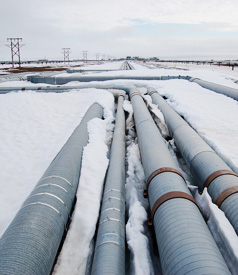
Truthout has spoken to employees and obtained documents that reveal that, "BP's Alaska Oilfield Plagued by Major Safety Issues."

Nearly 5,000 miles from the oil-spill catastrophe in the Gulf of Mexico, BP and its culture of cost-cutting are contributing to another environmental mess.

According to internal BP documents obtained by Truthout, and after interviewing more than a dozen employees over the past month, the Prudhoe Bay oil field, in a remote corner of North America on Alaska's north shore, is in danger.

After two serious oil spills and other mishaps, the BP employees fingered a long list of safety issues that have not been adequately addressed, making the Prudhoe Bay oilfield vulnerable to a devastating accident that potentially could rival the havoc in the Gulf.

"The condition of the [Prudhoe Bay] field is a lot worse and in my opinion a lot more dangerous," said Marc Kovac, who has worked for BP on Alaska's North Slope for more than three decades. "We still have hundreds of miles of rotting pipe ready to break that needs to be replaced. We are totally unprepared for a large spill."

Kovac, a mechanic and welder who is the steward of the United Steelworkers union local 4959, said a lot of employees share his feelings, but "don't want to risk their jobs for speaking out." Kovac said he was willing to take the risk because BP has been slow to deal with the Prudhoe Bay problems and that "many lives are at stake."

Some of the employees, speaking anonymously, said BP follows an "operate to failure" attitude.

Kovac said that means BP Alaska avoids spending money on "upkeep" and instead runs the equipment until it breaks down.

READ MORE>>>
The problem lies in the fact that the world is interconnected. What is happening in Alaska or the Gulf will ultimately effect each of us even though we live miles away from the devastation. A famous Cree Prophecy seems eerily appropriate at this time.
Only after the last tree has been cut down, Only after the last river has been poisoned, Only after the last fish has been caught, Only then will you find money cannot be eaten.

Monday, June 14, 2010

Health Care is a Right

Barbara Bush attends the Lela Rose Spring 2010 Fashion Show at  Bryant Park on September 13, 2009 in New York, New York. (Photo by Jason  Kempin/Getty I
Getty

Barbara Bush, the 28-year-old daughter of former President George W. Bush, sounded more like a Democrat according to Chris Wallace of Fox News.

Yesterday, President Bush’s 28-year old daughter Barbara was named Fox News Sunday’s “Power Player of the Week” for her work as co-founder of Global Health Corps, a group of young professionals promoting global health equality. During the interview with Fox, Barbara Bush’s comments on health care sounded like, as host Chris Wallace put it, “a mission statement from the Obama White House”:

BARBARA BUSH: Why do basically people with money have good health care and why do people that live on lower salaries not have good health care? You know, health should be a right for everyone. [...]

WALLACE: What do you think of Obama health care reform?

BUSH: That is a good question. And obviously, the health care reform bill, you know, was highly debated by a lot of people. And I guess I’m glad that, you know, a bill was passed.

WATCH:


She hasn't fallen far from the female side of the Bush tree. Recently, Laura Bush told Larry King that she supports abortion rights and gay marriage.

It is interesting that Fox's Chris Wallace was quite polite to Barbara Bush, given that she had strayed from the Republican talking points on health care. At least he didn't accuse her of being a socialist!

Headlines Regarding BP


BP Is Destroying Evidence and Censoring Journalists

BP is using federal agencies to shield itself from public accountability and is actually disappearing oiled wildlife. READ MORE
BP Oil Disaster Stalls Climate Bill
You’d think that after a seemingly unstoppable oil spill in the Gulf of Mexico (official estimates are up to 50,000 barrels a day, as of yesterday) and the hottest spring on record (hello, climate change!), U.S. citizens and elected representatives would recognize that our country’s thirst for resources has consequences. READ MORE
BP's 8 Dumbest Mistakes
It is now clear that the disastrous Deepwater Horizon oil spill was eminently preventable. And even since the April 20 rig fire, poor choices by BP have worsened an already dire situation.
READ MORE
How Oil Spills Affect the Food Chain
The reason disasters like this happen is due to a lack of understanding that, though we may be at the top of the food chain, we are not separate from it. READ MORE

Sunday, June 13, 2010

Gasland

Brodner's Cartoon du Jour: Gasland

Gasland

Via Mother Jones

The winner of the special Sundance prize for documentaries this year was Gasland, by Josh Fox (airing on HBO June 21). It discusses a kind of drilling called hydraulic fracturing and what a bright idea it is...or isn't. Get a load of this trailer for the film, in which this guy is able to light up his faucet.

Sharp increases in pollution, illness, and death are a big price for this gas. Seems like the same story all over: Killing ourselves chasing down the last drop of fossil fuel.

Now, here's the solution. The people of Samso Island in Denmark decided instead to chase every possible non-fossil-fuel solution to the problem. Today, they produce more energy than they need and sell it at a profit. Two very close dots, very easy to connect. If only we could move the greed machine out of the way.

A Smile of Pure Joy!

This 8 month old baby was born deaf. Watch the moment his cochlear implant is activated and he hears sound for the first time, and his mother's voice.

Playful Penguin or A Whale of a Tale

A penguin is being chased by a pod of killer whales. The whales were really just playing with the penguin while training a younger member of the pod. However, a very smart penguin has a unique way of escape.